


A better start for health equity? Qualitative content analysis of implementation of extended postnatal home visiting in a disadvantaged area in Sweden
- PMID: 29636071
- PMCID: PMC5894165
- DOI: 10.1186/s12939-018-0756-6
A better start for health equity? Qualitative content analysis of implementation of extended postnatal home visiting in a disadvantaged area in Sweden
Abstract
Background: Health inequities among children in Sweden persist despite the country's well-developed welfare system and near universal access to the national child health care programme. A multisectoral extended home visiting intervention, based on the principles of proportionate universalism, has been carried out in a disadvantaged area since 2013. The present study investigates the content of the meetings between families and professionals during the home visits to gain a deeper understanding of how it relates to a health equity perspective on early childhood development.
Methods: Three child health care nurses documented 501 visits to the families of 98 children between 2013 and 2016. A qualitative data-driven conventional content analysis was performed on all data from the cycle of six visits per child, and a general content model was developed. Additional content analysis was carried out on the data from visits to families who experienced adverse situations or greater needs.
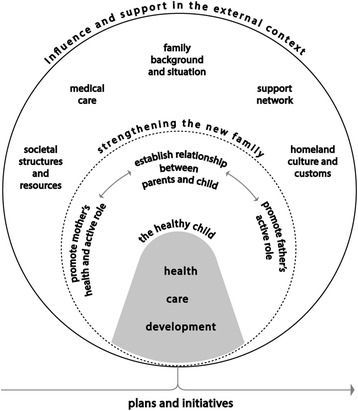
Results: The analysis revealed that the home visits covered three main categories of content related to the health, care and development of the child; the strengthening of roles and relations within the new family unit; and the influence and support located in the broader external context around the family. The model of categories and sub-categories proved stable over all six visits. Families with extra needs received continuous attention to their additional issues during the visits, as well as the standard content described in the content model.
Conclusions: This study on home visiting implementation indicates that the participating families received programme content which covered all the domains of nurturing care as recommended by the WHO Commission on Social Determinants of Health and recent research. The content of the home visits can be understood to create enabling conditions for health equity effects. The intervention can be seen to represent a practical example of proportionate universalism.
Keywords: Early childhood development; Extended home visiting; Health inequity; Nurturing care; Proportionate universalism; Qualitative study.
Conflict of interest statement
Ethics approval and consent to participate
Ethical approval for the study was granted by the by the Regional Ethical Review Board in Stockholm (dr nr 2013/877–31/1), and an approval of the extension of the evaluation period of participating children (2014/327–32). Informed consent has been obtained from parents for participation in the study.
Consent for publication
Not applicable
Competing interests
The authors declare that they have no competing interests.
Publisher’s Note
Springer Nature remains neutral with regard to jurisdictional claims in published maps and institutional affiliations.
Figures
References
-
- Commission on Social Determinants of Health. Closing the gap in a generation: health equity through action on the social determinants of health. Final Report of the Commission on Social Determinants of Health: World Health Organization; 2008. http://apps.who.int/iris/bitstream/10665/43943/1/9789241563703_eng.pdf. Accessed 9 Nov 2017
-
- Strategic review of health inequalities in England post-2010. Fair society, healthy lives. The Marmot review. 2010. https://www.parliament.uk/documents/fair-society-healthy-lives-full-repo.... Accessed 9 Nov 2017.
-
- Irwin L, Siddiqi A, Hertzman C. Early child development: a powerful equalizer. Final report for the WHO’s Commission on social determinants of health: World Health Organization; 2007. http://www.who.int/social_determinants/resources/ecd_kn_report_07_2007.pdf. Accessed 9 Nov 2017
-
- Richter LM, Daelmans B, Lombardi J, Heymann J, Boo FL, Behrman JR, Lu C, Lucas JE, Perez-Escamilla R, Dua T, et al. Investing in the foundation of sustainable development: pathways to scale up for early childhood development. Lancet. 2017;389:103–118. doi: 10.1016/S0140-6736(16)31698-1. - DOI - PMC - PubMed
Publication types
MeSH terms
LinkOut - more resources
Full Text Sources
Other Literature Sources
Medical
