. 2018 Apr 10;9(2):e02403-17.
doi: 10.1128/mBio.02403-17.

Robust Mercury Methylation across Diverse Methanogenic Archaea

Affiliations

Robust Mercury Methylation across Diverse Methanogenic Archaea

Cynthia C Gilmour et al. mBio. .

Abstract

Methylmercury (MeHg) production was compared among nine cultured methanogenic archaea that contain hgcAB, a gene pair that codes for mercury (Hg) methylation. The methanogens tested produced MeHg at inherently different rates, even when normalized to growth rate and Hg availability. Eight of the nine tested were capable of MeHg production greater than that of spent- and uninoculated-medium controls during batch culture growth. Methanococcoides methylutens, an hgcAB+ strain with a fused gene pair, was unable to produce more MeHg than controls. Maximal conversion of Hg to MeHg through a full batch culture growth cycle for each species (except M. methylutens) ranged from 2 to >50% of the added Hg(II) or between 0.2 and 17 pmol of MeHg/mg of protein. Three of the species produced >10% MeHg. The ability to produce MeHg was confirmed in several hgcAB+ methanogens that had not previously been tested (Methanocella paludicola SANAE, Methanocorpusculum bavaricum, Methanofollis liminatans GKZPZ, and Methanosphaerula palustris E1-9c). Maximal methylation was observed at low sulfide concentrations (<100 μM) and in the presence of 0.5 to 5 mM cysteine. For M. hollandica, the addition of up to 5 mM cysteine enhanced MeHg production and cell growth in a concentration-dependent manner. As observed for bacterial Hg methylators, sulfide inhibited MeHg production. An initial evaluation of sulfide and thiol impacts on bioavailability showed methanogens responding to Hg complexation in the same way as do Deltaproteobacteria The mercury methylation rates of several methanogens rival those of the better-studied Hg-methylating sulfate- and iron-reducing DeltaproteobacteriaIMPORTANCEArchaea, specifically methanogenic organisms, play a role in mercury methylation in nature, but their global importance to MeHg production and the subsequent risk to ecosystems are not known. Methanogenesis has been linked to Hg methylation in several natural habitats where methylmercury production incurs risk to people and ecosystems, including rice paddies and permafrost. In this study, we confirm that most methanogens carrying the hgcAB gene pair are capable of Hg methylation. We found that methylation rates vary inherently among hgcAB+ methanogens but that several species are capable of MeHg production at rates that rival those of the better-know Hg-methylating sulfate- and iron-reducing bacteria. Methanogens may need to be considered equally with sulfate and iron reducers in evaluations of MeHg production in nature.

Keywords: Archaea; bioavailability; complexation; cysteine; hgcAB; mercury; methylation; methylmercury; methyltransferase; thiols.


Figures

FIG 1
FIG 1
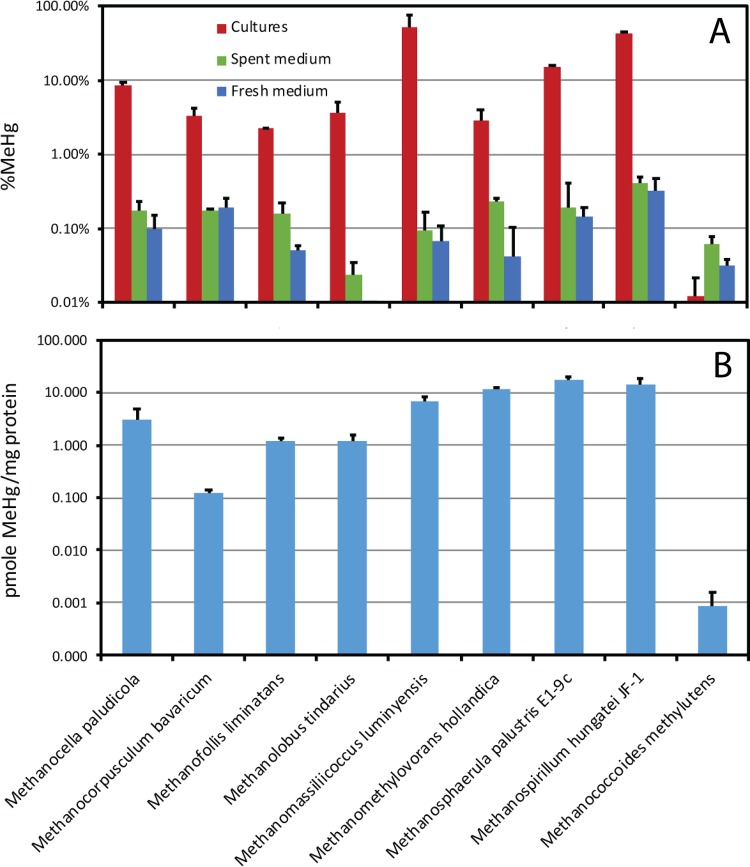
Maximal conversion of inorganic Hg to MeHg during batch culture growth by each hgcAB+ methanogen tested, expressed two ways. (Top) MeHg as a percentage of the total measured Hg in the culture medium (both unfiltered) at the end of log growth. Green and blue bars show noncellular control values. (Bottom) MeHg normalized to protein measured at the end of the log growth phase. Note the log scales. Bars are averages of triplicate separate cultures or controls. Methylation was measured from a 1 nM 201Hg(II) spike. Error bars are based on the standard deviation of MeHg only. M. luminyensis data are from reference .
FIG 2
FIG 2
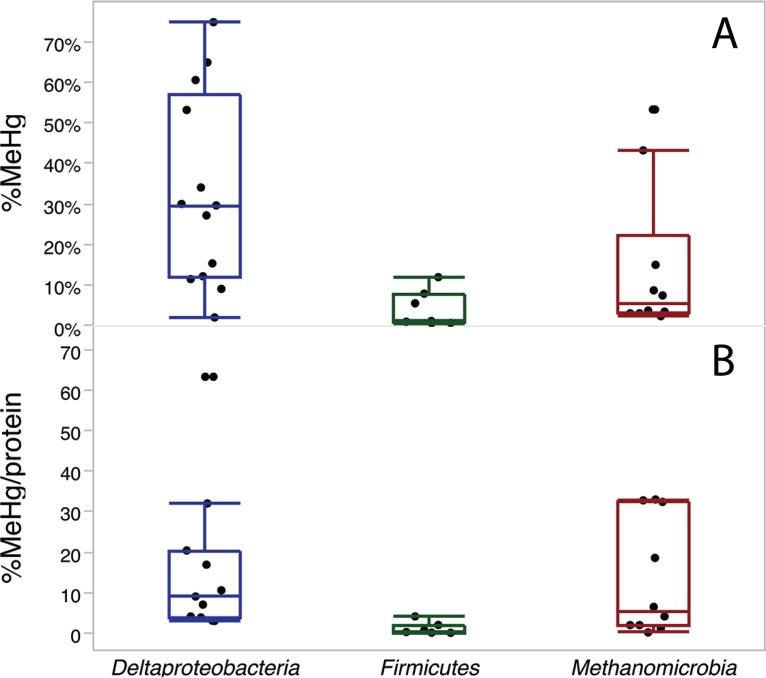
Comparison of maximal MeHg production among the three major clades of Hg-methylating bacteria. (Top) Maximal conversion of inorganic Hg to MeHg by 13 Deltaproteobacteria, 7 Firmicutes, and 10 Methanomicrobia species. (Bottom) MeHg production normalized to both the measured Hg and protein concentrations at the end of methylation assays, for the same organisms and assays, as (MeHg/Hg)/(mg of protein/liter). Hg spike levels ranged from 1 to 50 nM. Data combine assays done over the course of batch culture growth in this study, in the study described in reference , and during 3-h washed-cell assays (21). In these bar-and-whisker plots, the average value for each species is represented by a dot; the centerline, top, and bottom of each bar are the median and upper and lower quartiles, respectively, across all species; and the whiskers are drawn to the furthest data point within 1.5× the quartile value (thus excluding outliers).
FIG 3
FIG 3
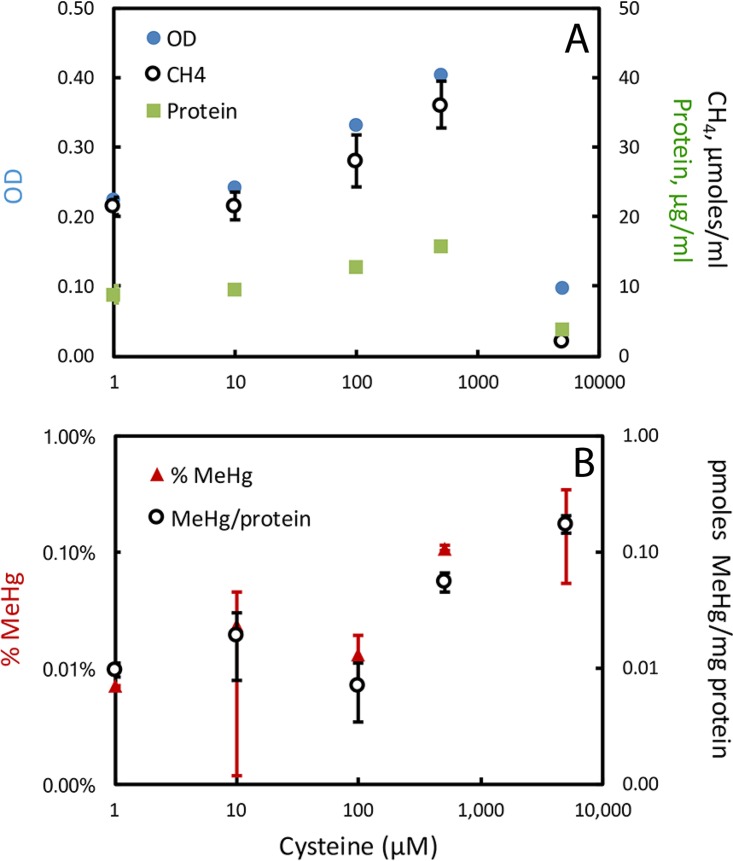
Impact of cysteine on M. hollandica growth and MeHg production. (Top) Growth assessed by OD and methane production. (Bottom) MeHg as a percentage of the total Hg in the culture medium and MeHg normalized to protein. All measurements were made once all cultures reached stationary phase (312 h). Methionine at 1 mM was included in all culture media. Sulfide was added to all at 10 μM, but the concentration was to 2 to 4 μM at the end of log-phase growth. Note the log scales. Error bars are standard deviations of triplicate cultures.
FIG 4
FIG 4
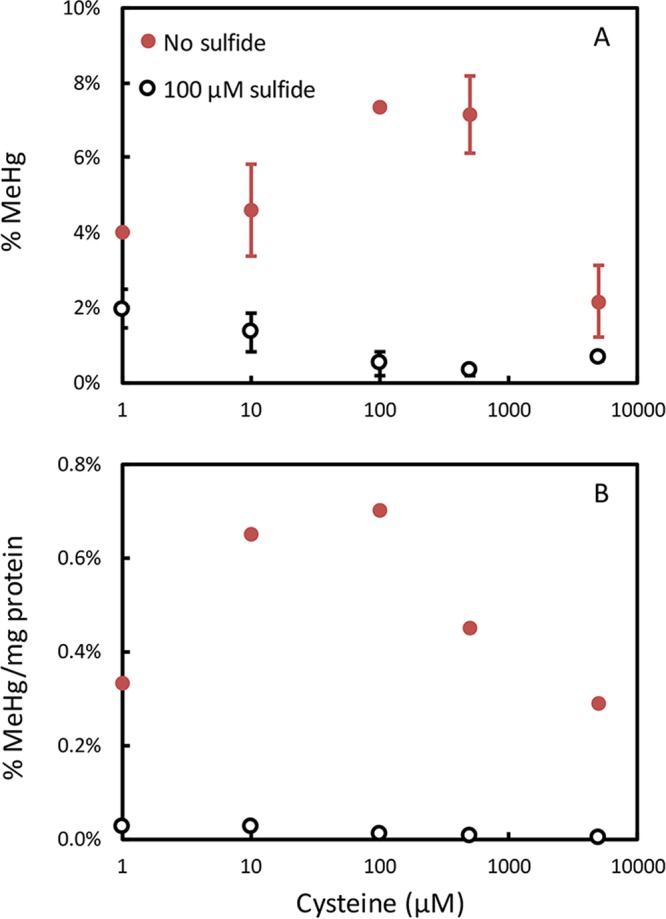
Impact of cysteine on MeHg production by M. tindarius in medium without (red) and with (black) 100 μM sulfide and 500 μM methionine. (Top) MeHg as a percentage of the total Hg in the culture medium. (Bottom) MeHg production normalized to both the measured Hg and protein concentrations at the end of methylation assays, as (MeHg/Hg)/(mg of protein/liter). All measurements were made once all cultures reached stationary phase. Error bars are standard deviations of triplicate cultures. Growth data are in Fig. S1.
FIG 5
FIG 5
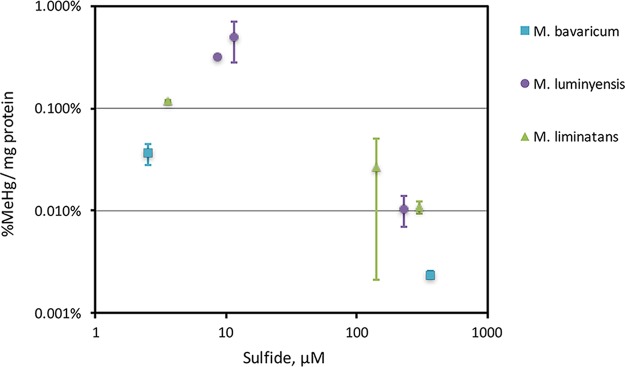
Impact of sulfide on MeHg production by three methanogens based on values measured at the end of log growth in triplicate batch cultures. Sulfide was added to all cultures (between 10 and 1,000 μM); the sulfide concentration shown was measured at the end of the log phase of growth. MeHg production is normalized to both the measured Hg and protein concentrations at the end of methylation assays, as (MeHg/Hg)/(mg of protein/liter). All cultures were grown with 4 mM cysteine. Error bars are standard deviations of triplicate cultures. All measurements were made once all cultures reached stationary phase.
FIG 6
FIG 6
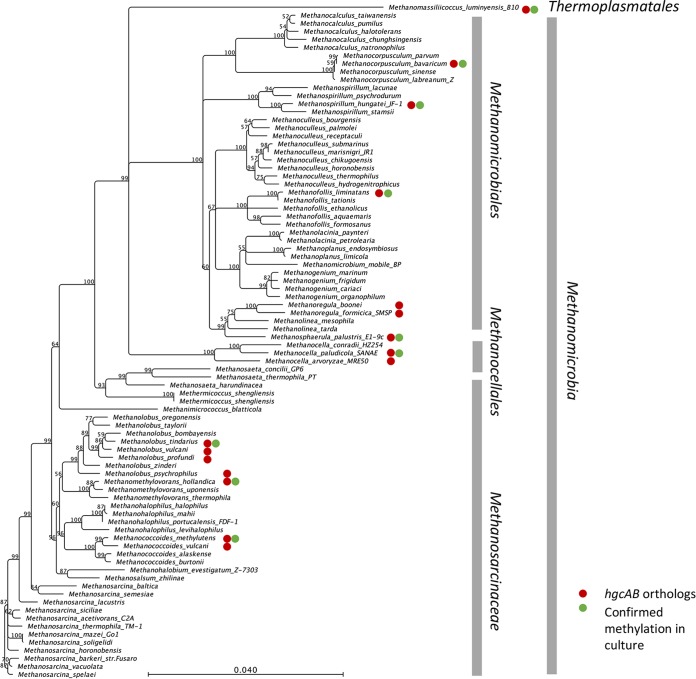
16S rRNA gene distance phylogeny of the Methanomicrobia/Thermoplasmata superclass (excluding the Halobacteria) within the methanogenic Euryarchaeota, showing all of the available sequenced genomes. Red circles show organisms with hgcAB orthologs. Green circles are organisms confirmed to methylate Hg in culture. Branch points supported with bootstrap values of ≥50% are shown. The scale bar indicates 0.04 substitution per nucleotide position.

References

    1. Rothenberg SE, Anders M, Ajami NJ, Petrosino JF, Balogh E. 2016. Water management impacts rice methylmercury and the soil microbiome. Sci Total Environ 572:608–617. doi: 10.1016/j.scitotenv.2016.07.017. - DOI - PMC - PubMed
    1. Podar M, Gilmour CC, Brandt CC, Soren A, Brown SD, Crable BR, Palumbo AV, Somenahally AC, Elias DA. 2015. Global prevalence and distribution of genes and microorganisms involved in mercury methylation. Sci Adv 1:e1500675. doi: 10.1126/sciadv.1500675. - DOI - PMC - PubMed
    1. Parks JM, Johs A, Podar M, Bridou R, Hurt RA Jr, Smith SD, Tomanicek SJ, Qian Y, Brown SD, Brandt CC, Palumbo AV, Smith JC, Wall JD, Elias DA, Liang L. 2013. The genetic basis for bacterial mercury methylation. Science 339:1332–1335. doi: 10.1126/science.1230667. - DOI - PubMed
    1. Gilmour CC, Podar M, Bullock AL, Graham AM, Brown SD, Somenahally AC, Johs A, Hurt RA Jr, Bailey KL, Elias DA. 2013. Mercury methylation by novel microorganisms from new environments. Environ Sci Technol 47:11810–11820. doi: 10.1021/es403075t. - DOI - PubMed
    1. Yu RQ, Reinfelder JR, Hines ME, Barkay T. 2013. Mercury methylation by the methanogen Methanospirillum hungatei. Appl Environ Microbiol 79:6325–6330. doi: 10.1128/AEM.01556-13. - DOI - PMC - PubMed

Publication types

LinkOut - more resources