


Factors associated with adherence to diabetes care recommendations among children and adolescents with type 1 diabetes: a facility-based study in two urban diabetes clinics in Uganda
- PMID: 29636626
- PMCID: PMC5880187
- DOI: 10.2147/DMSO.S156858
Factors associated with adherence to diabetes care recommendations among children and adolescents with type 1 diabetes: a facility-based study in two urban diabetes clinics in Uganda
Erratum in
-
Erratum: Factors associated with adherence to diabetes care recommendations among children and adolescents with type 1 diabetes: a facility-based study in two urban diabetes clinics in Uganda [Corrigendum].Diabetes Metab Syndr Obes. 2018 Oct 5;11:595. doi: 10.2147/DMSO.S179015. eCollection 2018. Diabetes Metab Syndr Obes. 2018. PMID: 30323639 Free PMC article.
Abstract
Purpose: The purpose of this study was to determine the level of adherence and the factors associated with adherence to diabetes care recommendations among type 1 diabetic children and adolescents at two urban diabetes clinics in Kampala, Uganda.
Research design and methods: A facility-based cross-sectional study was carried out among 200 children and adolescents with type 1 diabetes at two major diabetes clinics in Kampala. Caretakers of the children and adolescents were interviewed using pretested questionnaires to provide information on sociodemographic characteristics, diabetes care, knowledge, attitudes, and adherence to diabetes care recommendations in type 1 diabetes. Prevalence rate ratios (PRRs) at the 95% confidence interval (CI) were used to establish the factors associated with adherence using modified Poisson regression, with robust standard errors. The data were analyzed by using STATA Version 13.0.
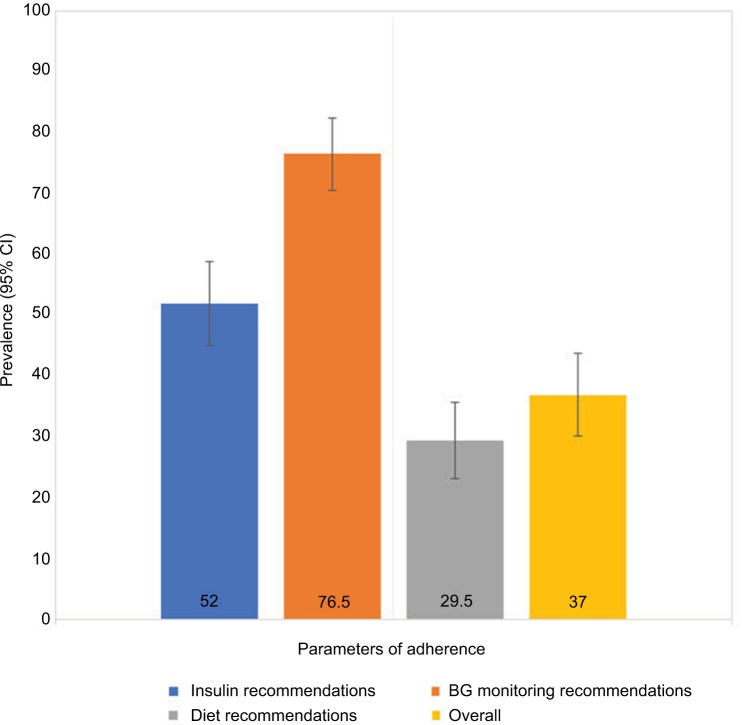
Results: The overall prevalence of adherence to diabetes care recommendations was at 37%. However, evaluating adherence to specific treatment parameters showed that 52%, 76.5%, and 29.5% of the children and adolescents adhered to insulin, blood glucose monitoring, and dietary recommendations, respectively. In the final adjusted model, active diet monitoring (adjusted PRR [APRR]: 1.95; 95% CI: 1.01, 3.78), being under care of a sibling (APRR: 1.66; 95% CI: 1.61, 1.71), being under care of a married caretaker (APRR: 1.10; 95% CI: 1.05, 1.14) and a separated or divorced caretaker (APRR: 1.60; 95% CI: 1.12, 2.27), taking three or less tests of blood glucose per day (APRR: 0.63; 95% CI: 0.42, 0.95), and having a caretaker with poor knowledge about diabetes (APRR: 0.49; 95% CI: 0.43, 0.57) and who is inactive in supervision of insulin injections (APRR: 0.58; 95% CI: 0.56, 0.60) were associated with adherence to type 1 diabetes care recommendations.
Conclusion: Adherence to type 1 diabetes care recommendations is still low among this population. The results suggest that reinforcing caretaker involvement could be vital in improving adherence to diabetes care recommendations in this population.
Keywords: Kampala; Uganda; adherence; adolescents; children; type 1 diabetes.
Conflict of interest statement
Disclosure The authors report no conflicts of interest in this work.
Figures
References
-
- World Health Organisation Media centre: diabetes. 2017. [Accessed November 11, 2017]. Available from: http://www.who.int/mediacentre/factsheets/fs312/en/
-
- Melmed S, Polonsky K, Larsen PR, Kronenberg PR. Williams Textbook of Endocrinology. Philadelphia, PA: Saunders; 2011.
-
- Della Manna T, Setian N, Savoldelli RD, et al. Diabetes mellitus in childhood: an emerging condition in the 21st century. Rev Assoc Med Bras (1992) 2016;62(6):594–601. - PubMed
-
- WHO Adherence to long term therapies: evidence for action. 2003. [Accessed February 16, 2018]. Available from: http://whqlibdoc.who.int/publications/2003/9241545992.pdf.
LinkOut - more resources
Full Text Sources
Other Literature Sources
