


Risk of tuberculosis transmission among healthcare workers
- PMID: 29637080
- PMCID: PMC5890027
- DOI: 10.1183/23120541.00161-2017
Risk of tuberculosis transmission among healthcare workers
Abstract
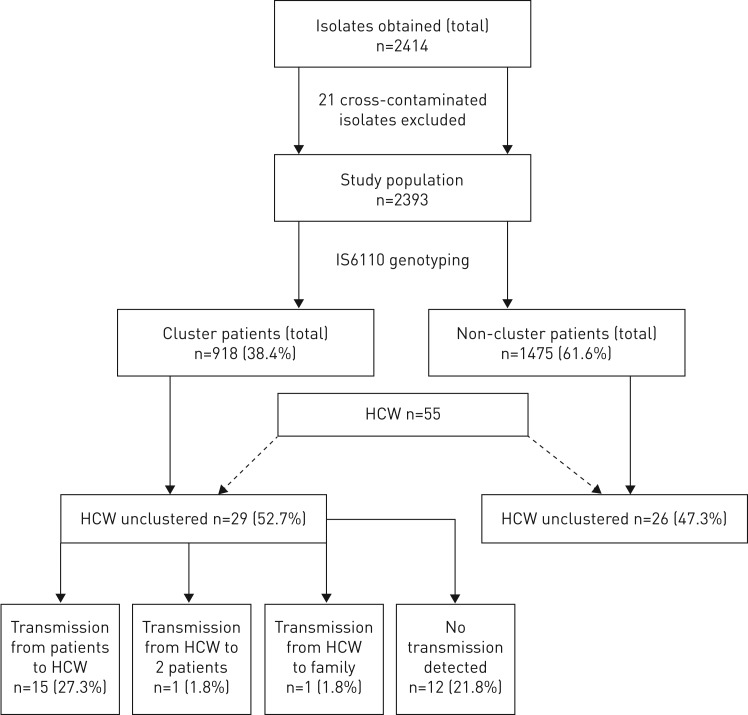
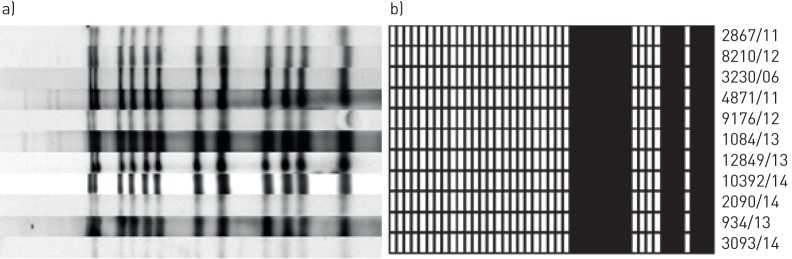
Data from a prospective molecular-epidemiological study (1997-2015) of patients with culture-confirmed tuberculosis in Hamburg, Germany, were evaluated to assess the occupational risk of Mycobacterium tuberculosis complex transmission in a low-incidence setting. Isolates of M. tuberculosis complex were genotyped using IS6110 restriction fragment length polymorphism analysis. Results of structured questionnaires, geographical mapping and additional patient interviews were used for confirming epidemiological links. Out of the 2393 cases, 918 (38.4%) were classified into 224 clusters comprising 2-70 patients per cluster. Among the 918 cluster members, epidemiological links could be confirmed in 340 (37.0%) patients. In total, 55 (2.3%) patients were healthcare workers; 26 healthcare workers remained unclustered, but 29 healthcare workers belonged to cluster groups. Conventional contact tracing performed before genotyping to identify sources of the reported index cases detected only 73 (3.1%) patients. Logistic regression analysis confirmed work in the healthcare sector as strongest predictor for clustering of patients with verified epidemiological links (odds ratio (OR) 3.1, 95% CI 1.6-5.9), followed by alcoholism (OR 2.3, 95% CI 1.7-3.2) and sputum smear positivity (OR 1.8, 95% CI 1.4-2.3). Immigrants were more likely to be cluster nonmembers (OR 0.3, 95% CI 0.3-0.5). Recent transmission in Hamburg within the 19-year study period was found to be strongly associated with working in a healthcare facility. Although clusters also include many "imported" strains from abroad or regional highly prevalent M. tuberculosis strains with no evident epidemiological connection, routine molecular-epidemiological survey is indispensable to optimising and controlling the effectiveness of TB control strategies in German healthcare settings.
Conflict of interest statement
Conflict of interest: None declared.
Figures
References
-
- Loddenkemper R, Sagebiel S, Meyer C, et al. Die Tuberkulosesituation in Deutschland 1998. [The state of tuberculosis in Germany 1998]. Pneumologie 2000; 54: 324–332. - PubMed
-
- Robert Koch-Institut. Bericht zur Epidemiologe der Tuberkulose für Deutschland 2015 Berlin, Robert Koch-Institut, 2016.
-
- Statistical Office for Hamburg and Schleswig Holstein. Bevölkerung in Hamburg 2015. [Population in Hamburg 2015]. www.statistik-nord.de/fileadmin/Dokumente/Presseinformationen/SI16_131.pdf
-
- Statistisches Bundesamt. Bevölkerungsfortschreibung 2015 [Population Update 2015] Wiesbaden, Germany, Statistisches Bundesamt; www.destatis.de/DE/ZahlenFakten/GesellschaftStaat/Bevoelkerung/Bevoelker...
-
- Hygiene Institut Hamburg. Meldepflichtige Infektionskrankheiten in Hamburg 2001. Jahresbericht [Notifiable Infectious Diseases in Hamburg 2001. Annual Report] Hamburg, Germany, Hygiene Institut Hamburg, 2001.
LinkOut - more resources
Full Text Sources
Other Literature Sources