A protocol for whole-exome sequencing in newborns with congenital deafness: a prospective population-based cohort
- PMID: 29637142
- PMCID: PMC5862171
- DOI: 10.1136/bmjpo-2017-000119
A protocol for whole-exome sequencing in newborns with congenital deafness: a prospective population-based cohort
Abstract
Introduction: The aetiology of congenital hearing loss is heterogeneous, and in many infants a genetic cause is suspected. Parents face a diagnostic odyssey when searching for a cause of their infant's hearing loss. Through the Melbourne Genomics Health Alliance, a prospective cohort of infants will be offered whole-exome sequencing (WES) with targeted analysis in conjunction with chromosome microarray to determine the genetic causes of congenital hearing loss. Parents will also be offered the opportunity to receive additional results from their infant's WES.
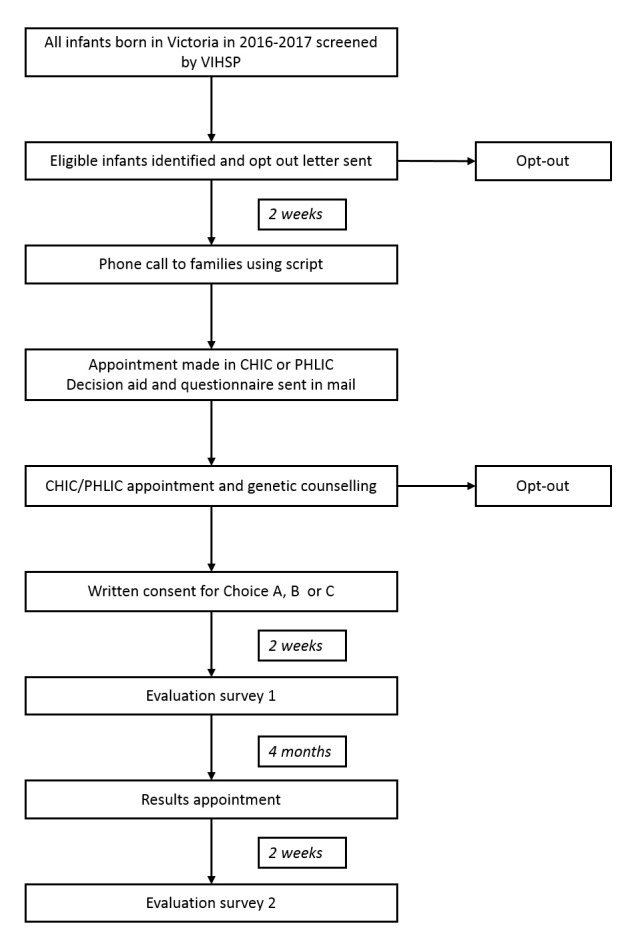
Methods: Eligible infants will be identified through the Victorian Infant Hearing Screening Program and offered an appointment in a paediatrician-run clinic, a genetics assessment and enrolment in the Victorian Childhood Hearing Impairment Longitudinal Databank. If parents consent to WES, genes causing deafness will be analysed and they can choose to obtain additional findings. For the additional results component, a modified laboratory protocol has been designed for reporting of results in the absence of a relevant phenotype. Parents' experience of being offered WES will be evaluated using surveys.
Discussion: This project will provide descriptive analysis of the genetic aetiology of congenital hearing loss in this cohort and may provide data on genotype-phenotype correlations. Additionally, choices regarding additional findings will be analysed. Participants will represent a diverse cross section of the population, increasing the ability to generalise results beyond the study group. Evaluation surveys will allow analysis of preferences around counselling, usefulness of a decision aid and adequacy of information provision.
Keywords: Deafness; Genetics; Screening.
Conflict of interest statement
Competing interests: None declared.
Figures
References
-
- Russ SA, Poulakis Z, Barker M, et al. Epidemiology of congenital hearing loss in Victoria, Australia. Int J Audiol 2003;42:385–90. - PubMed
-
- Wake M, Ching TY, Wirth K, et al. Population outcomes of three approaches to detection of congenital hearing loss. Pediatrics 2016;137:e20151722 doi:10.1542/peds.2015-1722 - DOI - PMC - PubMed
-
- Fitzpatrick E. Neurocognitive development in congenitally deaf children. Handb Clin Neurol 2015;129:335–56. doi:10.1016/B978-0-444-62630-1.00019-6 - DOI - PubMed
-
- Shearer AE, Smith RJ. Massively parallel sequencing for genetic diagnosis of hearing loss: the new standard of care. Otolaryngol Head Neck Surg 2015;153:175–82. doi:10.1177/0194599815591156 - DOI - PMC - PubMed
-
- Smith RJH, Bale JF, White KR. Sensorineural hearing loss in children. The Lancet 2005;365:879–90. doi:10.1016/S0140-6736(05)71047-3 - DOI - PubMed
LinkOut - more resources
Full Text Sources
Other Literature Sources