


Fucoxanthin and Polyunsaturated Fatty Acids Co-Extraction by a Green Process
- PMID: 29641444
- PMCID: PMC6017215
- DOI: 10.3390/molecules23040874
Fucoxanthin and Polyunsaturated Fatty Acids Co-Extraction by a Green Process
Abstract
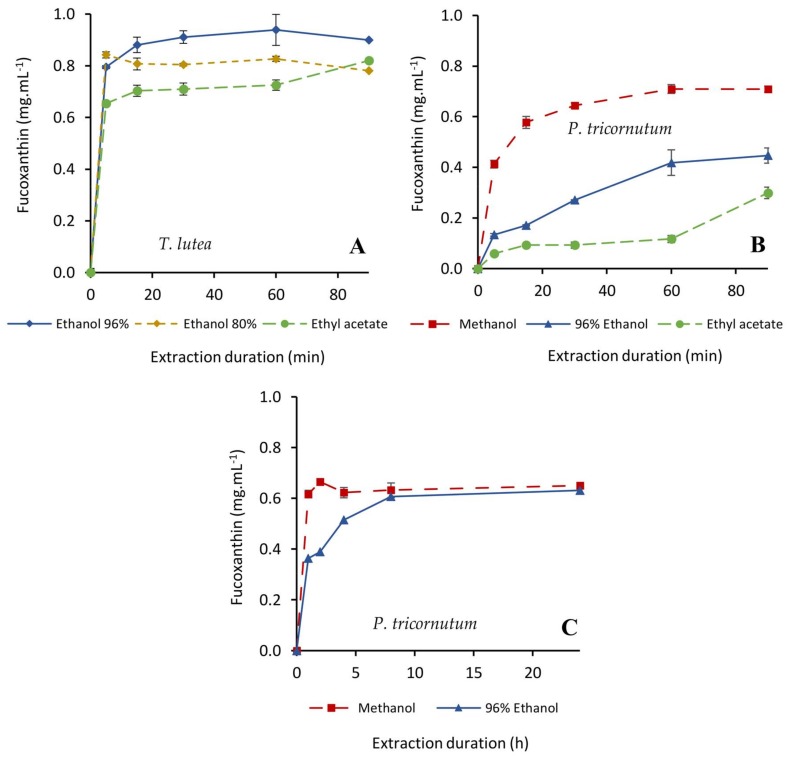
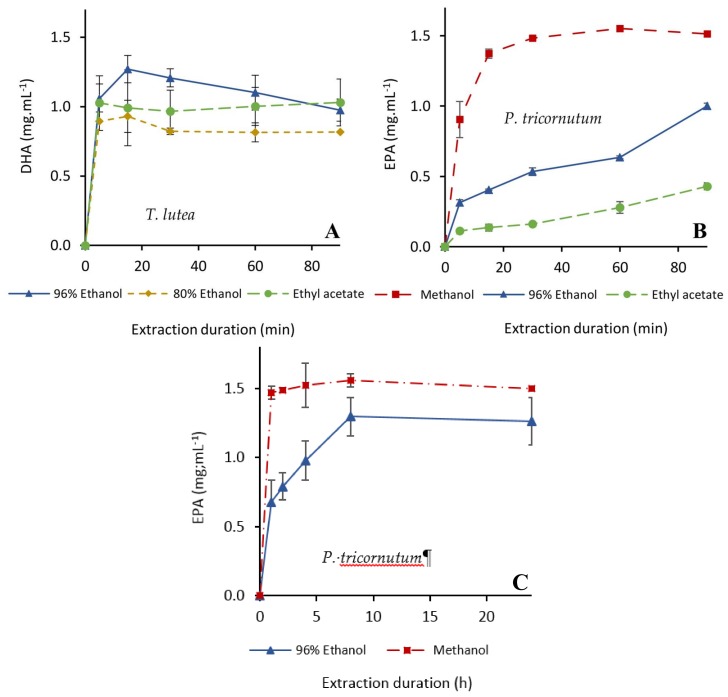
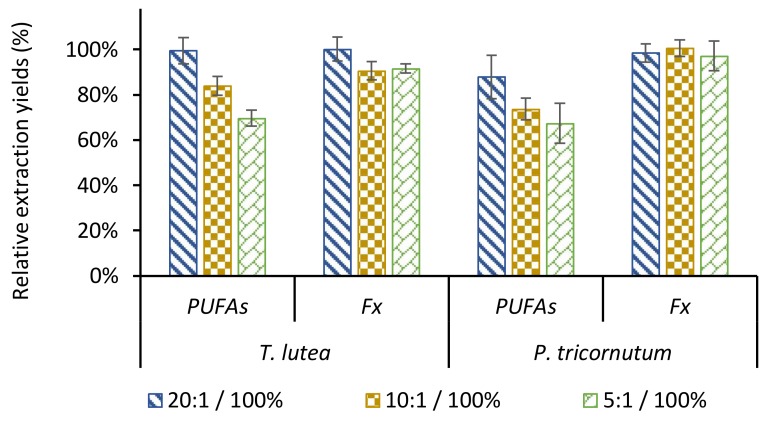
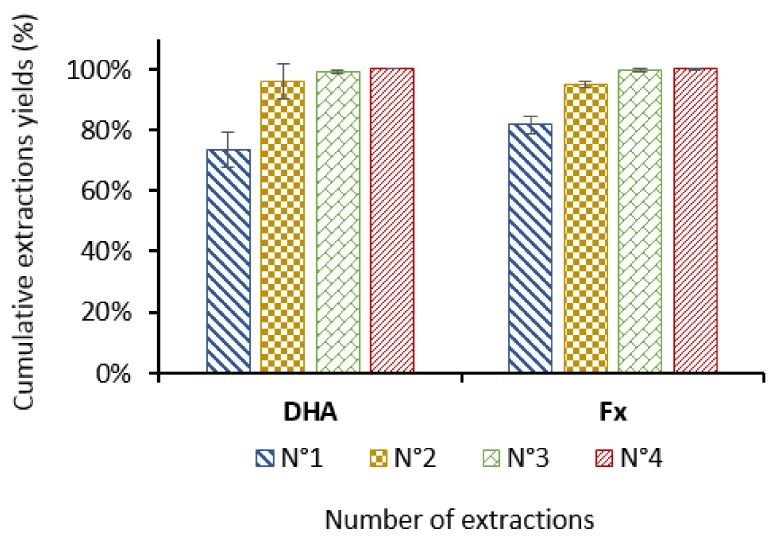
By their autotrophic nature and their molecular richness, microalgae are serious assets in the context of current environmental and societal challenges. Some species produce both omega-3 long chain polyunsaturated fatty acids (PUFAs) and xanthophylls, two molecular families widely studied for their bioactivities in the fields of nutrition and cosmetics. Whereas most studies separately deal with the two families, synergies could be exploited with extracts containing both PUFAs and xanthophylls. The purpose of our work was to determine cost effective and eco-friendly parameters for their co-extraction. The effect of several parameters (solvent, solvent/biomass ratio, temperature, duration) were studied, using two microalgal species, the non-calcifying Haptophyta Tisochrysis lutea, and the diatom Phaeodactylum tricornutum, that presents a silicified frustule. Analyses of PUFAs and fucoxanthin (Fx), the main xanthophyll, allowed to compare kinetics and extraction yields between experimental protocols. Co-extraction yields achieved using 96% ethanol as solvent were 100% for Fx and docosahexaenoic acid (DHA) in one hour from T. lutea biomass, and respectively 95% and 89% for Fx and eicosapentaenoic acid (EPA) in eight hours from P. tricornutum. These conditions are compatible with industrial applications.
Keywords: Phaeodactylum tricornutum; Tisochrysis lutea; cosmetics; food; fucoxanthin; green solvents; microalgae; polyunsaturated fatty acids.
Conflict of interest statement
The authors declare no conflict of interest.
Figures
References
-
- WHO|10 Facts on Obesity. [(accessed on 24 January 2018)]; Available online: http://www.who.int/features/factfiles/obesity/en/
-
- Data and Statistics. [(accessed on 13 February 2018)]; Available online: http://www.euro.who.int/en/health-topics/noncommunicable-diseases/diabet....
-
- Ng M., Fleming T., Robinson M., Thomson B., Graetz N., Margono C., Mullany E.C., Biryukov S., Abbafati C., Semaw F.A.M., et al. Global, regional, and national prevalence of overweight and obesity in children and adults during 1980–2013: A systematic analysis for the Global Burden of Disease Study 2013. Lancet Lond. Engl. 2014;384:766–781. doi: 10.1016/S0140-6736(14)60460-8. - DOI - PMC - PubMed
-
- Hu X., Tao N., Wang X., Xiao J., Wang M. Marine-derived bioactive compounds with anti-obesity effect: A review. J. Funct. Foods. 2016;21:372–387. doi: 10.1016/j.jff.2015.12.006. - DOI
Publication types
MeSH terms
Substances
LinkOut - more resources
Full Text Sources
Other Literature Sources
Research Materials
