Current situation and future prospects for the Australian beef industry - A review
- PMID: 29642662
- PMCID: PMC6039327
- DOI: 10.5713/ajas.18.0090
Current situation and future prospects for the Australian beef industry - A review
Abstract
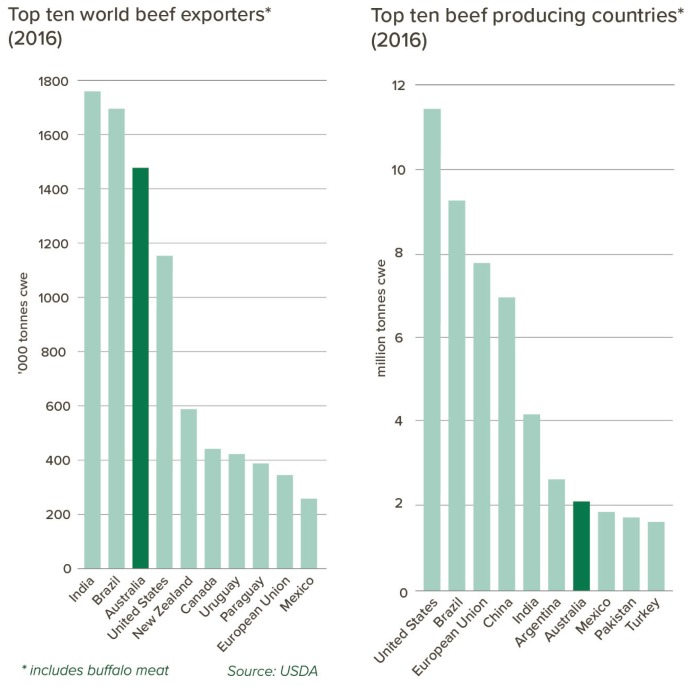
Beef production extends over almost half of Australia, with about 47,000 cattle producers that contribute about 20% ($A12.7 billion gross value of production) of the total value of farm production in Australia. Australia is one of the world's most efficient producers of cattle and was the world's third largest beef exporter in 2016. The Australian beef industry had 25 million head of cattle in 2016-17, with a national beef breeding herd of 11.5 million head. Australian beef production includes pasture-based cow-calf systems, a backgrounding or grow-out period on pasture, and feedlot or pasture finishing. Feedlot finishing has assumed more importance in recent years to assure the eating quality of beef entering the relatively small Australian domestic market, and to enhance the supply of higher value beef for export markets. Maintenance of Australia's preferred status as a quality assured supplier of high value beef produced under environmentally sustainable systems from 'disease-free' cattle is of highest importance. Stringent livestock and meat quality regulations and quality assurance systems, and productivity growth and efficiency across the supply chain to ensure price competiveness, are crucial for continued export market growth in the face of increasing competition. Major industry issues, that also represent research, development and adoption priorities and opportunities for the Australian beef industry have been captured within exhaustive strategic planning processes by the red meat and beef industries. At the broadest level, these issues include consumer and industry support, market growth and diversification, supply chain efficiency, productivity and profitability, environmental sustainability, and animal health and welfare. This review provides an overview of the Australian beef industry including current market trends and future prospects, and major issues and opportunities for the continued growth, development and profitability of the industry.
Keywords: Beef Production; Beef Value Chain; Quality Assurance; Research and Development; Beef Markets.
Conflict of interest statement
We certify that there is no conflict of interest with any financial organization regarding the material discussed in the manuscript.
Figures
References
-
- MLA . Fast Facts [Internet] Sydney, NSW, Australia: Meat and Livestock Australia; 2017. [cited 2018 March 25]. Available from: https://www.mla.com.au/.../mla.../fast-facts.../mla_beef-fast-facts-2017....
-
- ABRI . BREEDPLAN A modern genetic evaluation system for beef cattle [Internet] Agricultural Business Research Institute; 2017. [cited 2018 Mar 25]. Available from: http://breedplan.une.edu.au/brochures/BREEDPLAN%20Flyer%20Web.pdf.
-
- ABRI . BREEDPLAN International [Internet] Agricultural Business Research Institute; 2017. [cited 2018 Mar 25]. Available from: http://breedplan.une.edu.au/brochures/International%20Brochure%20A4.pdf.
-
- MLA . Global Market Snapshot Beef [Internet] Sydney, NSW, Australia: Meat and Livestock Australia; 2017. [cited 2018 Mar 25]. Available from: https://www.mla.com.au/globalassets/mla-corporate/prices--markets/docume....
-
- Bell AW, Charmley E, Hunter RA, Archer JA. The Australasian beef industries - Challenges and opportunities in the 21st century. Anim Front. 2011;1:10–9.
LinkOut - more resources
Full Text Sources
Other Literature Sources