


Development of a novel motivational interviewing (MI) informed peer-support intervention to support mothers to breastfeed for longer
- PMID: 29642864
- PMCID: PMC5896150
- DOI: 10.1186/s12884-018-1725-1
Development of a novel motivational interviewing (MI) informed peer-support intervention to support mothers to breastfeed for longer
Abstract
Background: Many women in the UK stop breastfeeding before they would like to, and earlier than is recommended by the World Health Organization (WHO). Given the potential health benefits for mother and baby, new ways of supporting women to breastfeed for longer are required. The purpose of this study was to develop and characterise a novel Motivational Interviewing (MI) informed breastfeeding peer-support intervention.
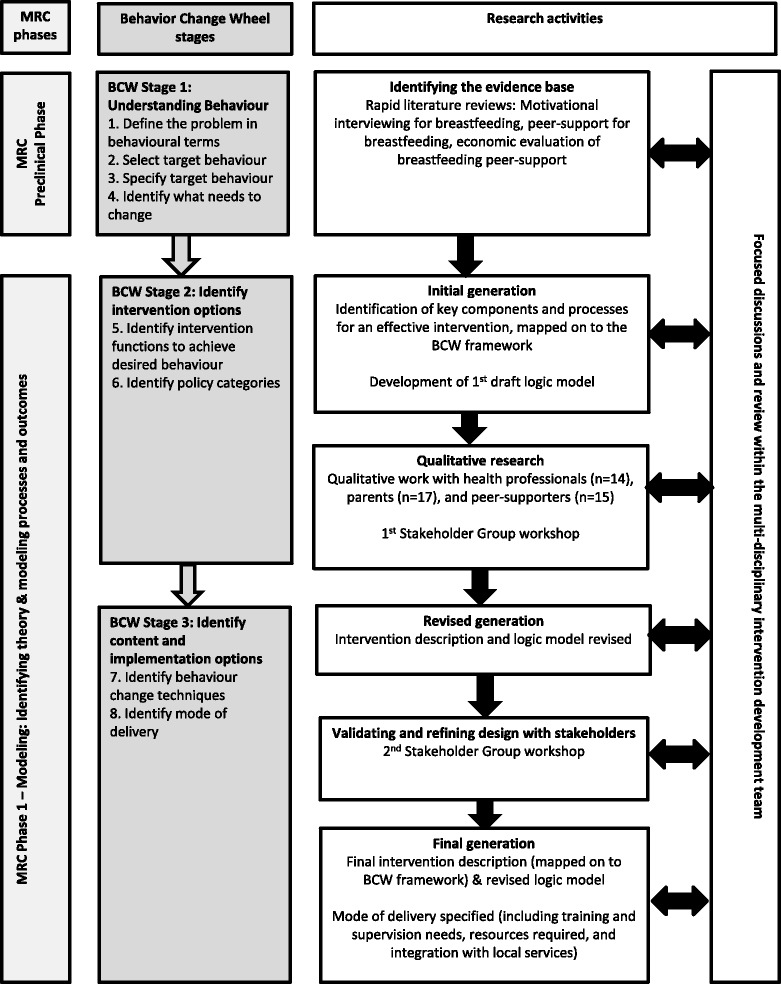
Methods: Qualitative interviews with health professionals and service providers (n = 14), and focus groups with mothers (n = 14), fathers (n = 3), and breastfeeding peer-supporters (n = 15) were carried out to understand experiences of breastfeeding peer-support and identify intervention options. Data were audio-recorded, transcribed, and analysed thematically. Consultation took place with a combined professional and lay Stakeholder Group (n = 23). The Behaviour Change Wheel (BCW) guided intervention development process used the findings of the qualitative research and stakeholder consultation, alongside evidence from existing literature, to identify: the target behaviour to be changed; sources of this behaviour based on the Capability, Opportunity and Motivation (COM-B) model; intervention functions that could alter this behaviour; and; mode of delivery for the intervention. Behaviour change techniques included in the intervention were categorised using the Behaviour Change Technique Taxonomy Version 1 (BCTTv1).
Results: Building knowledge, skills, confidence, and providing social support were perceived to be key functions of breastfeeding peer-support interventions that aim to decrease early discontinuation of breastfeeding. These features of breastfeeding peer-support mapped onto the BCW education, training, modelling and environmental restructuring intervention functions. Behaviour change techniques (BCTTv1) included social support, problem solving, and goal setting. The intervention included important inter-personal relational features (e.g. trust, honesty, kindness), and the BCTTv1 needed adaptation to incorporate this.
Conclusions: The MI-informed breastfeeding peer-support intervention developed using this systematic and user-informed approach has a clear theoretical basis and well-described behaviour change techniques. The process described could be useful in developing other complex interventions that incorporate peer-support and/or MI.
Keywords: Behaviour change wheel; Breastfeeding maintenance; COM-B; Complex intervention; Intervention development; Motivational interviewing; Peer-support; Qualitative.
Conflict of interest statement
Ethics approval and consent to participate
All study procedures, including the informed consent process for focus groups and interviews, were conducted in accordance with the ethical standards of the Helsinki Declaration of 1975, as revised in 2000, and the National Institute for Social Care and Health Research Ethics Service, Wales REC 3 Panel, who provided ethical approval for the study in November 2014 (Reference: 14/WA/1123). Participants in qualitative interviews and focus groups all provided informed consent in writing (women, partners, and peer-supporters) or verbal consent which was audio-recorded (health professionals).
Competing interests
Billie Hunter’s post is part-funded by the Royal College of Midwifery. Stephen Rollnick is a co-founder of Motivational Interviewing and has authored several texts on the topic. Stephen Rollnick and Nina Gobat both provide Motivational Interviewing training and consultancy. In addition to her research post at Cardiff University, Heather Trickey works as a part-time research manager for the National Childbirth Trust (NCT) charity. All other authors have no conflicts of interest to declare.
Publisher’s Note
Springer Nature remains neutral with regard to jurisdictional claims in published maps and institutional affiliations.
Figures

References
-
- Britton C, McCormick FM, Renfrew MJ, Wade A, King SE. Support for breastfeeding mothers. Cochrane Database Syst Rev. 2007;1:CD001141. - PubMed
-
- McAndrew F, Thompson J, Fellows L, Large A, Speed M, Renfrew MJ: Infant feeding survey 2010. In.; 2012.
Publication types
MeSH terms
Grants and funding
LinkOut - more resources
Full Text Sources
Other Literature Sources
Medical
