


Characteristics of human encounters and social mixing patterns relevant to infectious diseases spread by close contact: a survey in Southwest Uganda
- PMID: 29642869
- PMCID: PMC5896105
- DOI: 10.1186/s12879-018-3073-1
Characteristics of human encounters and social mixing patterns relevant to infectious diseases spread by close contact: a survey in Southwest Uganda
Abstract
Background: Quantification of human interactions relevant to infectious disease transmission through social contact is central to predict disease dynamics, yet data from low-resource settings remain scarce.
Methods: We undertook a social contact survey in rural Uganda, whereby participants were asked to recall details about the frequency, type, and socio-demographic characteristics of any conversational encounter that lasted for ≥5 min (henceforth defined as 'contacts') during the previous day. An estimate of the number of 'casual contacts' (i.e. < 5 min) was also obtained.
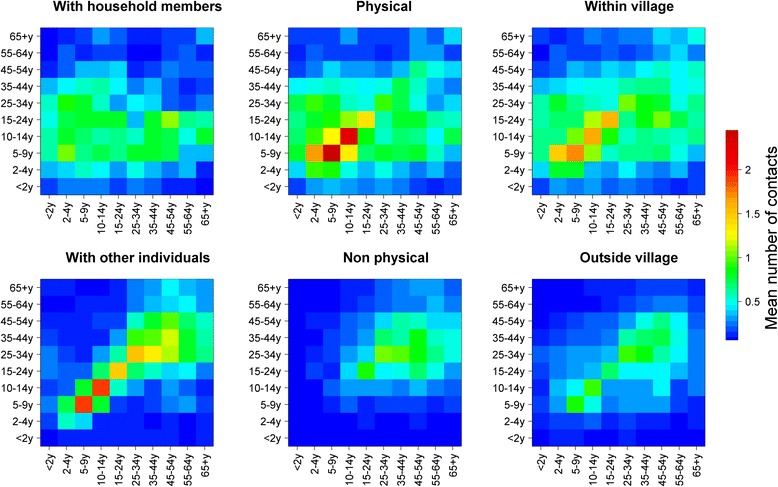
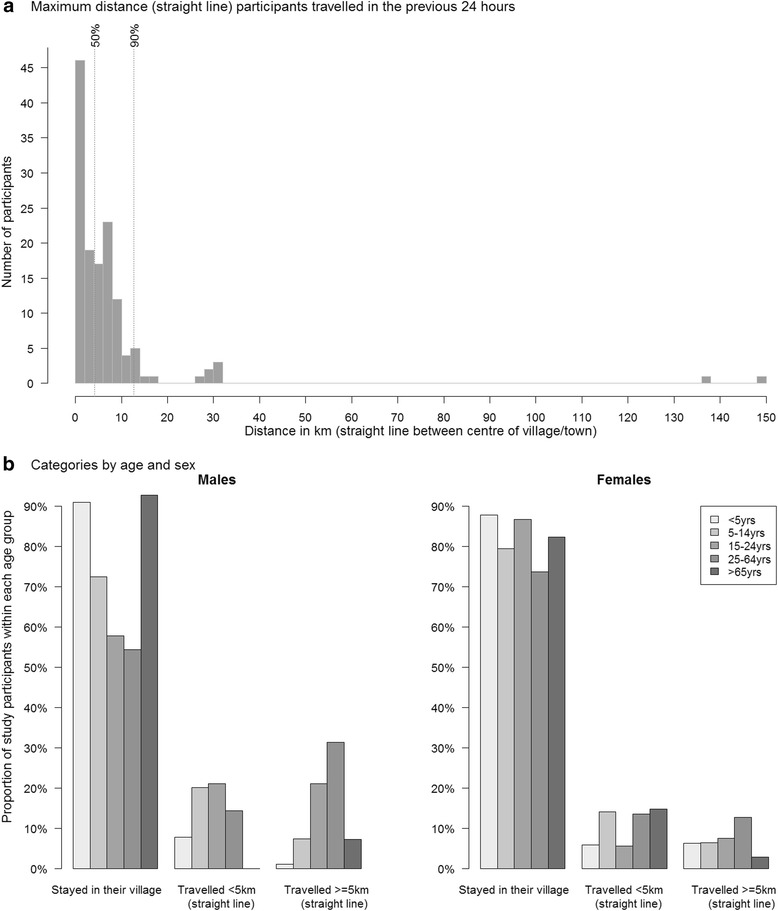
Results: In total, 566 individuals were included in the study. On average participants reported having routine contact with 7.2 individuals (range 1-25). Children aged 5-14 years had the highest frequency of contacts and the elderly (≥65 years) the fewest (P < 0.001). A strong age-assortative pattern was seen, particularly outside the household and increasingly so for contacts occurring further away from home. Adults aged 25-64 years tended to travel more often and further than others, and males travelled more frequently than females.
Conclusion: Our study provides detailed information on contact patterns and their spatial characteristics in an African setting. It therefore fills an important knowledge gap that will help more accurately predict transmission dynamics and the impact of control strategies in such areas.
Keywords: Close contact transmission; Infectious diseases; Social contact; Survey; Uganda.
Conflict of interest statement
Ethics approval and consent to participate
Written informed consent (in the form of a signature or a thumbmark) was sought for individuals aged > 17 years, and from a parent or carer for children < 18 years. In addition, assent was sought from children aged 7 – 17 years. Approval was obtained from the Ethical review boards of Médecins Sans Frontières (MSF), the Faculty of Medicine Research & Ethics Committee of the Mbarara University of Science and Technology (MUST), the Institutional Ethical Review Board of the MUST, the Uganda National Council for Science and Technology (UNCST) and the London School of Hygiene and Tropical Medicine (LSHTM).
Consent for publication
Not applicable.
Competing interests
Yap Boum is an editor of BMC Infectious Diseases. The authors declare they have no other competing interest.
Publisher’s Note
Springer Nature remains neutral with regard to jurisdictional claims in published maps and institutional affiliations.
Figures


References
-
- Beutels P, Shkedy Z, Aerts M, Van Damme P. Social mixing patterns for transmission models of close contact infections: exploring self-evaluation and diary-based data collection through a web-based interface. Epidemiol Infect. 2006;134(6):1158–1166. doi: 10.1017/S0950268806006418. - DOI - PMC - PubMed
Publication types
MeSH terms
LinkOut - more resources
Full Text Sources
Other Literature Sources
Medical
Miscellaneous
