Review
. 2018 Apr 11;16(1):96.
doi: 10.1186/s12967-018-1471-1.

Cisplatin based therapy: the role of the mitogen activated protein kinase signaling pathway

Affiliations
Review

Cisplatin based therapy: the role of the mitogen activated protein kinase signaling pathway

Iman W Achkar et al. J Transl Med. .

Abstract

Cisplatin is a widely used chemotherapeutic agent for treatment of various cancers. However, treatment with cisplatin is associated with drug resistance and several adverse side effects such as nephrotoxicity, reduced immunity towards infections and hearing loss. A Combination of cisplatin with other drugs is an approach to overcome drug resistance and reduce toxicity. The combination therapy also results in increased sensitivity of cisplatin towards cancer cells. The mitogen activated protein kinase (MAPK) pathway in the cell, consisting of extracellular signal regulated kinase, c-Jun N-terminal kinase, p38 kinases, and downstream mediator p90 ribosomal s6 kinase (RSK); is responsible for the regulation of various cellular events including cell survival, cell proliferation, cell cycle progression, cell migration and protein translation. This review article demonstrates the role of MAPK pathway in cisplatin based therapy, illustrates different combination therapy involving cisplatin and also shows the importance of targeting MAPK family, particularly RSK, to achieve increased anticancer effect and overcome drug resistance when combined with cisplatin.

Keywords: Apoptosis; Cisplatin; Combination therapy; Mitogen activated protein kinase; Synergy; p90 ribosomal s6 kinase.


Figures
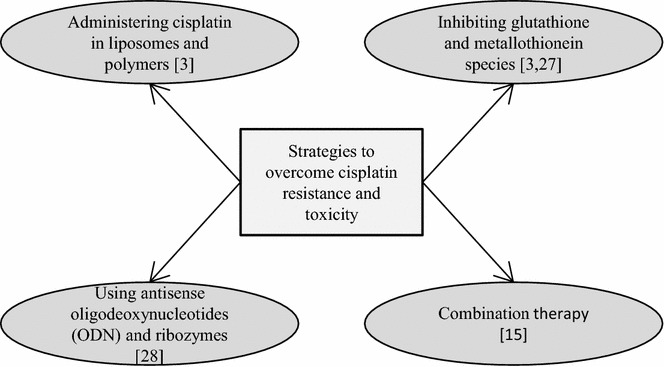
Fig. 1
Fig. 1
Various strategies to overcome cisplatin resistance. Delivery of cisplatin to target DNA can be improved by administering cisplatin in liposomes or polymers, and by inhibiting cisplatin inactivating species like glutathione and metallothionein. Cisplatin resistance can also be controlled by using antisense oligodeoxynucleotides (ODN) targeting responsible oncogenes for cisplatin resistance or by enhancement of cisplatin activity by combining with other drugs
Fig. 2
Fig. 2
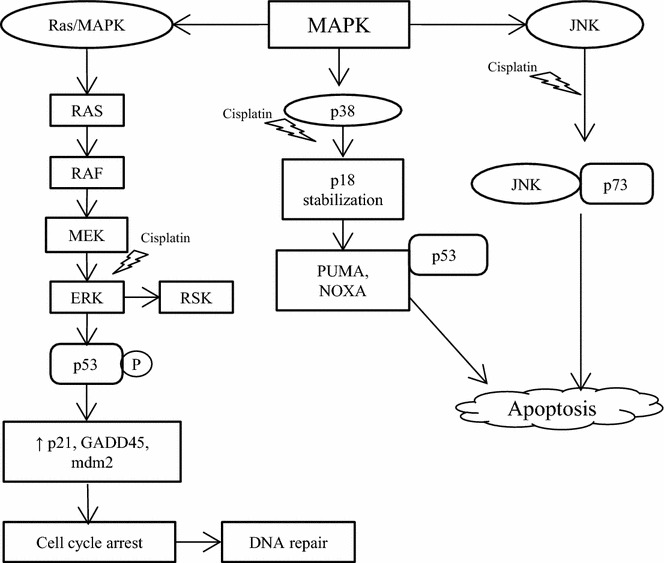
Illustration of MAPK pathway and the role of cisplatin in promoting apoptosis or cell survival. Cisplatin-induced ERK activation phosphorylates p53 which in turn upregulates expression of p21, 45kd-growth arrest and DNA damage (GADD45), and mouse double minute 2 homolog (Mdm2) thereby promoting cell cycle arrest and supporting repair of DNA damage induced by cisplatin. ERK also activates its downstream mediator, RSK which promotes cell survival and metastasis. Cisplatin induced DNA damage activates JNK and p73 and promotes their complex formation and leads to apoptosis. Cisplatin induces stabilization of p18 (Hamlet), a protein regulated by p38 MAPK. This enhances the ability of p53 to interact with and activate pro-apoptotic genes, PUMA and NOXA
Fig. 3
Fig. 3
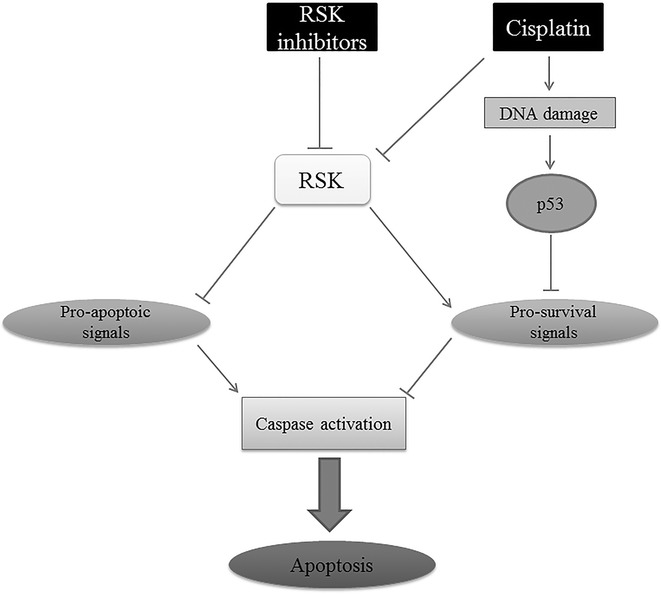
Illustration of combination therapy of cisplatin and RSK inhibitors. Cisplatin causes DNA damage to cell resulting in p53 activation which in turn inhibits pro-survival signals that regress caspase activation. Inhibition of RSK by cisplatin and RSK inhibitors result in inhibition of pro-apoptotic signals there by increasing caspase activation leading to apoptosis. Combination therapy with cisplatin along with RSK inhibitors may result in better inhibition of cancer progression

References

    1. Chen X, Wu Y, Dong H, Zhang CY, Zhang Y. Platinum-based agents for individualized cancer treatment. Curr Mol Med. 2013;13(10):1603–1612. doi: 10.2174/1566524013666131111125515. - DOI - PubMed
    1. Dilruba S, Kalayda GV. Platinum-based drugs: past, present and future. Cancer Chemother Pharmacol. 2016;77(6):1103–1124. doi: 10.1007/s00280-016-2976-z. - DOI - PubMed
    1. Kelland L. The resurgence of platinum-based cancer chemotherapy. Nat Rev Cancer. 2007;7(8):573–584. doi: 10.1038/nrc2167. - DOI - PubMed
    1. Tao K, Yin Y, Shen Q, Chen Y, Li R, Chang W, et al. Akt inhibitor MK-2206 enhances the effect of cisplatin in gastric cancer cells. Biomed Rep. 2016;4(3):365–368. doi: 10.3892/br.2016.594. - DOI - PMC - PubMed
    1. Baharuddin P, Satar N, Fakiruddin KS, Zakaria N, Lim MN, Yusoff NM, et al. Curcumin improves the efficacy of cisplatin by targeting cancer stem-like cells through p21 and cyclin D1-mediated tumour cell inhibition in non-small cell lung cancer cell lines. Oncol Rep. 2016;35(1):13–25. doi: 10.3892/or.2015.4371. - DOI - PMC - PubMed

Publication types

MeSH terms

Substances