


Desynchronization of diurnal rhythms in bipolar disorder and borderline personality disorder
- PMID: 29643339
- PMCID: PMC5895697
- DOI: 10.1038/s41398-018-0125-7
Desynchronization of diurnal rhythms in bipolar disorder and borderline personality disorder
Abstract
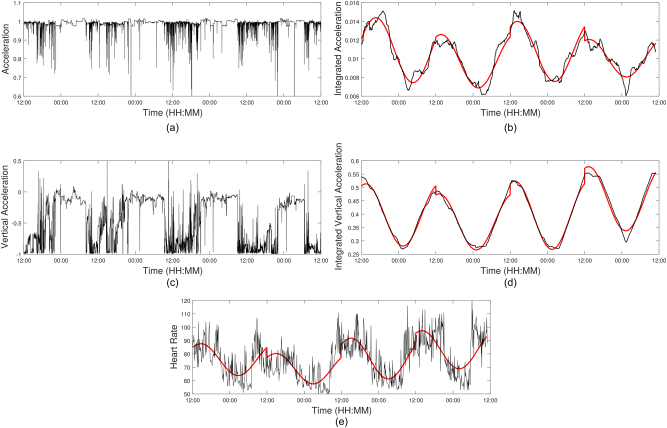
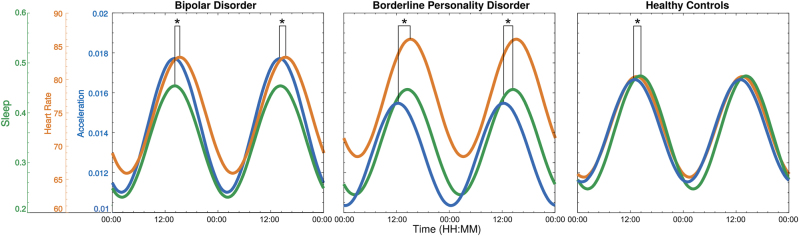
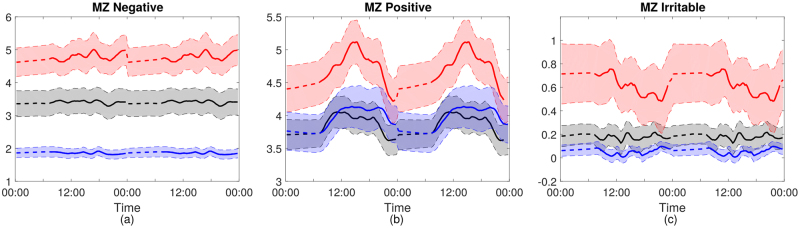
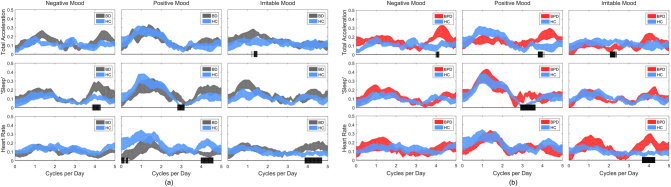
It has long been proposed that diurnal rhythms are disturbed in bipolar disorder (BD). Such changes are obvious in episodes of mania or depression. However, detailed study of patients between episodes has been rare and comparison with other psychiatric disorders rarer still. Our hypothesis was that evidence for desynchronization of diurnal rhythms would be evident in BD and that we could test the specificity of any effect by studying borderline personality disorder (BPD). Individuals with BD (n = 36), BPD (n = 22) and healthy volunteers (HC, n = 25) wore a portable heart rate and actigraphy device and used a smart-phone to record self-assessed mood scores 10 times per day for 1 week. Average diurnal patterns of heart rate (HR), activity and sleep were compared within and across groups. Desynchronization in the phase of diurnal rhythms of HR compared with activity were found in BPD (+3 h) and BD (+1 h), but not in HC. A clear diurnal pattern for positive mood was found in all subject groups. The coherence between negative and irritable mood and HR showed a four-cycle per day component in BD and BPD, which was not present in HC. The findings highlight marked de-synchronisation of measured diurnal function in both BD but particularly BPD and suggest an increased association with negative and irritable mood at ultradian frequencies. These findings enhance our understanding of the underlying physiological changes associated with BPD and BD, and suggest objective markers for monitoring and potential treatment targets. Improved mood stabilisation is a translational objective for management of both patient groups.
Conflict of interest statement
Prof Goodwin is a NIHR Senior Investigator, is co-PI grant of the Wellcome Trust award, holds shares in P1vital and has served as consultant, advisor or CME speaker for AstraZeneca, MSD, Eli Lilly, Lundbeck (/Otsuka or /Takeda), Medscape, P1Vital, Pfizer, Servier, Sunovion. The remaining authors declare that they have no conflict of interest.
Figures
References
-
- Wirz-Justice A. Biological rhythm disturbances in mood disorders. Int. Clin. Psychopharmacol. 2006;21:11–15. doi: 10.1097/01.yic.0000195660.37267.cf. - DOI - PubMed
Publication types
MeSH terms
Grants and funding
LinkOut - more resources
Full Text Sources
Other Literature Sources
Medical
