. 2018 Apr 11;8(1):5838.
doi: 10.1038/s41598-018-24196-3.

Satellite DNA in Vicia faba is characterized by remarkable diversity in its sequence composition, association with centromeres, and replication timing

Affiliations

Satellite DNA in Vicia faba is characterized by remarkable diversity in its sequence composition, association with centromeres, and replication timing

Laura Ávila Robledillo et al. Sci Rep. .

Abstract

Satellite DNA, a class of repetitive sequences forming long arrays of tandemly repeated units, represents substantial portions of many plant genomes yet remains poorly characterized due to various methodological obstacles. Here we show that the genome of the field bean (Vicia faba, 2n = 12), a long-established model for cytogenetic studies in plants, contains a diverse set of satellite repeats, most of which remained concealed until their present investigation. Using next-generation sequencing combined with novel bioinformatics tools, we reconstructed consensus sequences of 23 novel satellite repeats representing 0.008-2.700% of the genome and mapped their distribution on chromosomes. We found that in addition to typical satellites with monomers hundreds of nucleotides long, V. faba contains a large number of satellite repeats with unusually long monomers (687-2033 bp), which are predominantly localized in pericentromeric regions. Using chromatin immunoprecipitation with CenH3 antibody, we revealed an extraordinary diversity of centromeric satellites, consisting of seven repeats with chromosome-specific distribution. We also found that in spite of their different nucleotide sequences, all centromeric repeats are replicated during mid-S phase, while most other satellites are replicated in the first part of late S phase, followed by a single family of FokI repeats representing the latest replicating chromatin.


Conflict of interest statement

The authors declare no competing interests.

Figures
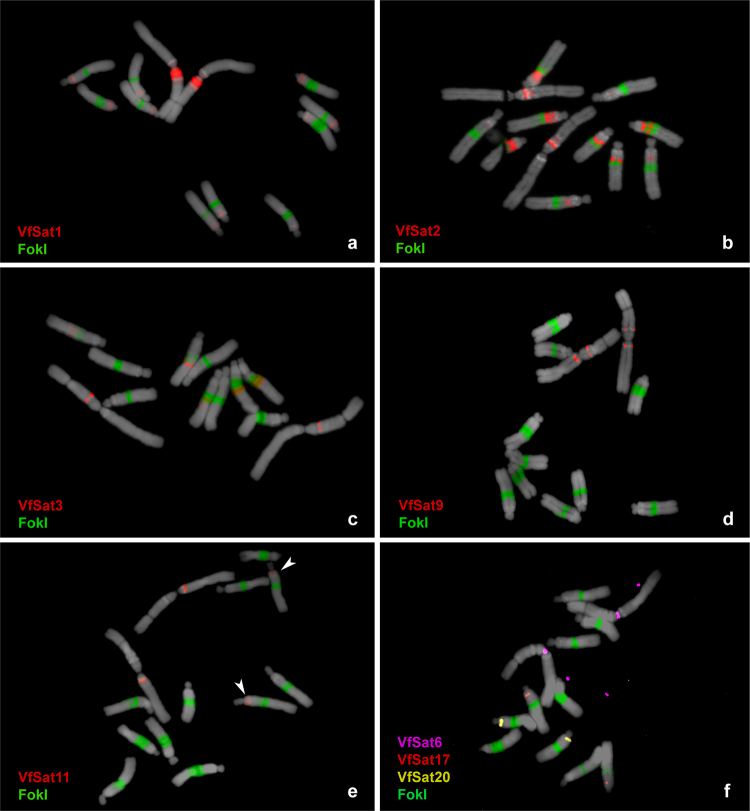
Figure 1
Figure 1
Distribution of selected satellite repeat families on metaphase chromosomes of Vicia faba. Satellites were visualized using multi-color FISH, with individual probes labeled as indicated by color-coded descriptions. Hybridization patterns of FokI repeats (green signals) were used for chromosome discrimination as shown in Supplementary Fig. S3. Chromosomes counterstained with DAPI are shown in gray. Arrowheads in (e) point to polymorphic VfSat11 signals on chromosome 2 (see Fig. 3b for comparison).
Figure 2
Figure 2
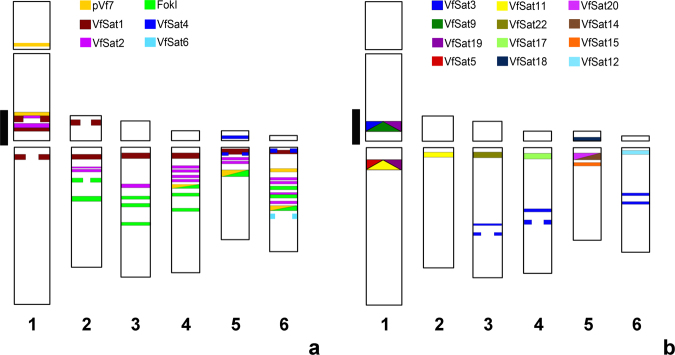
Schematic representation of genomic distributions of all non-centromeric satellites mapped by FISH. Satellites with short monomers are shown in (a), while those with long monomers exceeding 600 bp are in panel (b). The black line along chromosome 1 marks the region of accumulation of multiple satellite repeats.
Figure 3
Figure 3
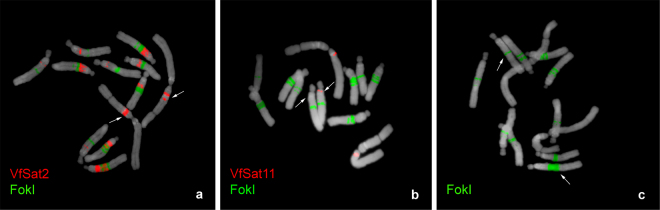
Variation in the number (a,b) or size (c) of FISH signals between homologous chromosomes detected for VfSat2, VfSat11, and FokI. Arrows indicate the positions of polymorphic loci on homologous chromosomes.
Figure 4
Figure 4
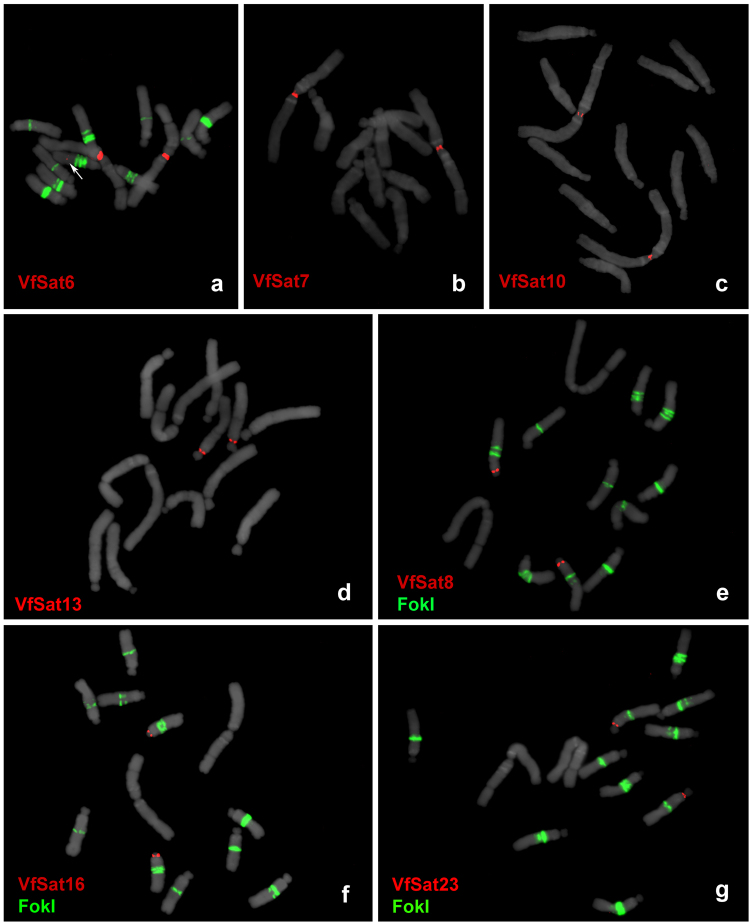
FISH localization of centromeric satellites. Three satellites located in the centromere of chromosome 1 (VfSat6, VfSat7 and VfSat10) are shown separately in panels a–c. Centromeres of four other chromosomes that each contain a single satellite repeat are labeled in panels d–g: (d) VfSat13 repeat located in centromere 5, (e) VfSat8 in centromere 4, (f) VfSat16 in centromere 6, and (g) VfSat23 in centromere 2. Arrow in (a) points to minor non-centromeric locus of VfSat6 which is detectable only on a fraction of chromosomes. Hybridization patterns of FokI repeats (green signals) were used for chromosome discrimination in (e–g). Chromosomes counterstained with DAPI are shown in gray.
Figure 5
Figure 5
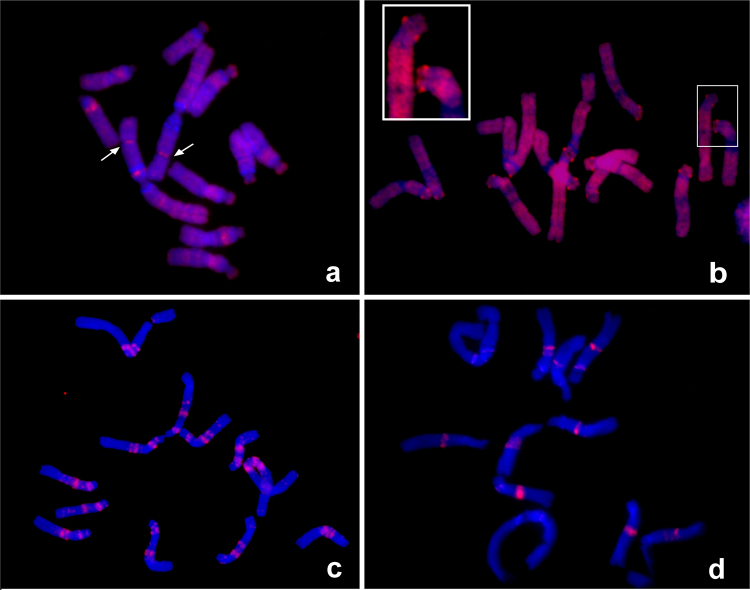
DNA replication assay. Examples of EdU labeling of early (a), mid (b) and late (c–d) replicated chromatin. Arrows in panel (a) show the positions of early replicating NORs. The inset in panel (b) shows a detail of two chromosomes, with bright spots corresponding to labeled centromeres. The two late replication patterns that could be distinguished consisted of labeling most satellite repeats (c), followed by exclusive labeling of FokI loci, which represented the last genomic sequences to be replicated (d).

References

    1. Macas J, Mészáros T, Nouzová M. PlantSat: a specialized database for plant satellite repeats. Bioinformatics. 2002;18:28–35. doi: 10.1093/bioinformatics/18.1.28. - DOI - PubMed
    1. Ellegren H. Microsatellites: simple sequences with complex evolution. Nat. Rev. Genet. 2004;5:435–445. doi: 10.1038/nrg1348. - DOI - PubMed
    1. Gong Z, et al. Repeatless and repeat-based centromeres in potato: implications for centromere evolution. Plant Cell. 2012;24:3559–74. doi: 10.1105/tpc.112.100511. - DOI - PMC - PubMed
    1. Garcia, S., Garnatje, T. & Kovařík, A. Plant rDNA database: ribosomal DNA loci information goes online. Chromosoma121, 389–394 (2012). - PubMed
    1. Chan SRWL, Blackburn EH. Telomeres and telomerase. Philos. Trans. R. Soc. B Biol. Sci. 2004;359:109–122. doi: 10.1098/rstb.2003.1370. - DOI - PMC - PubMed

Publication types

LinkOut - more resources