


Joint perception and patient perceived satisfaction after total hip and knee arthroplasty in the American population
- PMID: 29643693
- PMCID: PMC5889697
- DOI: 10.1016/j.jor.2018.03.018
Joint perception and patient perceived satisfaction after total hip and knee arthroplasty in the American population
Abstract
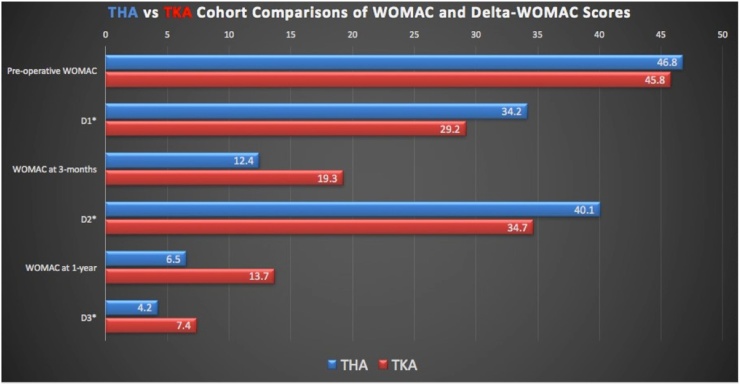
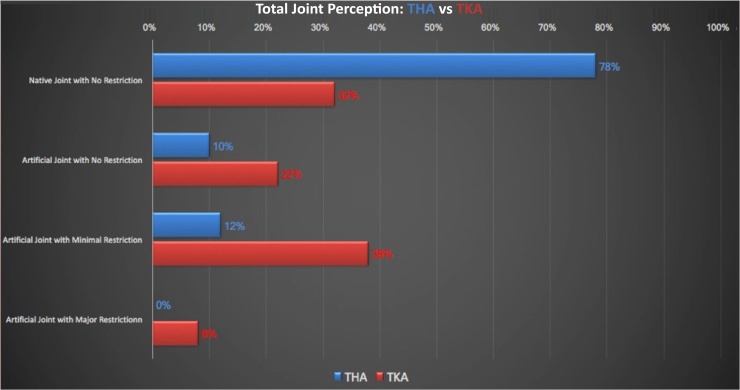
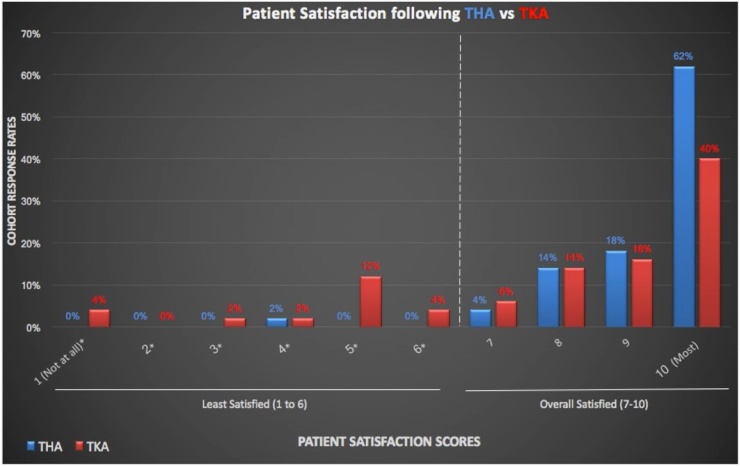
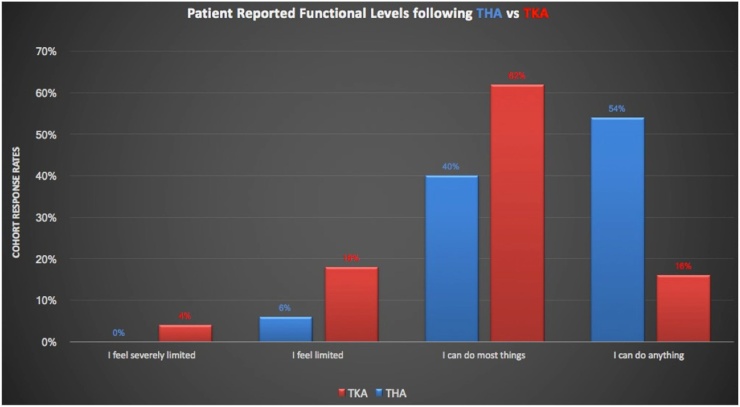
Background: Total hip (THA) and knee arthroplasty (TKA) are two of the most successful procedures in orthopedics. Current evaluation trends focus on patient-reported outcomes. We sought to compare the changing WOMAC scores from various time points from pre-operative to 1-year follow-up between separate THA and TKA cohorts. In addition, we compared THA and TKA patients' joint perception, satisfaction, and function via a questionnaire.
Methods: One hundred elective THA (n = 50) and TKA (n = 50) patients at one institution were randomly selected and contacted between 2 and 4 years after the index surgery. A questionnaire assessed joint perception, satisfaction and function of their total joint. Clinical function scores utilizing the Western Ontario and McMaster Universities Osteoarthritis Index (WOMAC) from the pre-operative, 3-month and 1-year post-arthroplasty visits were compared between groups.
Results: 78% of the THA group perceived their replaced joint as "native" vs 32% of TKA patients. 54% of THA patients (vs 16% of TKA patients) reported uninhibited function of their total joint. 24% of TKA patients noted to be least satisfied with their total joint compared to 2% in the THA group. Both groups demonstrated significant improvement in WOMAC scores after surgery, but the mean 3-month (12.4 (THA) vs 19.3 (TKA)) and 1-year (6.5 (THA) vs 14.1 (TKA)) follow-up WOMAC scores were significantly better in the THA group.
Conclusion: Evaluation of a patient's joint perception is a valuable tool that should be used to assess function in conjunction with validated clinical functional scores. Our data suggest further improvements in total knee implant design and implantation strategies are necessary.
Keywords: Adult reconstruction; Joint perception; Total hip arthroplasty; Total joint arthroplasty outcomes; Total knee arthroplasty; WOMAC scores.
Figures
References
-
- Kahn T.L., Soheili A.C., Schwarzkopf R. Poor WOMAC scores in contralateral knee negatively impact TKA outcomes: data from the osteoarthritis initiative. J Arthroplasty. 2014;29(8):1580–1585. - PubMed
-
- Theodoulou A., Bramwell D.C., Spiteri A.C., Kim S.W., Krishnan J. The use of scoring systems in knee arthroplasty: a systematic review of the literature. J Arthroplasty. 2016;31(10):2364–2370. e8. - PubMed
-
- Behrend H., Zdravkovic V., Giesinger J., Giesinger K. Factors predicting the forgotten joint score after total knee arthroplasty. J Arthroplasty. 2016;31(9):1927–1932. - PubMed
-
- Lieberman J.R., Thomas B.J., Finerman G.A., Dorey F. Patients’ reasons for undergoing total hip arthroplasty can change over time. J Arthroplasty. 2003;18(1):63–68. - PubMed
LinkOut - more resources
Full Text Sources
Other Literature Sources
