


Experiences, expectations and challenges of an interactive mobile phone-based system to support self-management of hypertension: patients' and professionals' perspectives
- PMID: 29643739
- PMCID: PMC5885974
- DOI: 10.2147/PPA.S157658
Experiences, expectations and challenges of an interactive mobile phone-based system to support self-management of hypertension: patients' and professionals' perspectives
Abstract
Background: A well-controlled blood pressure (BP) reduces cardiovascular complications. Patient participation in care using technology may improve the current situation of only 13.8% of adults diagnosed with hypertension worldwide having their BP under control.
Objective: The objective of this study was to explore patients' and professionals' experiences of and expectations for an interactive mobile phone-based system to support self-management of hypertension.
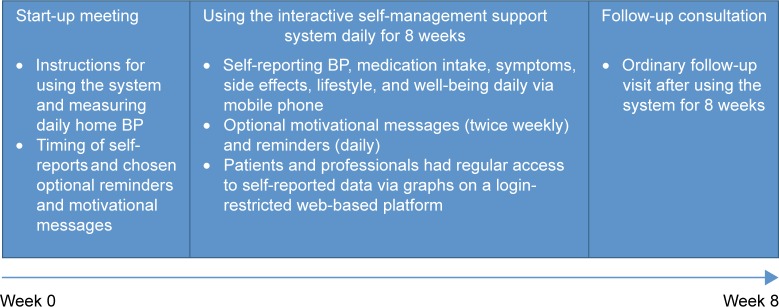
Methods: The self-management system consists of: 1) a mobile phone platform for self-reports, motivational messages and reminders; 2) a device for measuring BP and 3) graphical feedback of self-reports. Patients diagnosed with high BP (n=20) and their treating professionals (n=7) participated in semi-structured interviews, after 8 weeks use of the system in clinical practice. Data were analyzed thematically.
Results: The self-reporting of BP, symptoms, medication use, medication side effects, lifestyle and well-being was perceived to offer insight into how daily life activities influenced BP and helped motivate a healthy lifestyle. Taking increased responsibility as a patient, by understanding factors affecting one's well-being, was reported as an enabling factor for a more effective care. Based on the experiences, some challenges were mentioned: for adoption of the system into clinical practice, professionals' educational role should be extended and there should be a reorganization of care to fully benefit from technology. The patients and professionals gave examples of further improvements to the system, for example, related to the visualization of graphs from self-reports and an integration of the system into the general technical infrastructure. These challenges are important on the path to accomplishing adoption.
Conclusion: The potential of a more autonomous, knowledgeable and active patient, through use of the interactive mobile system would improve outcomes of hypertension treatment, which has been desired for decades. Documentation and visualization of patients' self-reports and the possibilities to communicate these with professionals may be a significant resource for person-centered care.
Keywords: adherence; adoption; blood pressure; cellular phone; mHealth; person-centered care.
Conflict of interest statement
Disclosure The authors report no conflicts of interest in this work.
Figures
References
-
- Chobanian AV. Time to reassess blood-pressure goals. N Engl J Med. 2015;373(22):2093–2095. - PubMed
-
- Barlow J, Wright C, Sheasby J, Turner A, Hainsworth J. Self-management approaches for people with chronic conditions: a review. Patient Educ Couns. 2002;48(2):177–187. - PubMed
-
- Petitti DB, Grumbach K. Variation in physicians’ recommendations about revisit interval for three common conditions. J Fam Pract. 1993;37(3):235–240. - PubMed
LinkOut - more resources
Full Text Sources
Other Literature Sources
