. 2018 Mar 28:9:516.
doi: 10.3389/fmicb.2018.00516. eCollection 2018.

Azole-Resistance in Aspergillus terreus and Related Species: An Emerging Problem or a Rare Phenomenon?

Affiliations

Azole-Resistance in Aspergillus terreus and Related Species: An Emerging Problem or a Rare Phenomenon?

Tamara Zoran et al. Front Microbiol. .

Erratum in

  • Corrigendum: Azole-Resistance in Aspergillus terreus and Related Species: An Emerging Problem or a Rare Phenomenon?
    Zoran T, Sartori B, Sappl L, Aigner M, Sánchez-Reus F, Rezusta A, Chowdhary A, Taj-Aldeen SJ, Arendrup MC, Oliveri S, Kontoyiannis DP, Alastruey-Izquierdo A, Lagrou K, Lo Cascio G, Meis JF, Buzina W, Farina C, Drogari-Apiranthitou M, Grancini A, Tortorano AM, Willinger B, Hamprecht A, Johnson E, Klingspor L, Arsic-Arsenijevic V, Cornely OA, Meletiadis J, Prammer W, Tullio V, Vehreschild JJ, Trovato L, Lewis RE, Segal E, Rath PM, Hamal P, Rodriguez-Iglesias M, Roilides E, Arikan-Akdagli S, Chakrabarti A, Colombo AL, Fernández MS, Martin-Gomez MT, Badali H, Petrikkos G, Klimko N, Heimann SM, Uzun O, Roudbary M, de la Fuente S, Houbraken J, Risslegger B, Sabino R, Lass-Flörl C, Lackner M. Zoran T, et al. Front Microbiol. 2019 Jan 14;9:3245. doi: 10.3389/fmicb.2018.03245. eCollection 2018. Front Microbiol. 2019. PMID: 30692970 Free PMC article.

Abstract

Objectives: Invasive mold infections associated with Aspergillus species are a significant cause of mortality in immunocompromised patients. The most frequently occurring aetiological pathogens are members of the Aspergillus section Fumigati followed by members of the section Terrei. The frequency of Aspergillus terreus and related (cryptic) species in clinical specimens, as well as the percentage of azole-resistant strains remains to be studied. Methods: A global set (n = 498) of A. terreus and phenotypically related isolates was molecularly identified (beta-tubulin), tested for antifungal susceptibility against posaconazole, voriconazole, and itraconazole, and resistant phenotypes were correlated with point mutations in the cyp51A gene. Results: The majority of isolates was identified as A. terreus (86.8%), followed by A. citrinoterreus (8.4%), A. hortai (2.6%), A. alabamensis (1.6%), A. neoafricanus (0.2%), and A. floccosus (0.2%). One isolate failed to match a known Aspergillus sp., but was found most closely related to A. alabamensis. According to EUCAST clinical breakpoints azole resistance was detected in 5.4% of all tested isolates, 6.2% of A. terreus sensu stricto (s.s.) were posaconazole-resistant. Posaconazole resistance differed geographically and ranged from 0% in the Czech Republic, Greece, and Turkey to 13.7% in Germany. In contrast, azole resistance among cryptic species was rare 2 out of 66 isolates and was observed only in one A. citrinoterreus and one A. alabamensis isolate. The most affected amino acid position of the Cyp51A gene correlating with the posaconazole resistant phenotype was M217, which was found in the variation M217T and M217V. Conclusions:Aspergillus terreus was most prevalent, followed by A. citrinoterreus. Posaconazole was the most potent drug against A. terreus, but 5.4% of A. terreus sensu stricto showed resistance against this azole. In Austria, Germany, and the United Kingdom posaconazole-resistance in all A. terreus isolates was higher than 10%, resistance against voriconazole was rare and absent for itraconazole.

Keywords: Aspergillus section Terrei; Cyp51A alterations; azoles; cryptic species; susceptibility profiles.


Figures
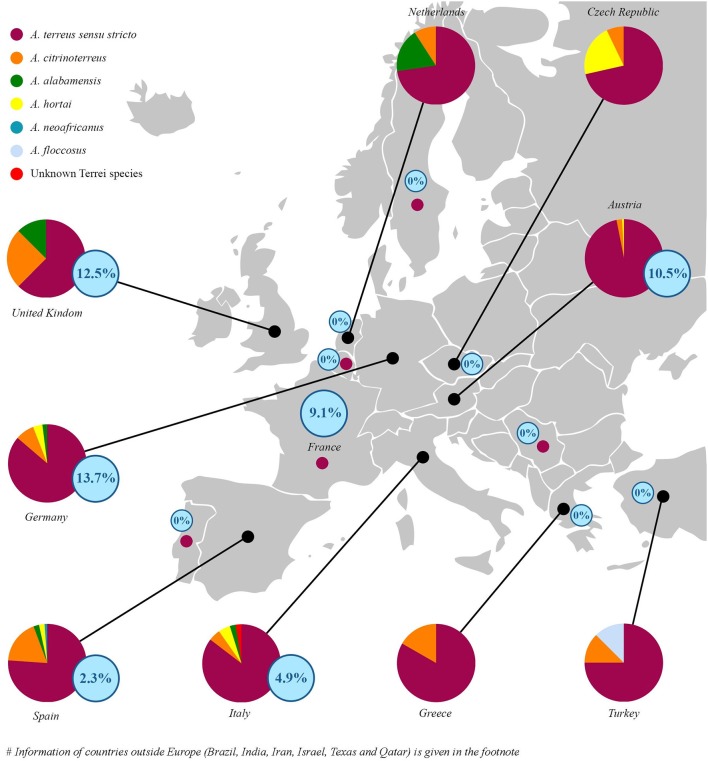
Figure 1
Figure 1
Epidemiological distribution of species (circles) and relative percentage of posaconazole resistance (according to EUCAST clinical breakpoints, see Table 2) isolates per country (blue numbers in blue circles) in respect to all investigated isolates. In France, Portugal, Serbia, and Sweden all collected isolates were identified as A. terreus sensu stricto (small dots in magenta). Azole-resistance percentage per countries are given in blue circled numbers. Species distribution in non-EU countries were as follows: India 100% A. terreus s.s.; Israel 84.85% A. terreus s.s. 12.12% A. citrinoterreus 3.03% A. hortai; Texas 80% A. terreus s.s. 10% A. alabamensis 10% A. hortai; Qatar: 83.34% A. terreus s.s. 16.66% A. citrinoterreus; Iran 63.64% A. terreus s.s. 36.36% A. citrinoterreus; and Brazil 85.71% A. terreus s.s., 14.29% A. hortai. All isolates from Iran, Israel, India, Brazil, Texas, and Qatar were susceptible to all azoles tested. For detailed information see Table 4.
Figure 2
Figure 2
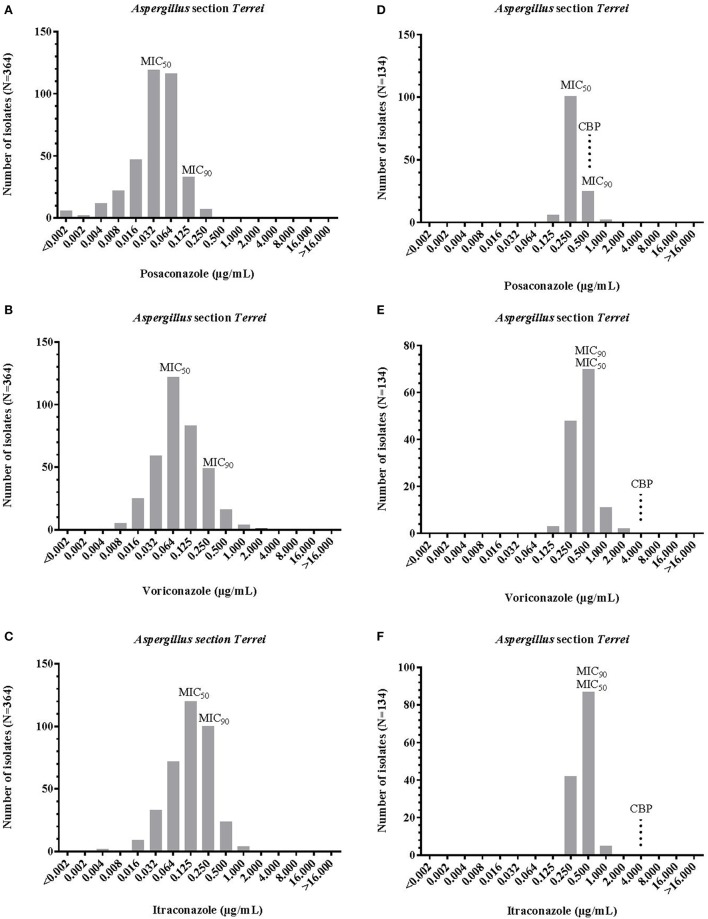
MIC distribution of posaconazole, itraconazole, voriconazole, and posaconazoleintraconazole against Aspergillus section Terrei, obtained by ETest® (A-C) and EUCAST method (D-F). MIC, minimum inhibitory concentration; MIC50 and MIC90, MIC for 50 and 90% of tested population; CBP EUCAST clinical breakpoint (see Table 2).

References

    1. Alastruey-Izquierdo A., Mellado E., Peláez T., Pemán J., Zapico S., Alvarez M., et al. (2013). Population-based survey of filamentous fungi and antifungal resistance in Spain (FILPOP Study). Antimicrob. Agents Chemother. 57, 3380–3387. 10.1128/AAC.00383-13 - DOI - PMC - PubMed
    1. Arendrup M. C. (2014). Update on antifungal resistance in Aspergillus and Candida. Clin. Microbiol. Infect. 20, 42–48. 10.1111/1469-0691.12513 - DOI - PubMed
    1. Arendrup M. C., Jensen R. H., Grif K., Skov M., Pressler T., Johansen H. K., et al. . (2012). In vivo emergence of Aspergillus terreus with reduced azole susceptibility and a Cyp51a M217I Alteration. J. Infect. Dis. 206, 981–985. 10.1093/infdis/jis442 - DOI - PubMed
    1. Arendrup M. C., Mavridou E., Mortensen K. L., Snelders E., Frimodt-Møller N., Khan H. (2010). Development of azole resistance in Aspergillus fumigatus during azole therapy associated with change in virulence. PLoS ONE 5:e10080. 10.1371/journal.pone.0010080 - DOI - PMC - PubMed
    1. Arzanlou M., Samadi R., Frisvad J. C., Houbraken J., Ghosta Y. (2016). Two novel Aspergillus species from hypersaline soils of the national park of lake Urmia, Iran. Mycol. Prog. 15, 1081–1092. 10.1007/s11557-016-1230-8 - DOI