Review
. 2018 Apr 3:4:8.
doi: 10.1038/s41526-018-0043-2. eCollection 2018.

Limitations in predicting the space radiation health risk for exploration astronauts

Affiliations
Review

Limitations in predicting the space radiation health risk for exploration astronauts

Jeffery C Chancellor et al. NPJ Microgravity. .

Abstract

Despite years of research, understanding of the space radiation environment and the risk it poses to long-duration astronauts remains limited. There is a disparity between research results and observed empirical effects seen in human astronaut crews, likely due to the numerous factors that limit terrestrial simulation of the complex space environment and extrapolation of human clinical consequences from varied animal models. Given the intended future of human spaceflight, with efforts now to rapidly expand capabilities for human missions to the moon and Mars, there is a pressing need to improve upon the understanding of the space radiation risk, predict likely clinical outcomes of interplanetary radiation exposure, and develop appropriate and effective mitigation strategies for future missions. To achieve this goal, the space radiation and aerospace community must recognize the historical limitations of radiation research and how such limitations could be addressed in future research endeavors. We have sought to highlight the numerous factors that limit understanding of the risk of space radiation for human crews and to identify ways in which these limitations could be addressed for improved understanding and appropriate risk posture regarding future human spaceflight.


Conflict of interest statement

The authors declare no competing interests.

Figures

Fig. 1
Fig. 1
Depth dose, energy, and linear energy transfer characteristics of protons. The range of proton energies relative to the body diameter (dotted lines) and bone marrow depth (ordinate) for mice, pigs, and humans for energies up to 60 MeV. Figure reprinted by permission from Conditions for RightsLink Permissions Springer Customer Service Center GmbH:Springer-Verlag
Fig. 2
Fig. 2
Relative abundance of atomic species, normalized to Z = 1 (hydrogen) and up to Z = 26 (iron), in the Galactic Cosmic Ray (GCR) spectrum. The GCR spectrum includes every atom in the periodic table, with ions up to nickel (Z = 28) contributing to any significance. Note the energy of each ion species varies widely, more prominently in the range of 400–600 MeV. This broad disparity in ions and energies makes it extremely difficult to accurately simulate the GCR environment during ground-based radiobiology experiments. While larger ions may provide lower relative contribution to the spectrum makeup they may have a more significant biological impact than smaller, abundant ions. Data adapted from Saganti et al. 2014
Fig. 3
Fig. 3
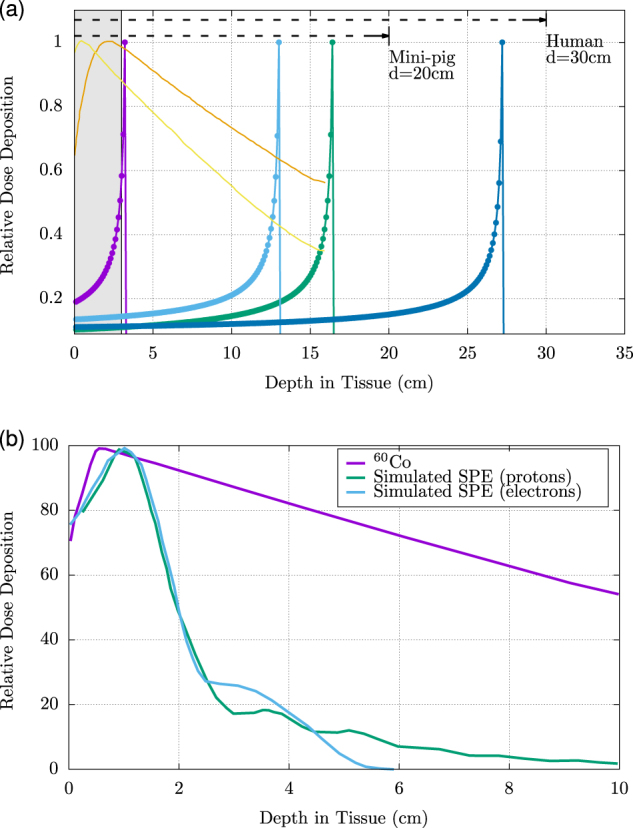
a The Bragg peak and depth dose characteristics of space radiation. The Bragg peak and relative dose deposition for ions at energies commonly used in space radiation studies compared to the X-ray and gamma sources used as surrogate radiations for Relative Biological Effectiveness (RBE) quantification. The Bragg peak refers to the point where a charged particle promptly loses kinetic energy before coming to rest in a medium. This effect is very pronounced for fast moving, charged particles. Shown are 60 MeV Protons (hydrogen, purple), 600 MeV 56Fe (iron, light blue), 290 MeV12C (carbon, green), 1 GeV 56Fe (iron, dark blue), X-ray (orange dotted line), and 60Co (cobalt, yellow dotted line). The shaded gray area, representing the average diameter of a mouse, demonstrates that the Bragg peak, and thus the majority of dose deposition, is outside the mouse body for SPE protons (energies ≥50 MeV) and GCR ions. b The proton and electron range, energy and dose distributions for the October 1989 solar particle event compared to a dose-equivalent 60Co exposure. Charged particles (electrons, protons, heavy-charged particles) typically deposit more energy towards the end of their range. In contrast, the current standard, 60Co radiation, loses the most energy at the tissue surface. These energy characteristics demonstrate the poor fidelity of 60Co as a surrogate for studying the complex SPE and GCR spectrums. Figure 3 (b) reprinted by permission from Conditions for RightsLink Permissions Springer Customer Service Center GmbH:Springer-Verlag
Fig. 4
Fig. 4
The intravehicular LET of the Space Shuttle. Displayed are the integrated LET/day values measured by Badhwar et al. 1998 (purple dotted line), as well as the LET of five single-ion exposures (290 MeV 14C (carbon), 600 MeV 16O (oxygen), 1 GeV 47Ti (titanium), 1 GeV 56Fe (iron), and 600 MeV 56Fe (iron)). As studies generally focus on a single, mono-energetic radiation exposure, this figure highlights the lack in breadth of energies or radiation field complexity used in current radiobiological studies. Data adapted from Badhwar et al. 1998
Fig. 5
Fig. 5
Comparison of lymphocyte and neutrophil counts following proton and X-ray (comparable to gamma radiation) exposures in mice, ferrets, and Yucatan mini-pigs. The relative fraction of lymphocyte (a) and neutrophil (b) counts following a homogeneous proton or X-ray exposure to the bone marrow compartment are shown. Note: calculations indicate that animals received approximately a 2 Gy marrow dose. In both cases, the mouse models demonstrated the ability to fully recover within 30 days following proton exposures while the ferret and pig models showed no recovery. The ferrets were euthanized at day 13. The RBE values for white blood cell counts varied greatly between the mice, ferret and pig models. RBE values were greater in ferrets than mice, and considerably greater in pigs compared to either ferrets or mice. This suggests that model-specific sensitivity to radiation exposure may lead to drastically different results in experimental outcome, leading to difficulty in extracting clinical significance from animal models with dissimilar radiation sensitivity compared to humans. Data from Kennedy (mouse and ferret results) and Krigsfeld et al., (Yucatan mini-pig results)
Fig. 6
Fig. 6
Results from Yucatan mini-pigs exposed to simulated Solar Particle Event (SPE)-like radiation consisting of several different energies of protons. In this study, Kennedy et al. utilized an inhomogeneous distribution of protons that resembled a SPE spectrum, as demonstrated in Fig. 3. Electrons were used as the surrogate radiation for determining the RBE following exposure to a SPE-like distribution of protons. Electrons were chosen because a SPE-like distribution could not be achieved with 60Co as demonstrated in Fig. 3. Note the white blood cell counts in the mini-pig model recovered to near pre-irradiation levels following exposure to the electron radiation while the white blood cell counts for those exposed to a SPE-like proton spectrum remained suppressed for 30 days after exposures. These results indicate that the mini-pigs were not capable of repairing the hematopoietic damage caused by the proton radiation exposure as efficiently as they could repair the electron radiation damage. Data from Kennedy 2014
Fig. 7
Fig. 7
Moderator block geometry concept for the emulation of space radiation spectra. Artist conception of GCR analog detailed in Chancellor et al. A primary beam of 56Fe (iron, left) is selectively degraded with a carefully designed moderator block to produce a desired distribution of energies and ions (represented by the colorful lines on the right) simulating the intravehicular space radiation environment. To preferentially enhance fragmentation and energy loss, cuts are performed in the moderator block made up of different materials (depicted by different shades of gray). Before the spallation products exit the moderator block, a high-Z material layer is added for scattering. Image courtesy of R. Blue

References

    1. National Council on Radiation Protection andMeasurements (NCRP). Guidance on Radiation Received in Space Activities. Tech. Rep. NCRP 98 (National Council on Radiation Protection and Measurements, Bethesda, 1989).
    1. National Council on Radiation Protection andMeasurements (NCRP). Radiation Protection for Space Activities: Supplement to Previous Recommendations. Tech. Rep. NCRP Commentary No. 23 (National Council on Radiation Protection and Measurements, Bethesda, 2015).
    1. Aeronautics, N. & Administration, S. Nasa Spaceflight Human-system Standard. Tech. Rep. NASA-STD-3001 Vol. 1 (REV A, Washington 2015).
    1. Schwadron NA, et al. Does the worsening galactic cosmic radiation environment observed by CRaTER preclude future manned deep space exploration? J. Space Weather. 2014;12:622–632. doi: 10.1002/2014SW001084. - DOI
    1. Attix FH. Introduction to Radiological Physics and Radiation Dosimetry. New York: Wiley; 1986.