


Predictive performance of dual modality of computed tomography angiography and intravascular ultrasound for no-reflow phenomenon after percutaneous coronary stenting in stable coronary artery disease
- PMID: 29644449
- PMCID: PMC6133068
- DOI: 10.1007/s00380-018-1160-2
Predictive performance of dual modality of computed tomography angiography and intravascular ultrasound for no-reflow phenomenon after percutaneous coronary stenting in stable coronary artery disease
Abstract
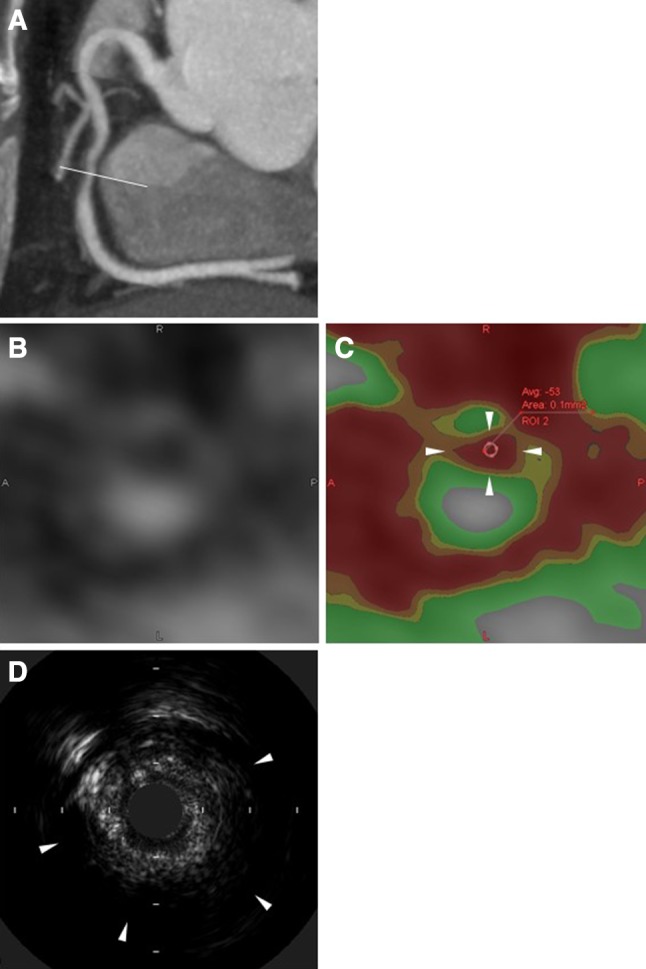
Attenuated plaque on intravascular ultrasound (IVUS) and low attenuation plaque on computed tomography angiography (CTA) are associated with no-reflow phenomenon during percutaneous coronary intervention (PCI). However, evaluation by a single modality has been unable to satisfactorily predict this phenomenon. We investigated whether the combination of IVUS and CTA findings can ameliorate the predictive potential for no-reflow phenomenon after stent implantation during PCI in stable coronary artery disease (CAD). A total of 988 lesions of 707 stable CAD patients who underwent coronary CTA before PCI were enrolled. PCI was performed with preprocedural IVUS and stent implantation. As for plaque characters, very low attenuation plaque (CTA v-LAP) whose minimum density was < 0 Hounsfield units on CTA and attenuated plaque (IVUS AP) on IVUS were evaluated. No-reflow phenomenon was observed in 22 lesions (2.2%) of 19 patients (2.7%). Both CTA v-LAP and IVUS AP were much more frequently observed in patients with no-reflow phenomenon. Positive (PPV) and negative predictive values (NPV) and accuracy for prediction of no-reflow were almost equivalent between CTA v-LAP (13.2, 99.6, and 87.0%) and IVUS AP (15.7, 99.8, and 89.0%). The combination of CTA v-LAP and IVUS AP markedly ameliorated PPV (31.7%) without deterioration of NPV (99.7%) and increased the diagnostic accuracy (95.5%). These findings showed that the combination of CTA v-LAP and IVUS AP improved the predictive power for no-reflow phenomenon after coronary stenting in stable CAD patients, suggesting the usefulness of combined estimation by using CTA and IVUS for predicting no-reflow phenomenon during PCI in clinical practice.
Keywords: Computed tomography angiography; Intravascular ultrasound; No-reflow; Percutaneous coronary intervention; Plaque.
Conflict of interest statement
The authors have no conflict of interest to declare.
Figures
References
-
- Ito H, Tomooka T, Sakai N, Yu H, Higashino Y, Fujii K, Masuyama T, Kitabatake A, Minamino T. Lack of myocardial perfusion immediately after successful thrombolysis. A predictor of poor recovery of left ventricular function in anterior myocardial infarction. Circulation. 1992;85:1699–1705. doi: 10.1161/01.CIR.85.5.1699. - DOI - PubMed
-
- Morishima I, Sone T, Okumura K, Tsuboi H, Kondo J, Mukawa H, Matsui H, Toki Y, Ito T, Hayakawa T. Angiographic no-reflow phenomenon as a predictor of adverse long-term outcome in patients treated with percutaneous transluminal coronary angioplasty for first acute myocardial infarction. J Am Coll Cardiol. 2000;36:1202–1209. doi: 10.1016/S0735-1097(00)00865-2. - DOI - PubMed
-
- Yip HK, Chen MC, Chang HW, Hang CL, Hsieh YK, Fang CY, Wu CJ. Angiographic morphologic features of infarct-related arteries and timely reperfusion in acute myocardial infarction: predictors of slow-flow and no-reflow phenomenon. Chest. 2002;122:1322–1332. doi: 10.1378/chest.122.4.1322. - DOI - PubMed
MeSH terms
LinkOut - more resources
Full Text Sources
Other Literature Sources
Medical
Molecular Biology Databases
Research Materials
Miscellaneous
