


Association of Frailty With Recovery From Disability Among Community-Dwelling Older Adults: Results From Two Large U.S. Cohorts
- PMID: 29648574
- PMCID: PMC6601525
- DOI: 10.1093/gerona/gly080
Association of Frailty With Recovery From Disability Among Community-Dwelling Older Adults: Results From Two Large U.S. Cohorts
Abstract
Background: Disability in activities of daily living (ADLs) is a dynamic process and transitions among different disability states are common. However, little is known about factors affecting recovery from disability. We examined the association between frailty and recovery from disability among nondisabled community-dwelling elders.
Methods: We studied 1,023 adults from the Cardiovascular Health Study (CHS) and 685 adults from the Health and Retirement Study (HRS), who were ≥65 years and had incident disability, defined as having difficulty in ≥1 ADL (dressing, eating, toileting, bathing, transferring, walking across a room). Disability recovery was defined as having no difficulty in any ADLs. Frailty was assessed by slowness, weakness, exhaustion, inactivity, and shrinking. Persons were classified as "nonfrail" (0 criteria), "prefrail" (1-2 criteria), or "frail" (3-5 criteria).
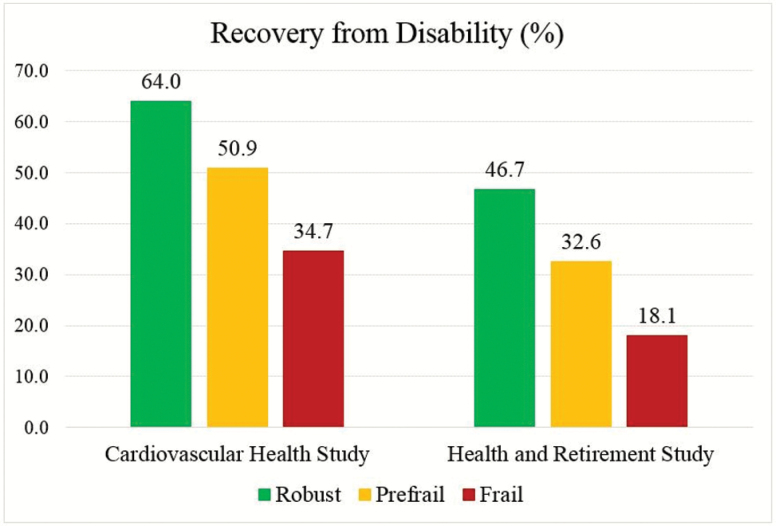
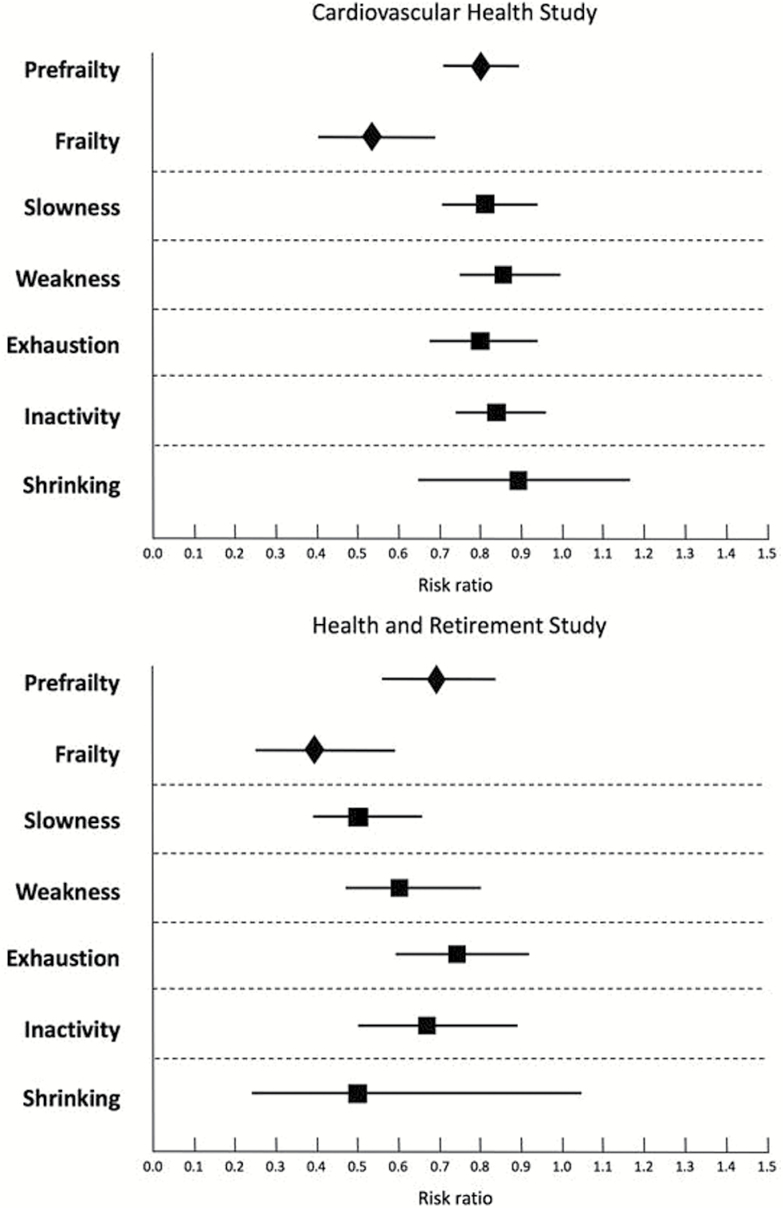
Results: In total, 539 (52.7%) CHS participants recovered from disability within 1 year. Almost two-thirds of nonfrail persons recovered, while less than two-fifths of the frail recovered. In the HRS, 234 (34.2%) participants recovered from disability within 2 years. Approximately half of the nonfrail recovered, while less than one-fifth of the frail recovered. After adjustment, prefrail and frail CHS participants were 16% and 36% less likely to recover than the nonfrail, respectively. In the HRS, frail persons had a 41% lower likelihood of recovery than the nonfrail.
Conclusions: Frailty is an independent predictor of poor recovery from disability among nondisabled older adults. These findings validate frailty as a marker of decreased resilience and may offer opportunities for individualized interventions and geriatric care based on frailty assessment.
Keywords: Disablement process; Frailty; Recovery; Resilience.
© The Author(s) 2018. Published by Oxford University Press on behalf of The Gerontological Society of America. All rights reserved. For permissions, please e-mail: journals.permissions@oup.com.
Figures
References
-
- Freedman VA, Martin LG, Schoeni RF. Recent trends in disability and functioning among older adults in the United States: a systematic review. JAMA. 2002;288:3137–3146. doi:10.1001/jama.288.24.3137 - PubMed
Publication types
MeSH terms
Grants and funding
- K08 AG051187/AG/NIA NIH HHS/United States
- HHSN268201200036C/HL/NHLBI NIH HHS/United States
- HHSN268200800007C/HL/NHLBI NIH HHS/United States
- N01HC55222/HL/NHLBI NIH HHS/United States
- N01HC85079/HL/NHLBI NIH HHS/United States
- N01HC85080/HL/NHLBI NIH HHS/United States
- N01HC85081/HL/NHLBI NIH HHS/United States
- N01HC85082/HL/NHLBI NIH HHS/United States
- N01HC85083/HL/NHLBI NIH HHS/United States
- N01HC85086/HL/NHLBI NIH HHS/United States
- U01 HL080295/HL/NHLBI NIH HHS/United States
- U01 HL130114/HL/NHLBI NIH HHS/United States
- R01 AG023629/AG/NIA NIH HHS/United States
- R03 AG048541/AG/NIA NIH HHS/United States
- P30 CA006973/CA/NCI NIH HHS/United States
- P30 AG031679/AG/NIA NIH HHS/United States
LinkOut - more resources
Full Text Sources
Other Literature Sources
