


Long-Term Outcomes Following Achievement of Clinically Inactive Disease in Juvenile Idiopathic Arthritis: The Importance of Definition
- PMID: 29648683
- PMCID: PMC6175118
- DOI: 10.1002/art.40519
Long-Term Outcomes Following Achievement of Clinically Inactive Disease in Juvenile Idiopathic Arthritis: The Importance of Definition
Abstract
Objective: Potential targets for treat-to-target strategies in juvenile idiopathic arthritis are minimal disease activity (MDA) and clinically inactive disease (CID). We undertook this study to compare short- and long-term outcomes following achievement of MDA and CID on the 10-joint clinical Juvenile Arthritis Disease Activity Score (cJADAS10) and following achievement of CID on Wallace et al's preliminary criteria.
Methods: Children recruited to the Childhood Arthritis Prospective Study, a UK multicenter inception cohort, were selected if they were recruited prior to January 2011 and diagnosed as having oligoarthritis or rheumatoid factor-negative or -positive polyarthritis. One year following diagnosis, children were assessed for MDA on the cJADAS10 and for CID on both Wallace et al's preliminary criteria and the cJADAS10. Associations were tested between those disease states and functional ability, absence of joints with limited range of motion, psychosocial health, and pain at 1 year and annually to 5 years.
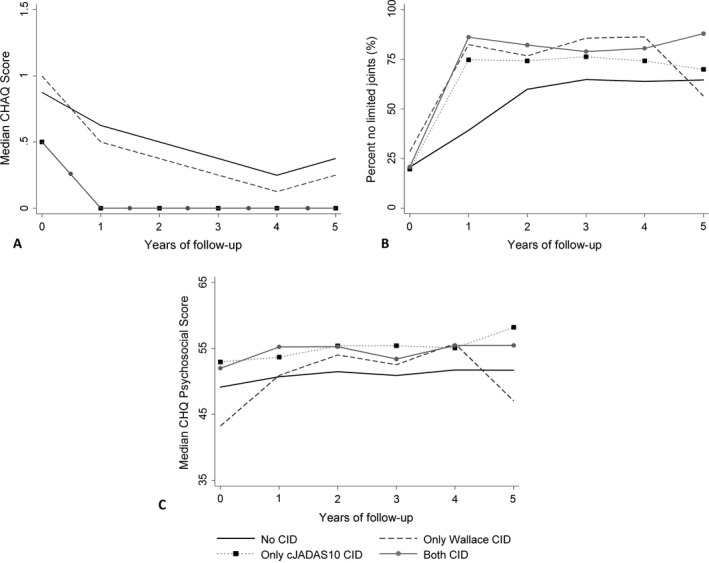
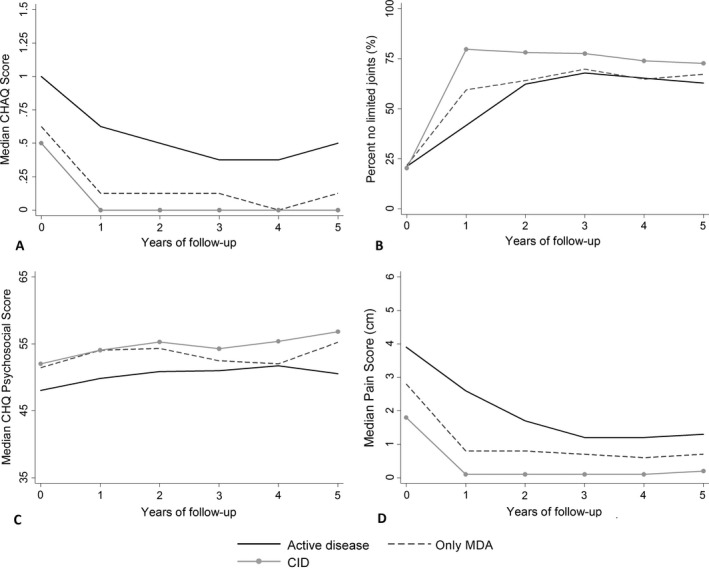
Results: Of 832 children, 70% were female and the majority had oligoarthritis (68%). At 1 year, 21% had achieved CID according to both definitions, 7% according to Wallace et al's preliminary criteria alone, and 16% according to the cJADAS10 alone; 56% had not achieved CID. Only 10% of children in the entire cohort achieved MDA without also achieving CID. Achieving either early CID state was associated with a greater absence of joints with limited range of motion. However, only CID according to the cJADAS10 was associated with improved functional ability and psychosocial health. Achieving CID was superior to achieving MDA in terms of short- and long-term pain and the absence of joints with limited range of motion.
Conclusion: CID on the cJADAS10 may be preferable as a treatment target to CID on Wallace et al's preliminary criteria in terms of both feasibility of application and long-term outcomes.
© 2018 The Authors. Arthritis & Rheumatology published by Wiley Periodicals, Inc. on behalf of American College of Rheumatology.
Figures
References
-
- National Institute for Health and Care Excellence . Guidance on the use of etanercept for the treatment of juvenile idiopathic arthritis. 2002. URL: https://www.nice.org.uk/guidance/ta35.
-
- Davies K, Cleary G, Foster H, Hutchinson E, Baildam E. BSPAR standards of care for children and young people with juvenile idiopathic arthritis. Rheumatology (Oxford) 2010;49:1406–8. - PubMed
Publication types
MeSH terms
Substances
Grants and funding
LinkOut - more resources
Full Text Sources
Other Literature Sources
Medical
Miscellaneous
