. 2018 Apr 12;10(2):47.
doi: 10.3390/pharmaceutics10020047.

Influence of Solvent Composition on the Performance of Spray-Dried Co-Amorphous Formulations

Affiliations

Influence of Solvent Composition on the Performance of Spray-Dried Co-Amorphous Formulations

Jaya Mishra et al. Pharmaceutics. .

Abstract

Ball-milling is usually used to prepare co-amorphous drug-amino acid (AA) mixtures. In this study, co-amorphous drug-AA mixtures were produced using spray-drying, a scalable industrially preferred preparation method. The influence of the solvent type and solvent composition was investigated. Mixtures of indomethacin (IND) and each of the three AAs arginine, histidine, and lysine were ball-milled and spray-dried at a 1:1 molar ratio, respectively. Spray-drying was performed at different solvent ratios in (a) ethanol and water mixtures and (b) acetone and water mixtures. Different ratios of these solvents were chosen to study the effect of solvent mixtures on co-amorphous formulation. Residual crystallinity, thermal properties, salt/partial salt formation, and powder dissolution profiles of the IND-AA mixtures were investigated and compared to pure crystalline and amorphous IND. It was found that using spray-drying as a preparation method, all IND-AA mixtures could be successfully converted into the respective co-amorphous forms, irrespective of the type of solvent used, but depending on the solvent mixture ratios. Both ball-milled and spray-dried co-amorphous samples showed an enhanced dissolution rate and maintained supersaturation compared to the crystalline and amorphous IND itself. The spray-dried samples resulting in co-amorphous samples were stable for at least seven months of storage.

Keywords: co-amorphous; process parameter; salt formation; spray-drying; stability.


Conflict of interest statement

The Lundbeck Foundation had no role in the design of the study; in the collection, analyses, or interpretation of data; in the writing of the manuscript; or in the decision to publish the results. The authors declare no conflict of interest.

Figures
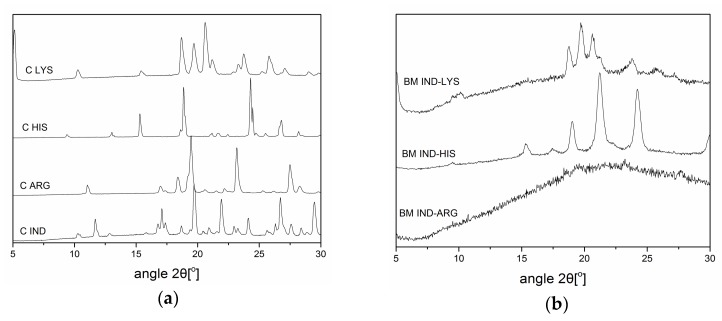
Figure 1
Figure 1
X-ray powder diffraction (XRPD) diffractograms of (a) crystalline (C) lysine (LYS), histidine (HIS), arginine (ARG), and indomethacin (IND). (b) Mixtures of IND–LYS, IND–HIS, and IND–ARG prepared by ball-milling (BM) for 60 min.
Figure 2
Figure 2
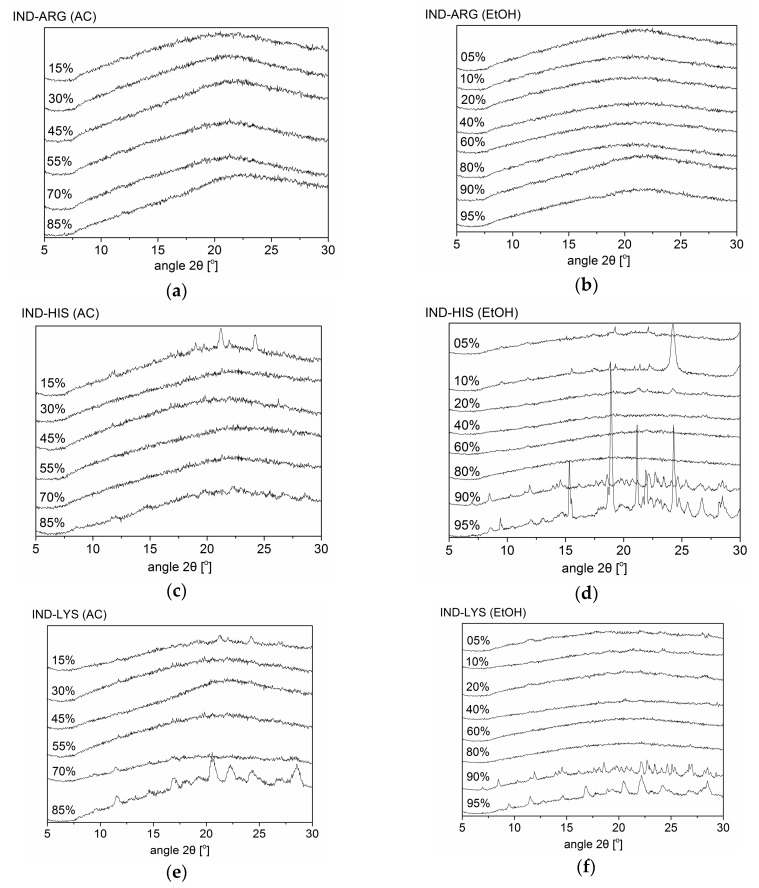
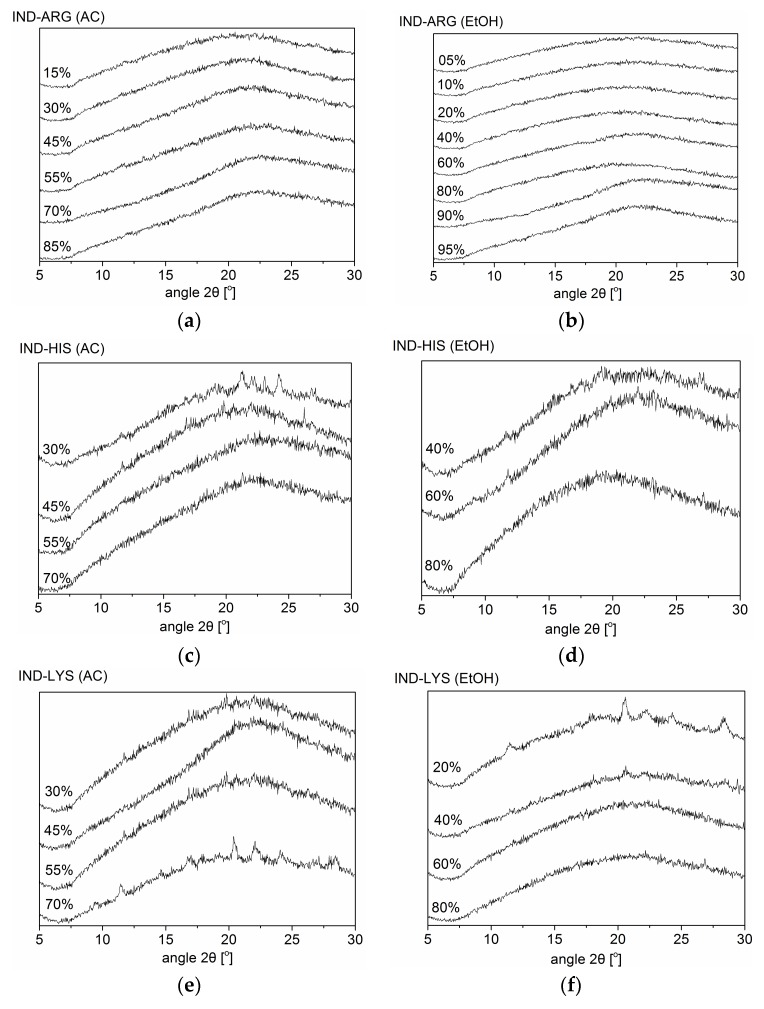
XRPD diffractograms of indomethacin–arginine (IND–ARG), IND–histidine (IND–HIS) and IND–lysine (IND–LYS) mixtures prepared by spray-drying (SD). Organic solvent denoted in percentage (%) is acetone (AC) in (a,c,e); and ethanol (EtOH) in (b,d,f).
Figure 3
Figure 3
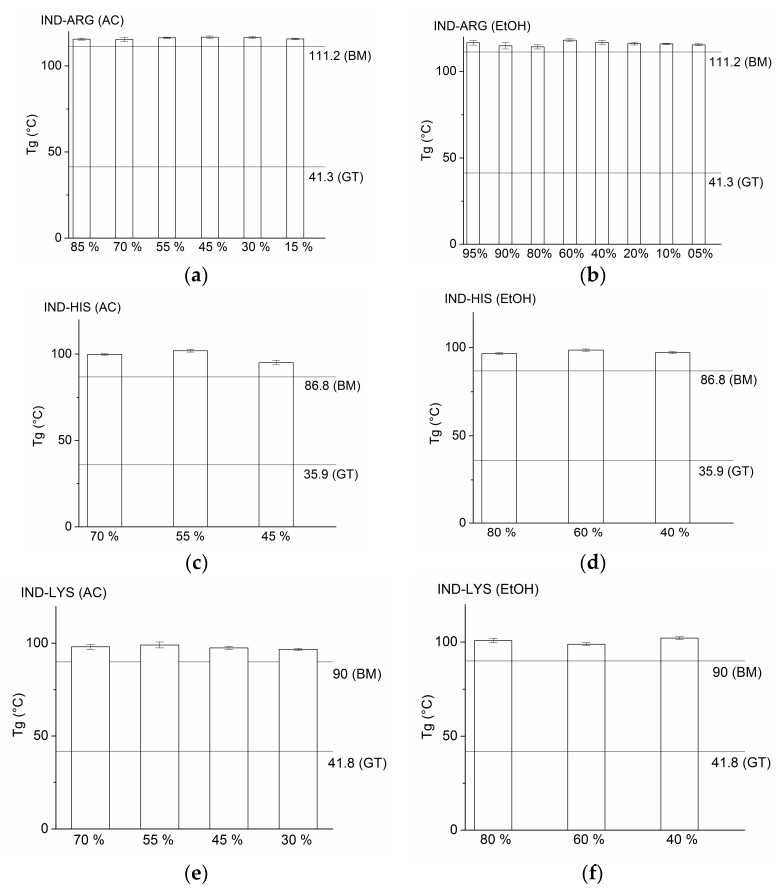
Glass transition temperature (Tg) of indomethacin–arginine (IND–ARG), IND–histidine (IND–HIS), and IND–lysine (IND–LYS) prepared by different preparation methods. The horizontal lines in each graph indicate the Tg measured from ball-milled (BM) samples and theoretical Tg calculated using the Gordon–Taylor equation (GT), respectively. Vertical bars represent Tg values of spray-dried co-amorphous samples where the organic solvent denoted in percentage (%) is acetone (AC) in (a,c,e); and ethanol (EtOH) in (b,d,f).
Figure 4
Figure 4
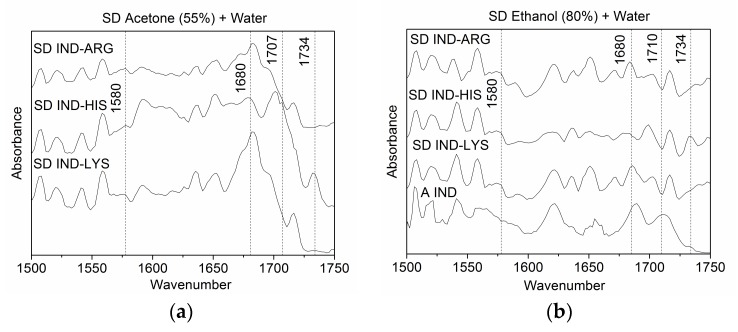
FTIR spectra of co-amorphous indomethacin–arginine (IND–ARG), IND–histidine (HIS), and IND–lysine (LYS) mixtures prepared by spray-drying (SD) with (a) 55% acetone as solvent and (b) 80% ethanol as solvent. For comparison, the FTIR spectrum of amorphous (A) IND is also shown in (b).
Figure 5
Figure 5
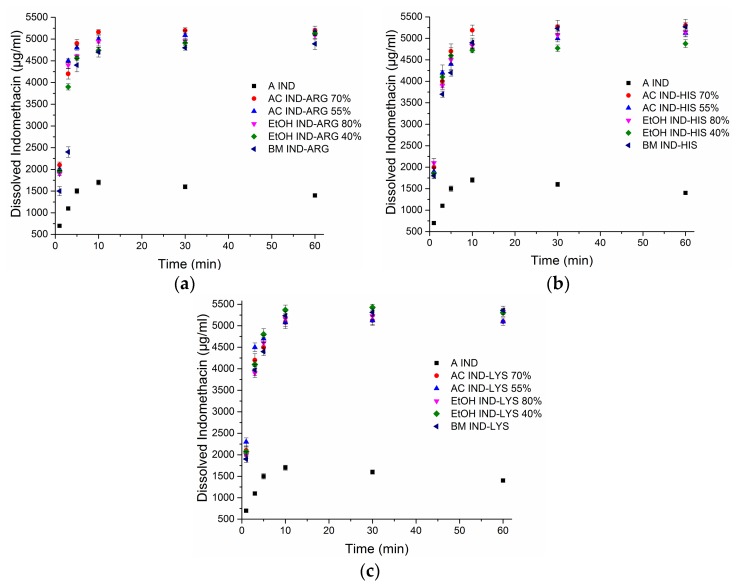
Powder dissolution curves of amorphous (A) indomethacin (IND), spray-dried IND–amino acid mixtures from 70% and 55% acetone (AC) concentration and 80% and 40% ethanol (EtOH) concentration, and ball-milled (BM) IND–amino acid mixtures; for (a) arginine (ARG), (b) histidine (HIS), and (c) lysine (LYS). Saturation solubility of crystalline IND is around 750 µg/mL [26].
Figure 6
Figure 6
Stability studies (XRPD diffractograms of spray-dried samples) of indomethacin–arginine (IND–ARG), IND–histidine (IND–HIS) and IND–lysine (IND–LYS) mixtures after eight months of storage. Organic solvent denoted in percentage (%) is acetone (AC) in (a,c,e); and ethanol (EtOH) in (b,d,f). (c,e,f) include diffractograms of SD IND–HIS with 30% acetone, SD IND–LYS with 70% acetone, and SD IND–LYS with 20% ethanol, respectively. These samples were co-amorphous until storage month seven.

References

    1. Colombo P., Sonvico F., Colombo G., Bettini R. Novel Platforms for Oral Drug Delivery. Pharm. Res. 2009;26:601–611. doi: 10.1007/s11095-008-9803-0. - DOI - PubMed
    1. Perioli L., D’Alba G., Pagano C. New oral solid dosage form for furosemide oral administration. Eur. J. Pharm. Biopharm. 2012;80:621–629. doi: 10.1016/j.ejpb.2011.12.011. - DOI - PubMed
    1. Naseem A., Olliff C.J., Martini L.G., Lloyd A.W. Effects of plasma irradiation on the wettability and dissolution of compacts of griseofulvin. Int. J. Pharm. 2004;269:443–450. doi: 10.1016/j.ijpharm.2003.09.029. - DOI - PubMed
    1. Williams H.D., Trevaskis N.L., Charman S.A., Shanker R.M., Charman W.N. Strategies to Address Low Drug Solubility in Discovery and Development. Pharmacogn. Rev. 2013;65:315–499. doi: 10.1124/pr.112.005660. - DOI - PubMed
    1. Hancock B.C., Zografi G. Characteristics and significance of the amorphous state in pharmaceutical systems. J. Pharm. Sci. 1997;86:1–12. doi: 10.1021/js9601896. - DOI - PubMed