


Age at antiretroviral therapy initiation and cell-associated HIV-1 DNA levels in HIV-1-infected children
- PMID: 29649264
- PMCID: PMC5896970
- DOI: 10.1371/journal.pone.0195514
Age at antiretroviral therapy initiation and cell-associated HIV-1 DNA levels in HIV-1-infected children
Abstract
Background: The latent viral reservoir is the major obstacle to achieving HIV remission and necessitates life-long antiretroviral therapy (ART) for HIV-infected individuals. Studies in adults and children have found that initiating ART soon after infection is associated with a reduction in the size of the HIV-1 reservoir. Here we quantified cell-associated HIV-1 DNA in early-treated but currently older HIV-infected children suppressed on ART.
Methods: The study participants comprised of a cohort of 146 early-treated children with HIV-1 RNA <50 copies/ml enrolled as part of a clinical trial in Johannesburg, South Africa. A stored buffy coat sample collected after a median 4.3 years on ART and where HIV-1 RNA was <50 copies/ml was tested for cell-associated HIV-1 DNA levels. An in-house, semi-nested real-time quantitative hydrolysis probe PCR assay to detect total HIV-1 subtype C proviral DNA was used. Children were followed prospectively for up to 3 years after this measurement to investigate subsequent HIV-1 RNA rebound/failure while remaining on ART. Age at ART initiation, HIV-1 RNA decline prior to HIV-1 DNA measurement and other factors were investigated.
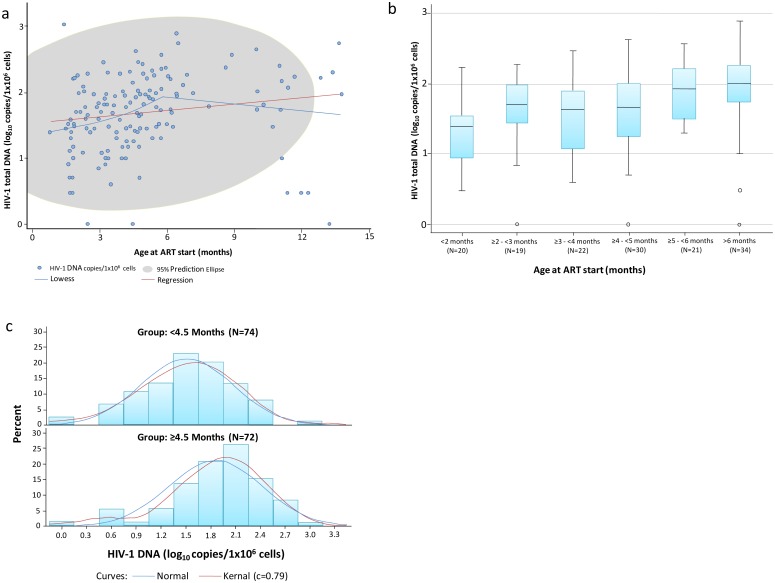
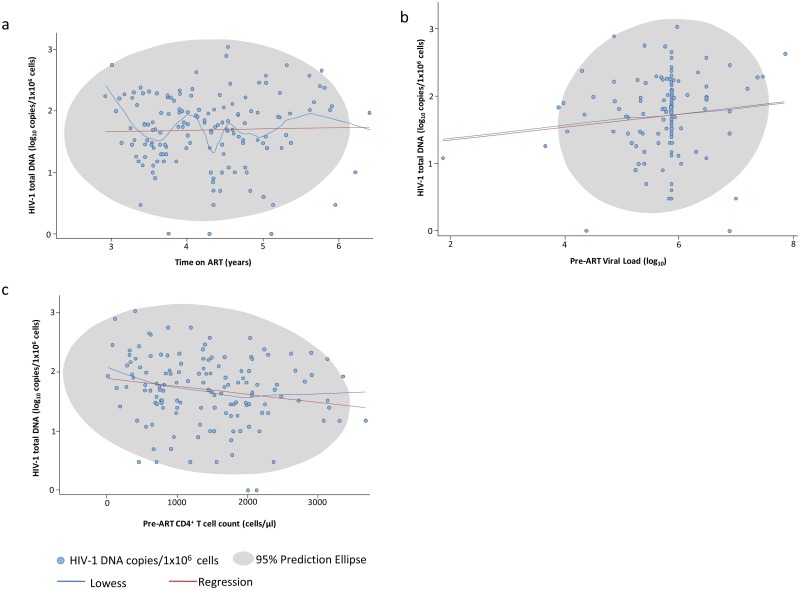
Results: A gradient between age at ART initiation and later HIV-1 DNA levels was observed. When ART was started <2 months of age, the lowest levels of cell-associated HIV-1 DNA (median 1.4 log10copies/106 cells, interquartile range [IQR] 0.95-1.55) were observed compared to ART started at 2-4 months (median 1.68, IQR 1.26-1.97) or 5-14 months of age (median1.98, IQR 1.69-2.25). A low CD4 T-cell count pre-treatment predicted higher levels of HIV-1 DNA on later testing. The probability of HIV-1 RNA rebound >50 copies/ml whilst on ART within 3 years after the DNA measurement was 2.07 (95% CI: 1.352-3.167) times greater if the HIV-1 DNA level was above the median of 55 copies/106 cells.
Conclusions: Cell-associated HIV-1 DNA levels measured after more than 4 years on ART were lower the younger the age of the child when ART was initiated. This marker of the size of the viral reservoir also predicted subsequent viral rebound/treatment failure while ART was sustained. The results provide additional evidence of the benefits of prompt diagnosis and early ART initiation in newborns and infants.
Conflict of interest statement
Figures
References
-
- Ananworanich J, Chomont N, Eller LA, Kroon E, Tovanabutra S, Bose M, et al. HIV DNA Set Point is Rapidly Established in Acute HIV Infection and Dramatically Reduced by Early ART. EBioMedicine. 2016;11:68–72. Epub 2016/07/28. doi: 10.1016/j.ebiom.2016.07.024 - DOI - PMC - PubMed
-
- Laanani M, Ghosn J, Essat A, Melard A, Seng R, Gousset M, et al. Impact of the Timing of Initiation of Antiretroviral Therapy During Primary HIV-1 Infection on the Decay of Cell-Associated HIV-DNA. Clin Infect Dis. 2015;60(11):1715–21. Epub 2015/03/05. doi: 10.1093/cid/civ171 . - DOI - PubMed
-
- Jain V, Hartogensis W, Bacchetti P, Hunt PW, Hatano H, Sinclair E, et al. Antiretroviral therapy initiated within 6 months of HIV infection is associated with lower T-cell activation and smaller HIV reservoir size. J Infect Dis. 2013;208(8):1202–11. Epub 2013/07/16. doi: 10.1093/infdis/jit311 - DOI - PMC - PubMed
-
- Saez-Cirion A, Bacchus C, Hocqueloux L, Avettand-Fenoel V, Girault I, Lecuroux C, et al. Post-treatment HIV-1 controllers with a long-term virological remission after the interruption of early initiated antiretroviral therapy ANRS VISCONTI Study. PLoS pathogens. 2013;9(3):e1003211 doi: 10.1371/journal.ppat.1003211 - DOI - PMC - PubMed
-
- Stohr W, Fidler S, McClure M, Weber J, Cooper D, Ramjee G, et al. Duration of HIV-1 viral suppression on cessation of antiretroviral therapy in primary infection correlates with time on therapy. PLoS One. 2013;8(10):e78287 Epub 2013/11/10. doi: 10.1371/journal.pone.0078287 - DOI - PMC - PubMed
Publication types
MeSH terms
Substances
Grants and funding
LinkOut - more resources
Full Text Sources
Other Literature Sources
Medical
Research Materials
