


Inclusion and exclusion criteria used in non-specific low back pain trials: a review of randomised controlled trials published between 2006 and 2012
- PMID: 29650015
- PMCID: PMC5898037
- DOI: 10.1186/s12891-018-2034-6
Inclusion and exclusion criteria used in non-specific low back pain trials: a review of randomised controlled trials published between 2006 and 2012
Abstract
Background: Low back pain is a common health complaint resulting in substantial economic burden. Each year, upwards of 20 randomised controlled trials (RCTs) evaluating interventions for non-specific low back pain are published. Use of the term non-specific low back pain has been criticised on the grounds of encouraging heterogeneity and hampering interpretation of findings due to possible heterogeneous causes, challenging meta-analyses. We explored selection criteria used in trials of treatments for nsLBP.
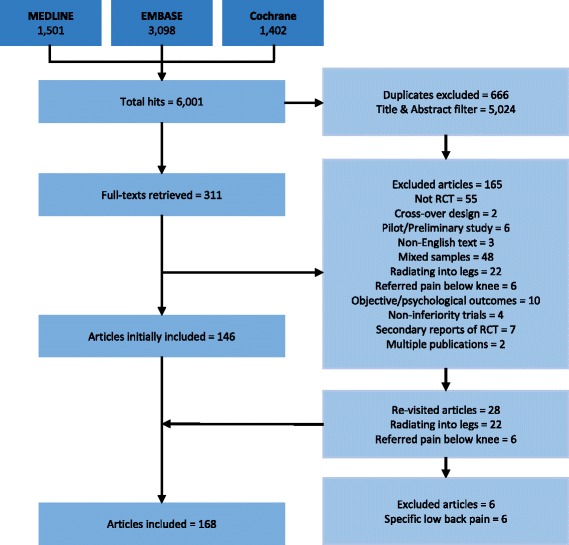
Methods: A systematic review of English-language reports of RCTs in nsLBP population samples, published between 2006 and 2012, identified from MEDLINE, EMBASE, and the Cochrane Library databases, using a mixed-methods approach to analysis. Study inclusion and exclusion criteria were extracted, thematically categorised, and then descriptive statistics were used to summarise the prevalence by emerging category.
Results: We included 168 studies. Two inclusion themes (anatomical area, and symptoms and signs) were identified. Anatomical area was most reported as between costal margins and gluteal folds (n = 8, 5%), while low back pain (n = 150, 89%) with or without referred leg pain (n = 27, 16%) was the most reported symptom. Exclusion criteria comprised 21 themes. Previous or scheduled surgery (n = 84, 50%), pregnancy (n = 81, 48%), malignancy (n = 78, 46%), trauma (n = 63, 37%) and psychological conditions (n = 58, 34%) were the most common. Sub-themes of exclusion criteria mostly related to neurological signs and symptoms: nerve root compromise (n = 44, 26%), neurological signs (n = 34, 20%) or disc herniation (n = 30, 18%). Specific conditions that were most often exclusion criteria were spondylolisthesis (n = 35, 21%), spinal stenosis (n = 31, 18%) or osteoporosis (n = 27, 16%).
Conclusion: RCTs of interventions for non-specific low back pain have incorporated diverse inclusion and exclusion criteria. Guidance on standardisation of inclusion and exclusion criteria for nsLBP trials will increase clinical homogeneity, facilitating greater interpretation of between-trial comparisons and meta-analyses. We propose a template for reporting inclusion and exclusion criteria.
Keywords: Definitions; Exclusion criteria; Inclusion criteria; Low back pain; Non-specific; Systematic review.
Conflict of interest statement
Ethics approval and consent to participate
Not applicable.
Competing interests
PA, TB, PB, DR, DE, RB, and SE declare that they have no competing interests. MU is co-author on multiple trials of treatments for nsLBP some of which are included in this review. He has received multiple research grants from NIHR and ARUK as chief or co-investigator, he is an editor for NIHR journal series for which he receives a fee. MU and RF are directors and shareholders of Clinvivo Ltd., a University of Warwick spin-out company.
Publisher’s Note
Springer Nature remains neutral with regard to jurisdictional claims in published maps and institutional affiliations.
Figures

References
-
- Murray CJ, Vos T, Lozano R, Naghavi M, Flaxman AD, Michaud C, et al. Disability-adjusted life years (DALYs) for 291 diseases and injuries in 21 regions, 1990-2010: a systematic analysis for the global burden of disease study 2010. Lancet. 2012;380(9859):2197–2223. doi: 10.1016/S0140-6736(12)61689-4. - DOI - PubMed
-
- DALYs GBD, Collaborators H, Murray CJ, Barber RM, Foreman KJ, Abbasoglu Ozgoren A, et al. Global, regional, and national disability-adjusted life years (DALYs) for 306 diseases and injuries and healthy life expectancy (HALE) for 188 countries, 1990-2013: quantifying the epidemiological transition. Lancet. 2015;386(10009):2145–2191. doi: 10.1016/S0140-6736(15)61340-X. - DOI - PMC - PubMed
Publication types
MeSH terms
LinkOut - more resources
Full Text Sources
Other Literature Sources
Medical
