. 2018 Apr 12;9(1):1439.
doi: 10.1038/s41467-018-03784-x.

Multicomponent reactions provide key molecules for secret communication

Affiliations

Multicomponent reactions provide key molecules for secret communication

Andreas C Boukis et al. Nat Commun. .

Abstract

A convenient and inherently more secure communication channel for encoding messages via specifically designed molecular keys is introduced by combining advanced encryption standard cryptography with molecular steganography. The necessary molecular keys require large structural diversity, thus suggesting the application of multicomponent reactions. Herein, the Ugi four-component reaction of perfluorinated acids is utilized to establish an exemplary database consisting of 130 commercially available components. Considering all permutations, this combinatorial approach can unambiguously provide 500,000 molecular keys in only one synthetic procedure per key. The molecular keys are transferred nondigitally and concealed by either adsorption onto paper, coffee, tea or sugar as well as by dissolution in a perfume or in blood. Re-isolation and purification from these disguises is simplified by the perfluorinated sidechains of the molecular keys. High resolution tandem mass spectrometry can unequivocally determine the molecular structure and thus the identity of the key for a subsequent decryption of an encoded message.


Conflict of interest statement

The authors declare no competing interests.

Figures
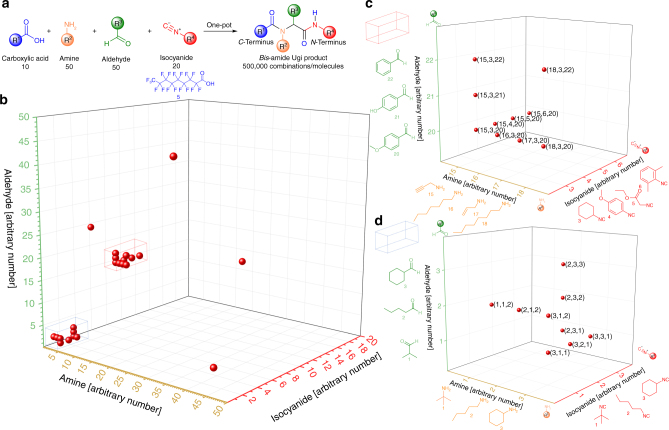
Fig. 1
Fig. 1
Molecular keys. a Schematic representation of the Ugi reaction. The combinatorial scope of components considered in the exemplary list of components involves 500,000 molecules. b 3D plot of a set of molecules synthesized with perfluorononaic acid (shorter and longer acids were also evaluated). The axes represent different functional groups. The numbers on the axes represent different components (i.e., sidechains). c, d Expansions of the two systematic variations highlighted by the red and blue box in b, respectively
Fig. 2
Fig. 2
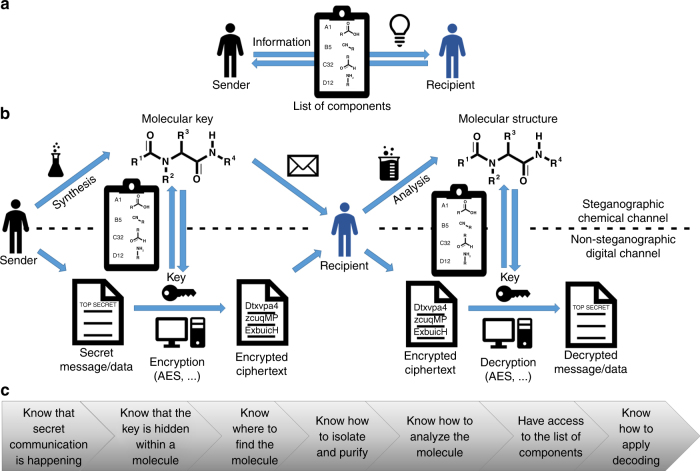
Steganographic key distribution. a The sender and recipient discuss details about their secret communication and exchange the list of components (assigns chemical information to alphanumerical symbols). b from left to right: The sender synthesizes one or several molecular keys and determines the alphanumeric code associated with the chemical structures according to the list of components. The alphanumeric code, e.g., A(001)-B(012)-C(007)-D(007) is serving as encryption key. The molecular key is concealed and transferred to the recipient via a steganographic channel. The recipient isolates the key and elucidates the molecular structure for decryption. c Levels of security and knowledge an adversary needs for decrypting the message
Fig. 3
Fig. 3
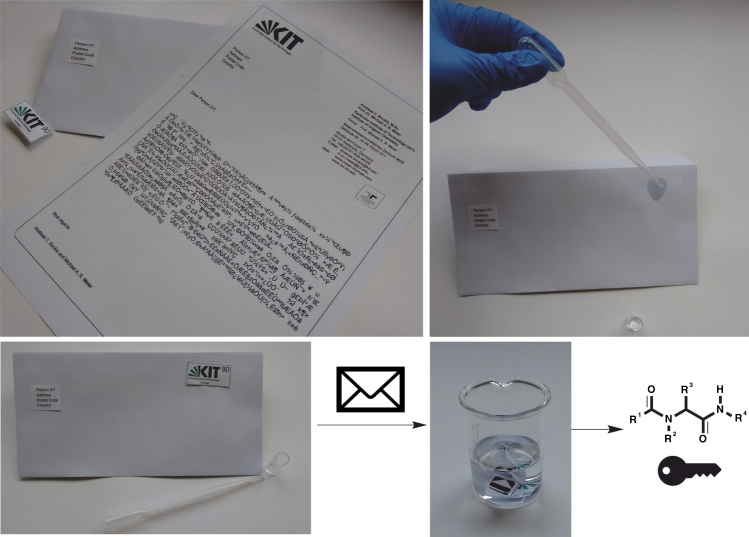
Transportation and extraction of the molecular key. The encrypted message is exemplarily transferred in form of a letter. The molecular key is dissolved and placed in the top right corner of the envelope and afterwards covered with a stamp. After the letter has been sent and received, the molecular key is extracted with a solvent and purified by F-SPE to subsequently analyze the molecule and encrypt the message. Additional images are included in Supplementary Figure 3
Fig. 4
Fig. 4
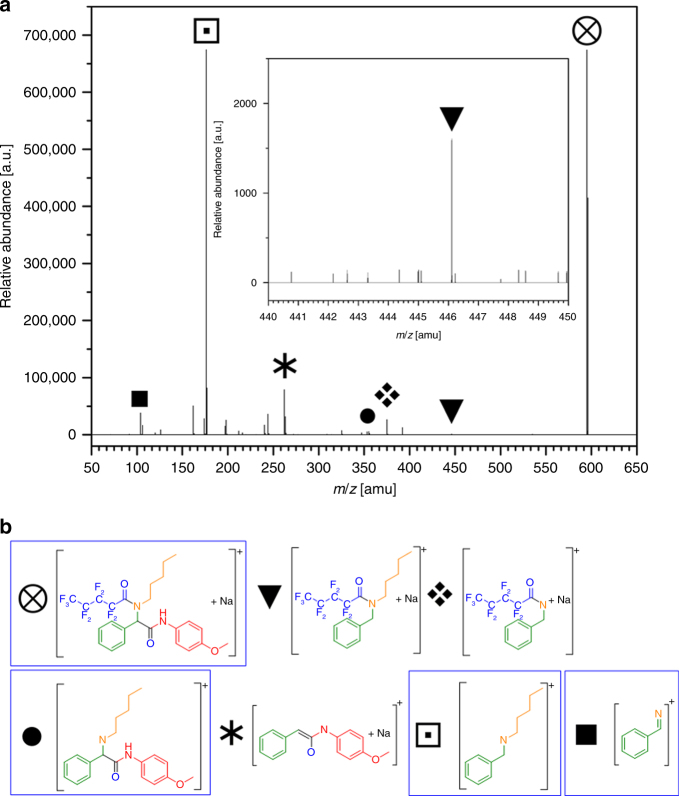
Readout of molecular keys via tandem-MS. a exemplary ESI-MS/MS spectrum. b Proposed fragment assignment. The monoisotopic mass of the intact molecule (circle containing cross) is the first information that significantly reduces the number of possibilities. Additionally, three fragments are necessary to unambiguously determine the combination of components. The three fragments marked in the blue frame (black circle, white square containing black square, and black square) are utilized in the computer analysis script (Supplementary Software 1) for assisted readout. The other fragments (black inverted triangle, diamond cluster, and asterisk) further confirm the structure, but are not essential for a successful readout
Fig. 5
Fig. 5
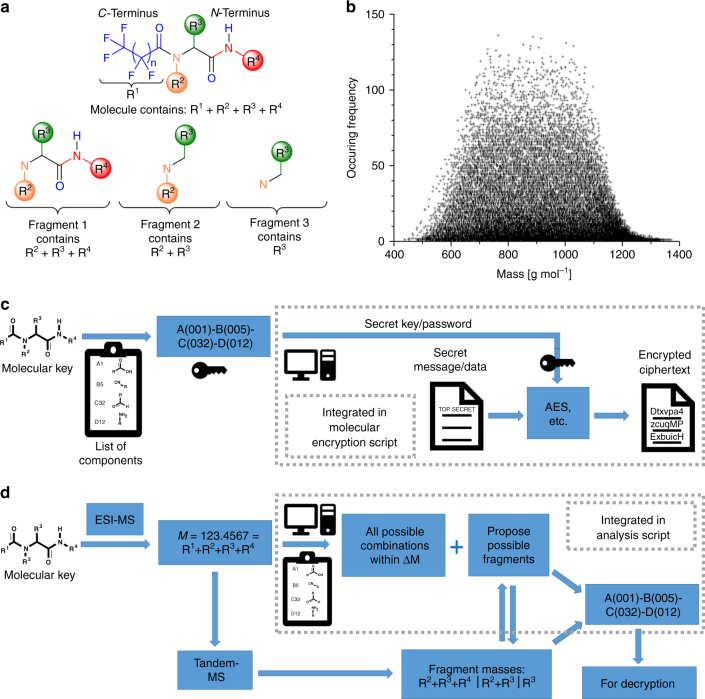
Cryptography integration of molecular keys. a Schematic representation of fragments, which can be used for the read out. Four masses are used for determining the sidechains R1–4. b Database evaluation of the most probable masses occurring within a ΔM threshold of 0.01 Da. The possibilities are reduced from 500,000 to a maximum of 140 after entering the monoisotopic mass. c Schematic illustration of molecular encryption. Supplementary Software 2. d Schematic illustration of analysis script. Supplementary Software 1. A function explanation is included in the methods section.

References

    1. Sarkar T, Selvakumar K, Motiei L, Margulies D. Message in a molecule. Nat. Commun. 2016;7:11374. doi: 10.1038/ncomms11374. - DOI - PMC - PubMed
    1. Challita K, Farhat H. Combining steganography and cryptography: new directions. Int. J. New Comput. Archit. Their Appl. 2011;1:199–208.
    1. Raphael AJ, Sundaram V. Cryptography and steganography—a survey. Int. J. Comput. Technol. Appl. 2011;2:626–630.
    1. Dooley JF. Review of prisoners, lovers, & spies by Kristie Macrakis. Cryptologia. 2016;40:107–112. doi: 10.1080/01611194.2015.1028684. - DOI
    1. Sun H, et al. Smart responsive phosphorescent materials for data recording and security protection. Nat. Commun. 2014;5:3601. - PubMed

Publication types