


Multicomponent reactions provide key molecules for secret communication
- PMID: 29651145
- PMCID: PMC5897361
- DOI: 10.1038/s41467-018-03784-x
Multicomponent reactions provide key molecules for secret communication
Abstract
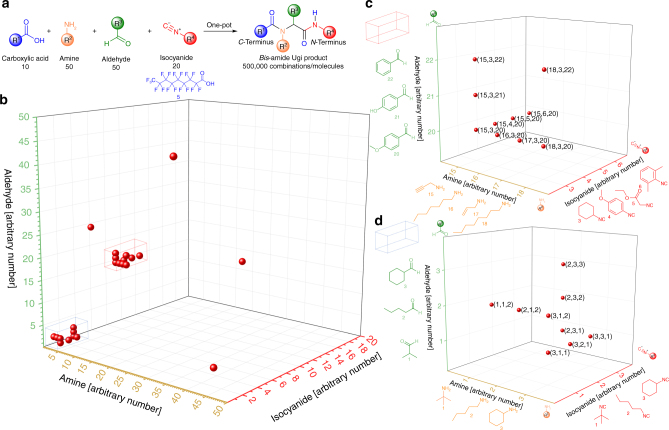
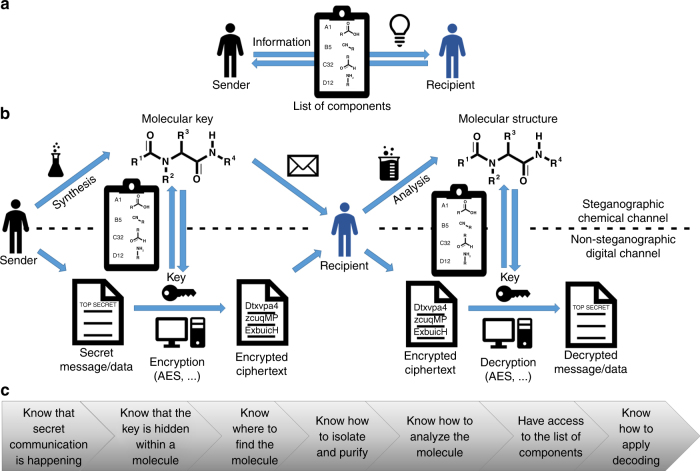
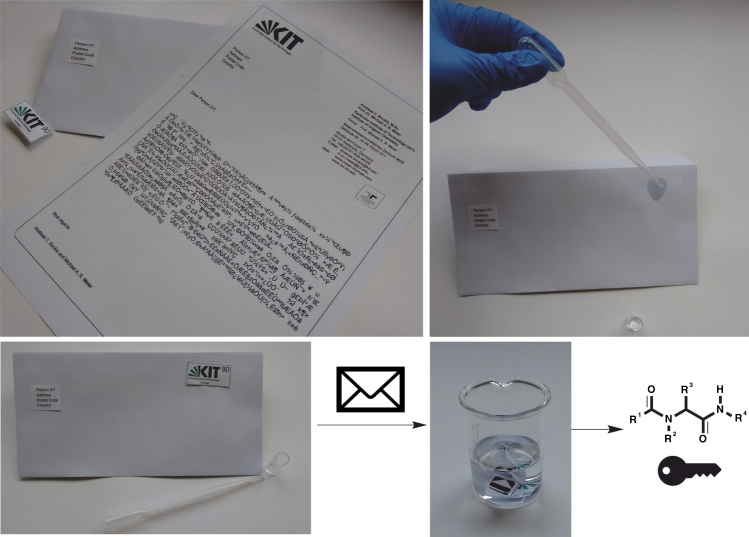
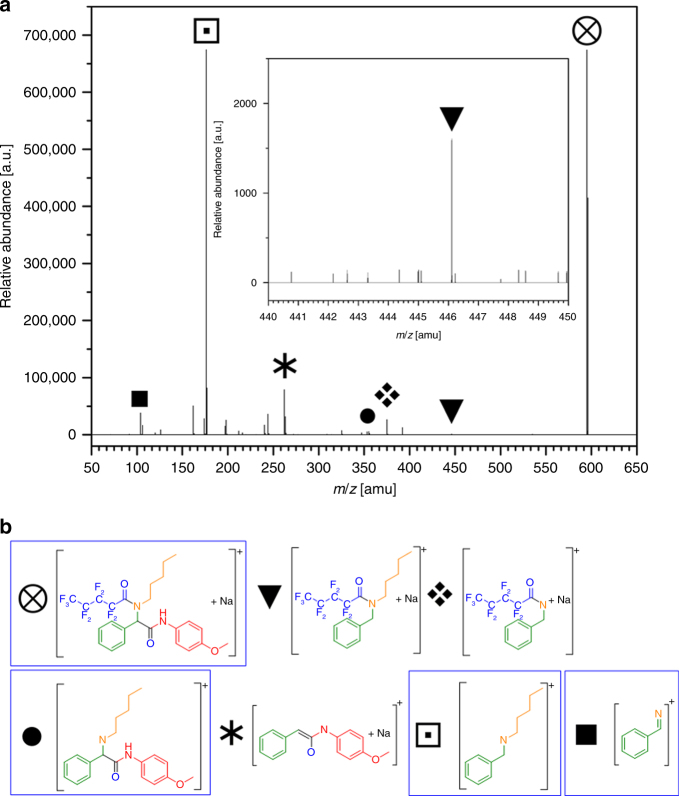
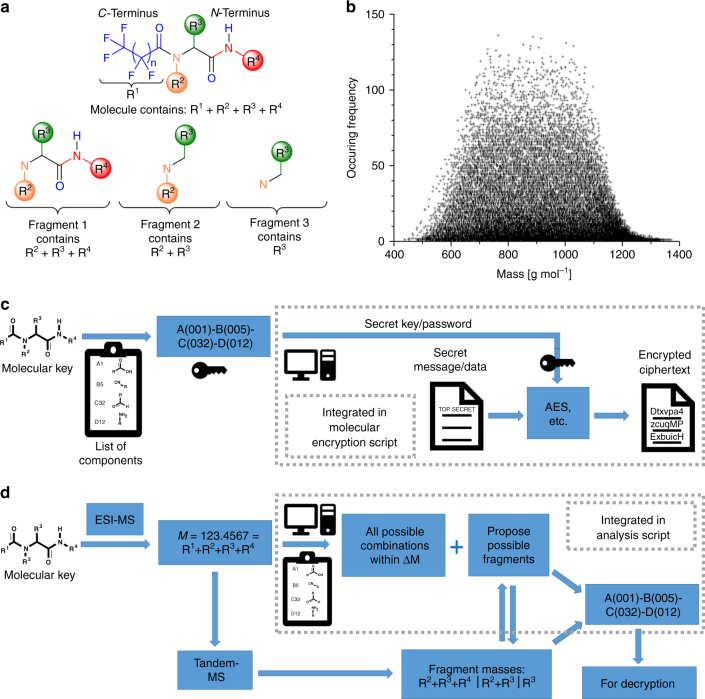
A convenient and inherently more secure communication channel for encoding messages via specifically designed molecular keys is introduced by combining advanced encryption standard cryptography with molecular steganography. The necessary molecular keys require large structural diversity, thus suggesting the application of multicomponent reactions. Herein, the Ugi four-component reaction of perfluorinated acids is utilized to establish an exemplary database consisting of 130 commercially available components. Considering all permutations, this combinatorial approach can unambiguously provide 500,000 molecular keys in only one synthetic procedure per key. The molecular keys are transferred nondigitally and concealed by either adsorption onto paper, coffee, tea or sugar as well as by dissolution in a perfume or in blood. Re-isolation and purification from these disguises is simplified by the perfluorinated sidechains of the molecular keys. High resolution tandem mass spectrometry can unequivocally determine the molecular structure and thus the identity of the key for a subsequent decryption of an encoded message.
Conflict of interest statement
The authors declare no competing interests.
Figures
References
-
- Challita K, Farhat H. Combining steganography and cryptography: new directions. Int. J. New Comput. Archit. Their Appl. 2011;1:199–208.
-
- Raphael AJ, Sundaram V. Cryptography and steganography—a survey. Int. J. Comput. Technol. Appl. 2011;2:626–630.
-
- Dooley JF. Review of prisoners, lovers, & spies by Kristie Macrakis. Cryptologia. 2016;40:107–112. doi: 10.1080/01611194.2015.1028684. - DOI
-
- Sun H, et al. Smart responsive phosphorescent materials for data recording and security protection. Nat. Commun. 2014;5:3601. - PubMed
Publication types
LinkOut - more resources
Full Text Sources
Other Literature Sources
