


Limited immune surveillance in lymphoid tissue by cytolytic CD4+ T cells during health and HIV disease
- PMID: 29652923
- PMCID: PMC5919077
- DOI: 10.1371/journal.ppat.1006973
Limited immune surveillance in lymphoid tissue by cytolytic CD4+ T cells during health and HIV disease
Retraction in
-
Retraction: Limited immune surveillance in lymphoid tissue by cytolytic CD4+ T cells during health and HIV disease.PLoS Pathog. 2025 Aug 27;21(8):e1013442. doi: 10.1371/journal.ppat.1013442. eCollection 2025 Aug. PLoS Pathog. 2025. PMID: 40864632 Free PMC article. No abstract available.
Abstract
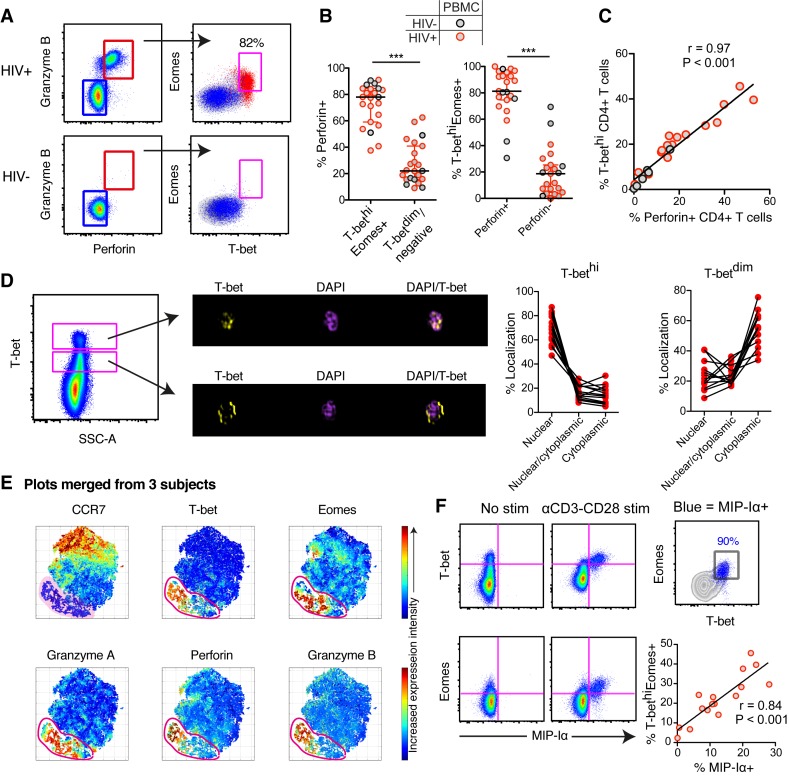
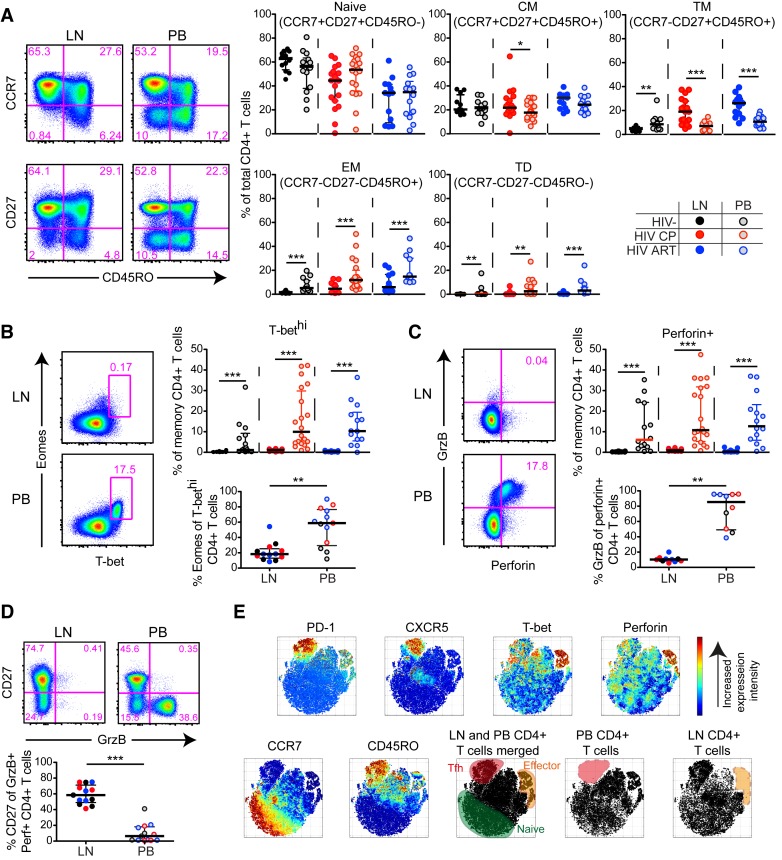
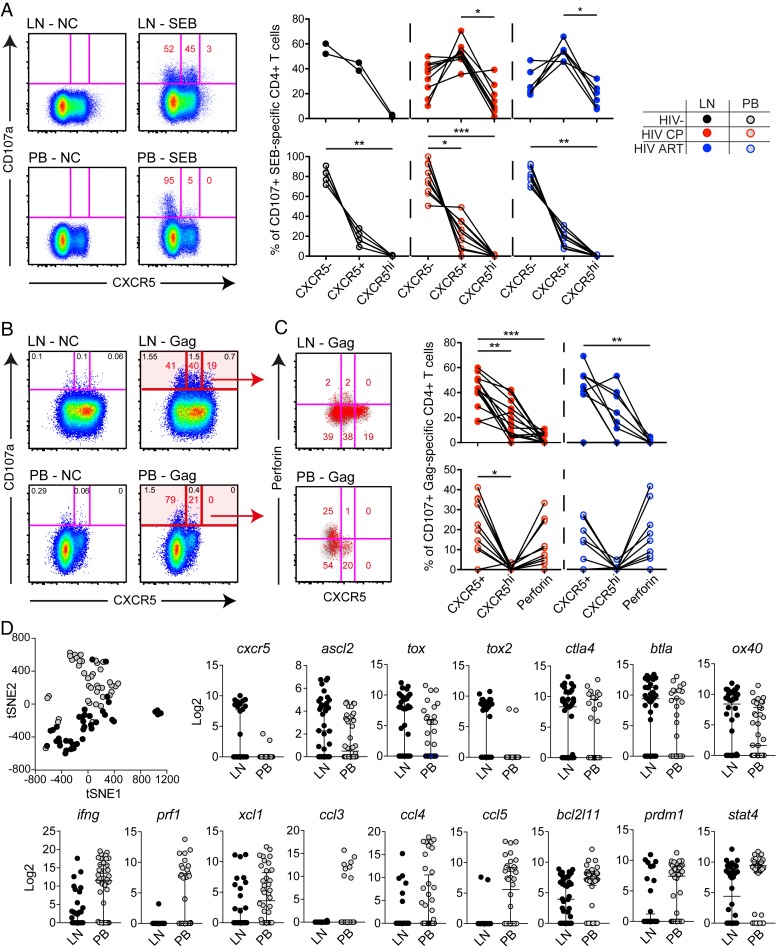
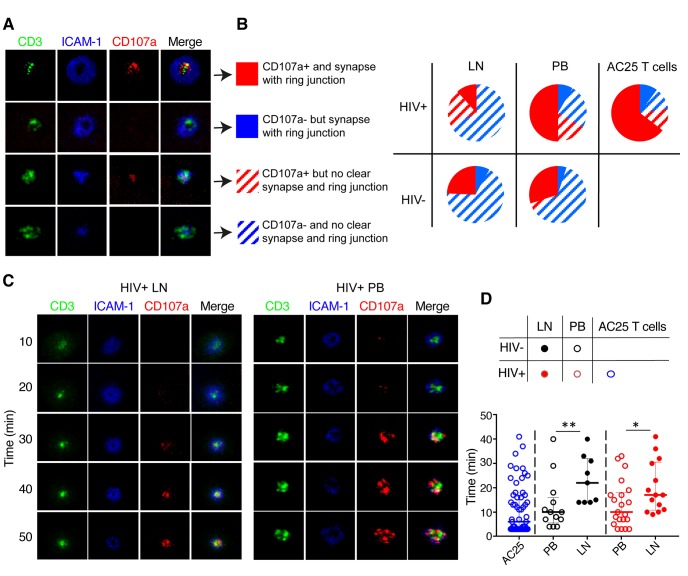
CD4+ T cells subsets have a wide range of important helper and regulatory functions in the immune system. Several studies have specifically suggested that circulating effector CD4+ T cells may play a direct role in control of HIV replication through cytolytic activity or autocrine β-chemokine production. However, it remains unclear whether effector CD4+ T cells expressing cytolytic molecules and β-chemokines are present within lymph nodes (LNs), a major site of HIV replication. Here, we report that expression of β-chemokines and cytolytic molecules are enriched within a CD4+ T cell population with high levels of the T-box transcription factors T-bet and eomesodermin (Eomes). This effector population is predominately found in peripheral blood and is limited in LNs regardless of HIV infection or treatment status. As a result, CD4+ T cells generally lack effector functions in LNs, including cytolytic capacity and IFNγ and β-chemokine expression, even in HIV elite controllers and during acute/early HIV infection. While we do find the presence of degranulating CD4+ T cells in LNs, these cells do not bear functional or transcriptional effector T cell properties and are inherently poor to form stable immunological synapses compared to their peripheral blood counterparts. We demonstrate that CD4+ T cell cytolytic function, phenotype, and programming in the peripheral blood is dissociated from those characteristics found in lymphoid tissues. Together, these data challenge our current models based on blood and suggest spatially and temporally dissociated mechanisms of viral control in lymphoid tissues.
Conflict of interest statement
The authors have declared that no competing interests exist.
Figures



References
-
- Cheroutre H, Husain MM. CD4 CTL: living up to the challenge. Semin Immunol. 2013;25(4):273–81. doi: 10.1016/j.smim.2013.10.022 ; PubMed Central PMCID: PMCPMC3886800. - DOI - PMC - PubMed
-
- Brown DM. Cytolytic CD4 cells: Direct mediators in infectious disease and malignancy. Cell Immunol. 2010;262(2):89–95. doi: 10.1016/j.cellimm.2010.02.008 ; PubMed Central PMCID: PMCPMC2874968. - DOI - PMC - PubMed
-
- Buggert M, Norstrom MM, Czarnecki C, Tupin E, Luo M, Gyllensten K, et al. Characterization of HIV-specific CD4+ T cell responses against peptides selected with broad population and pathogen coverage. PloS one. 2012;7(7):e39874 Epub 2012/07/14. doi: 10.1371/journal.pone.0039874 ; PubMed Central PMCID: PMC3390319. - DOI - PMC - PubMed
-
- Ferre AL, Hunt PW, McConnell DH, Morris MM, Garcia JC, Pollard RB, et al. HIV controllers with HLA-DRB1*13 and HLA-DQB1*06 alleles have strong, polyfunctional mucosal CD4+ T-cell responses. J Virol. 2010;84(21):11020–9. doi: 10.1128/JVI.00980-10 ; PubMed Central PMCID: PMCPMC2953185. - DOI - PMC - PubMed
-
- Kaufmann DE, Bailey PM, Sidney J, Wagner B, Norris PJ, Johnston MN, et al. Comprehensive analysis of human immunodeficiency virus type 1-specific CD4 responses reveals marked immunodominance of gag and nef and the presence of broadly recognized peptides. J Virol. 2004;78(9):4463–77. Epub 2004/04/14. doi: 10.1128/JVI.78.9.4463-4477.2004 ; PubMed Central PMCID: PMC387674. - DOI - PMC - PubMed
Publication types
MeSH terms
Grants and funding
- UM1 AI126620/AI/NIAID NIH HHS/United States
- AI126620 /NH/NIH HHS/United States
- AI106481 /NH/NIH HHS/United States
- R01 AI108972/AI/NIAID NIH HHS/United States
- AI118694 /NH/NIH HHS/United States
- R01 AI118694/AI/NIAID NIH HHS/United States
- P30 AI045008/AI/NIAID NIH HHS/United States
- R56 AI106481/AI/NIAID NIH HHS/United States
- A127966 /NH/NIH HHS/United States
- P30 AI027763/AI/NIAID NIH HHS/United States
- R01 AI076066/AI/NIAID NIH HHS/United States
- AI076066 /NH/NIH HHS/United States
- U19 AI096109/AI/NIAID NIH HHS/United States
- P30 AI027763 /NH/NIH HHS/United States
- AI096109 /NH/NIH HHS/United States
- P30 AI036219/AI/NIAID NIH HHS/United States
LinkOut - more resources
Full Text Sources
Other Literature Sources
Medical
Research Materials
