


Validation of the Narrowing Beam Walking Test in Lower Limb Prosthesis Users
- PMID: 29653108
- PMCID: PMC6064384
- DOI: 10.1016/j.apmr.2018.03.012
Validation of the Narrowing Beam Walking Test in Lower Limb Prosthesis Users
Abstract
Objective: To evaluate the content, construct, and discriminant validity of the Narrowing Beam Walking Test (NBWT), a performance-based balance test for lower limb prosthesis users.
Design: Cross-sectional study.
Setting: Research laboratory and prosthetics clinic.
Participants: Unilateral transtibial and transfemoral prosthesis users (N=40).
Interventions: Not applicable.
Main outcome measures: Content validity was examined by quantifying the percentage of participants receiving maximum or minimum scores (ie, ceiling and floor effects). Convergent construct validity was examined using correlations between participants' NBWT scores and scores or times on existing clinical balance tests regularly administered to lower limb prosthesis users. Known-groups construct validity was examined by comparing NBWT scores between groups of participants with different fall histories, amputation levels, amputation etiologies, and functional levels. Discriminant validity was evaluated by analyzing the area under each test's receiver operating characteristic (ROC) curve.
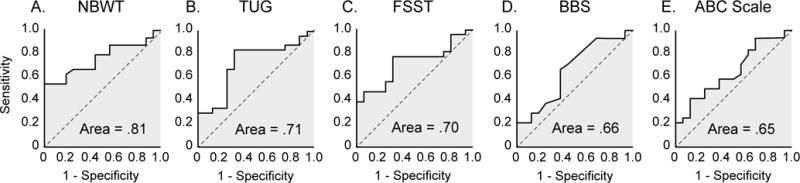
Results: No minimum or maximum scores were recorded on the NBWT. NBWT scores demonstrated strong correlations (ρ=.70‒.85) with scores/times on performance-based balance tests (timed Up and Go test, Four Square Step Test, and Berg Balance Scale) and a moderate correlation (ρ=.49) with the self-report Activities-specific Balance Confidence scale. NBWT performance was significantly lower among participants with a history of falls (P=.003), transfemoral amputation (P=.011), and a lower mobility level (P<.001). The NBWT also had the largest area under the ROC curve (.81) and was the only test to exhibit an area that was statistically significantly >.50 (ie, chance).
Conclusions: The results provide strong evidence of content, construct, and discriminant validity for the NBWT as a performance-based test of balance ability. The evidence supports its use to assess balance impairments and fall risk in unilateral transtibial and transfemoral prosthesis users.
Keywords: Accidental falls; Amputees; Patient outcome assessment; Postural balance; Rehabilitation.
Copyright © 2018 American Congress of Rehabilitation Medicine. Published by Elsevier Inc. All rights reserved.
Conflict of interest statement
The authors declare that there is no conflict of interest.
Figures


References
-
- Pauley T, Devlin M, Heslin K. Falls sustained during inpatient rehabilitation after lower limb amputation: prevalence and predictors. Am J Phys Med Rehabil. 2006;85:521–32. - PubMed
-
- Jayakaran P, Johnson GM, Sullivan SJ, Nitz JC. Instrumented measurement of balance and postural control in individuals with lower limb amputation. Int J Rehabil Res. 2012;35:187–96. - PubMed
-
- Miller WC, Speechley M, Deathe B. The prevalence and risk factors of falling and fear of falling among lower extremity amputees. Arch Phys Med Rehabil. 2001;82:1031–7. - PubMed
-
- Gauthier-Gagnon C, Grise MC, Potvin D. Enabling factors related to prosthetic use by people with transtibial and transfemoral amputation. Arch Phys Med Rehabil. 1999;80:706–13. - PubMed
-
- Wong CK, Chen CC, Blackwell WM, Rahal RT, Benoy SA. Balance ability measured with the Berg balance scale: a determinant of fall history in community-dwelling adults with leg amputation. J Rehabil Med. 2015;47:80–6. - PubMed
Publication types
MeSH terms
Grants and funding
LinkOut - more resources
Full Text Sources
Other Literature Sources
Medical
