


Interactions between risk factors in the prediction of onset of eating disorders: Exploratory hypothesis generating analyses
- PMID: 29653254
- PMCID: PMC5929474
- DOI: 10.1016/j.brat.2018.03.005
Interactions between risk factors in the prediction of onset of eating disorders: Exploratory hypothesis generating analyses
Abstract
Objective: Because no study has tested for interactions between risk factors in the prediction of future onset of each eating disorder, this exploratory study addressed this lacuna to generate hypotheses to be tested in future confirmatory studies.
Method: Data from three prevention trials that targeted young women at high risk for eating disorders due to body dissatisfaction (N = 1271; M age 18.5, SD 4.2) and collected diagnostic interview data over 3-year follow-up were combined to permit sufficient power to predict onset of anorexia nervosa (AN), bulimia nervosa (BN), binge eating disorder (BED), and purging disorder (PD) using classification tree analyses, an analytic technique uniquely suited to detecting interactions.
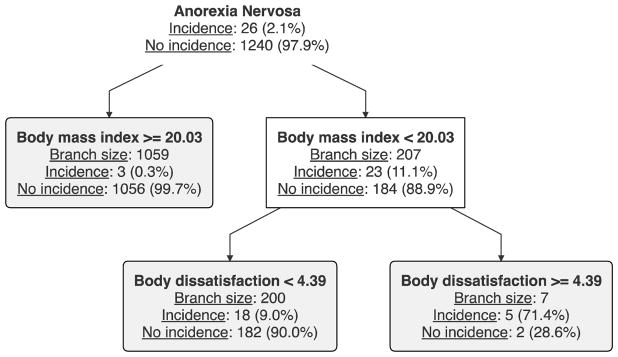
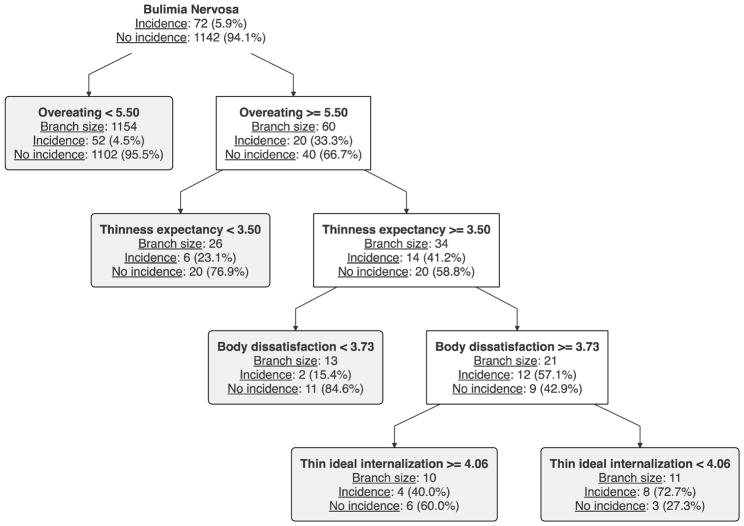
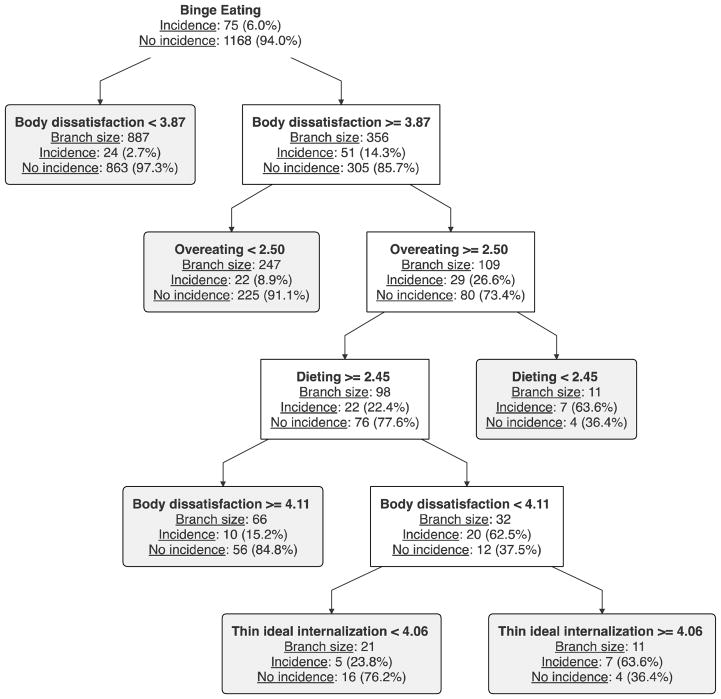
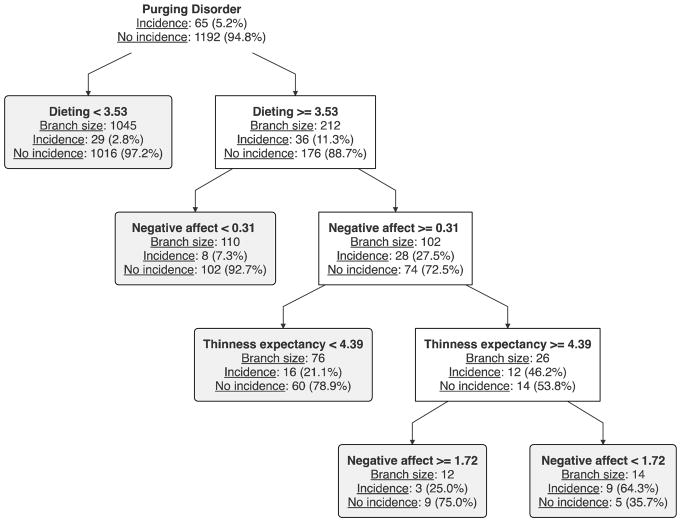
Results: Low BMI was the most potent predictor of AN onset, and body dissatisfaction amplified this relation. Overeating was the most potent predictor of BN onset, and positive expectancies for thinness and body dissatisfaction amplified this relation. Body dissatisfaction was the most potent predictor of BED onset, and overeating, low dieting, and thin-ideal internalization amplified this relation. Dieting was the most potent predictor of PD onset, and negative affect and positive expectancies for thinness amplified this relation.
Conclusions: Results provided evidence of amplifying interactions between risk factors suggestive of cumulative risk processes that were distinct for each disorder; future confirmatory studies should test the interactive hypotheses generated by these analyses. If hypotheses are confirmed, results may allow interventionists to target ultra high-risk subpopulations with more intensive prevention programs that are uniquely tailored for each eating disorder, potentially improving the yield of prevention efforts.
Keywords: Anorexia nervosa; Binge eating disorder; Bulimia nervosa; Interactions; Prospective; Purging disorder; Risk factors.
Copyright © 2018 Elsevier Ltd. All rights reserved.
Figures
References
-
- Allen K, Byrne S, Oddy H, Crosby R. Eating Disorders in Adolescents: Prevalence, Stability, and Psychosocial Correlates in a Population-Based Sample of Male and Female Adolescents. Journal of Abnormal Psychology. 2013;122:720–32. - PubMed
-
- Andrews JA, Lewinsohn PM, Hops H. Psychometric properties of scales for the measurement of psychosocial variables associated with depression in adolescence. Psychological Reports. 1993;73:1019–1046. - PubMed
-
- Arcelus J, Mitchell A, Wales J, Nielsen S. Mortality rates in patients with anorexia nervosa and other eating disorders: A meta-analysis of 36 studies. JAMA Psychiatry. 2011;68:724–731. - PubMed
-
- Beck AT, Steer RM, Garbin M. Psychometric properties of the Beck Depression Inventory: 25 years of evaluation. Clinical Psychology Review. 1988;8:77–100.
-
- Berg P, Thompson JK, Obremski-Brandon K, Coovert M. The tripartite influence model of body image and eating disturbance: A covariance structure modeling investigation testing the meditational role of appearance comparison. Journal of Psychosomatic Research. 2002;53:1007–1020. - PubMed
Publication types
MeSH terms
Grants and funding
LinkOut - more resources
Full Text Sources
Other Literature Sources
Medical
