


Review
doi: 10.1016/j.drudis.2018.04.003.
Epub 2018 Apr 10.
Design strategies for physical-stimuli-responsive programmable nanotherapeutics
Affiliations
- PMID: 29653291
- PMCID: PMC6195679
- DOI: 10.1016/j.drudis.2018.04.003
Item in Clipboard
Review
Design strategies for physical-stimuli-responsive programmable nanotherapeutics
Drug Discov Today.
2018 May.
Abstract
Nanomaterials that respond to externally applied physical stimuli such as temperature, light, ultrasound, magnetic field and electric field have shown great potential for controlled and targeted delivery of therapeutic agents. However, the body of literature on programming these stimuli-responsive nanomaterials to attain the desired level of pharmacologic responses is still fragmented and has not been systematically reviewed. The purpose of this review is to summarize and synthesize the literature on various design strategies for simple and sophisticated programmable physical-stimuli-responsive nanotherapeutics.
Copyright © 2018. Published by Elsevier Ltd.
Figures
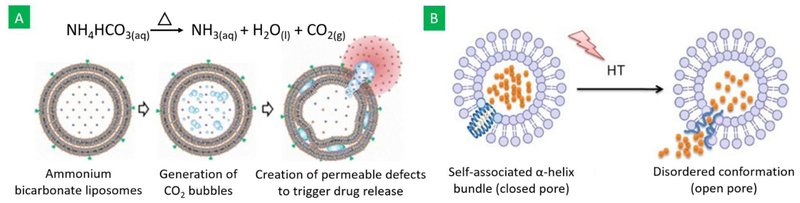
Schematic representation of (A) thermoresponsive bubble-generating liposomes, designed by adding bubble generating agents, and (B) liposome-peptide hybrid thermoresponsive vesicles, designed by adding a thermoresponsive amphiphilic leucine zipper peptide, into thermoresponsive liposomes and their response to hyperthermia (HT) (Figures obtained from references [69] and [71]).
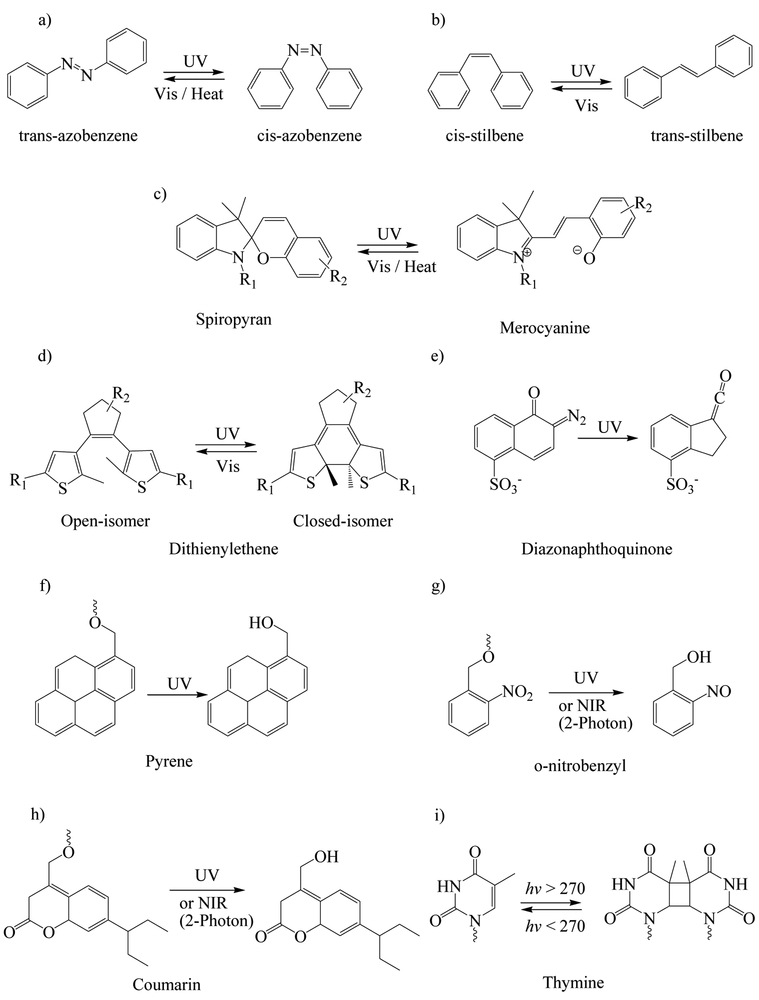
Commonly used photosensitive (a-e) and photocleavable (f-i) compounds/functionalities used for the preparation of light-responsive nanomaterials and their reaction to light.
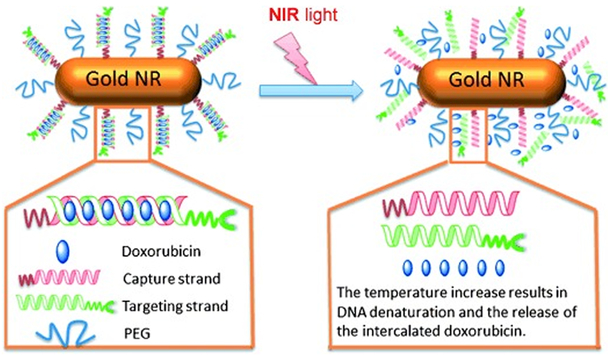
Doxorubicin loaded and folic acid modified DNA nanoaggregates that are attached to gold nanorods (gold NR) to form NIR-responsive nanotherapeutics. Upon NIR exposure, the gold NR generate heat that dehybridizes the DNA aggregates and releases the loaded doxorubicin (Figure taken from reference [85]).
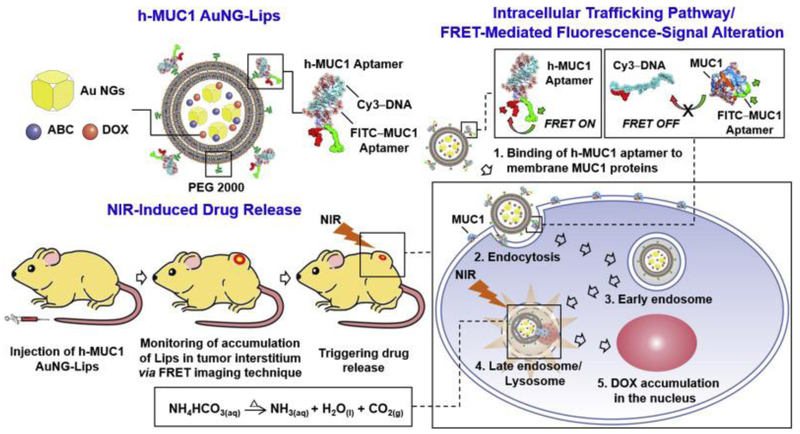
Selective endocytosis of Mucin-1 aptamer and PEG 2000 modified and gold nanocages (AuNG), ammonium bicarbonate (ABC), and doxorubicin (Dox), loaded bubble-generating thermoresponsive liposomes (Lips) by cancerous cells. Upon NIR exposure, the AuNGs convert the NIR to heat, which heats the ABC and generates bubble that disrupts the liposome to releases the Dox at the target site (Figure taken from reference [98]).
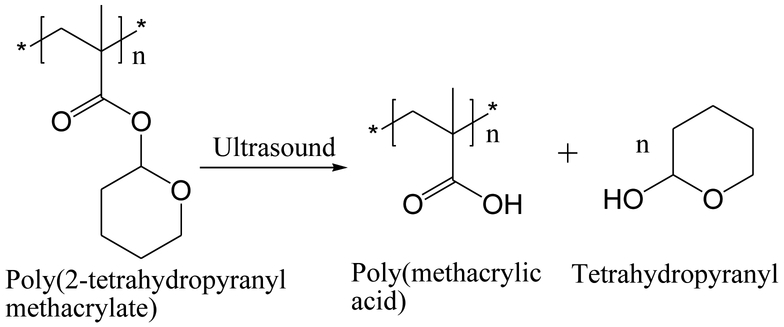
Cleavage of 2-hydroxytetrahydropyranyl group to from poly(2-tetrahydropyranyl methacrylate) by the action of ultrasound.
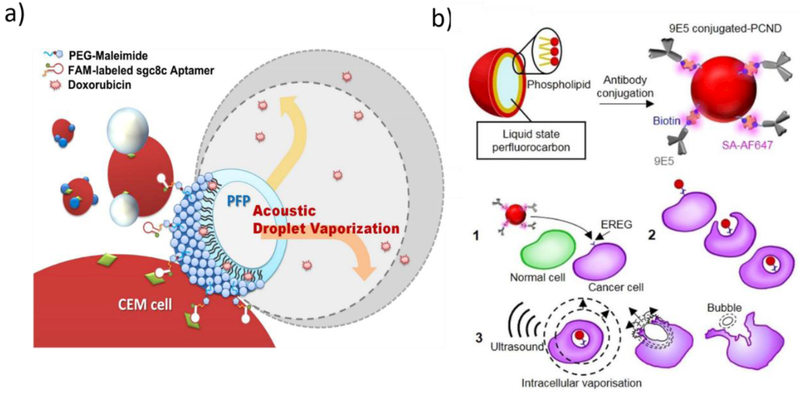
(a) aptamer- and (b) antibody-conjugated ultrasound-responsive nanodroplets designed for tumor targeted therapy and their interaction with cancerous cells and subseqent degradation by ultrasound (Figures taken from references [109] and [110], respectively).
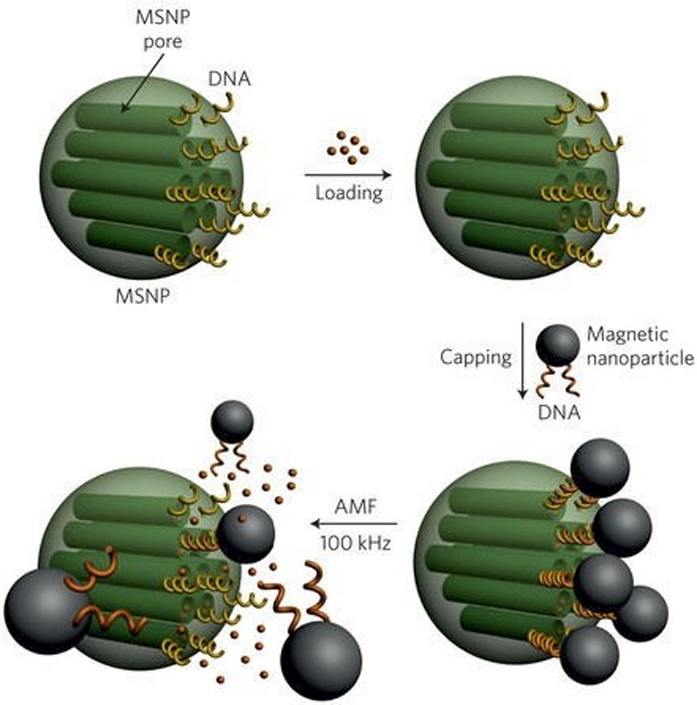
DNA modified drug loaded mesoporous silica nanoparticles (MSNP) that are hybridized with magnetic nanoparticles as gatekeepers. Upon exposure to alternating magnetic field, the nanoparticles generated hyperthermia caused DNA dehybridization, pore opening, and on-demand drug release from the mesoporous silica nanoparticles (Figure taken from reference [118]).
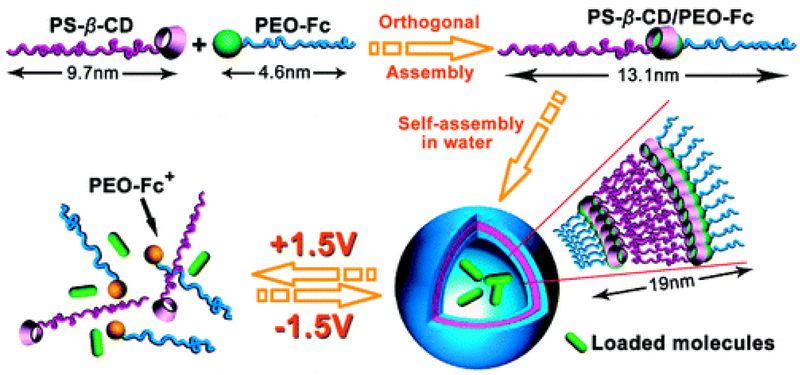
Schematics representing formation of electro-responsive, drug loaded, micelle-like vesicles by self-assembly of an electro-responsive amphiphilic molecule and subsequent on-demand drug release from the vesicles by the action of applied electric field (Figure taken from reference [125]).
References
-
- Gil ES et al. (2012) β-Cyclodextrin-poly(β-Amino Ester) Nanoparticles for Sustained Drug Delivery across the Blood–Brain Barrier. Biomacromolecules 13 (11), 3533–3541 - PubMed
-
- Müller RH et al. (2000) Solid lipid nanoparticles (SLN) for controlled drug delivery – a review of the state of the art. European Journal of Pharmaceutics and Biopharmaceutics 50 (1), 161–177 - PubMed
-
- Hua MY et al. (2011) The effectiveness of a magnetic nanoparticle-based delivery system for BCNU in the treatment of gliomas. Biomaterials 32 (2), 516–527 - PubMed
-
- Poß M et al. (2017) Multimodal [GdO]+[ICG]− Nanoparticles for Optical, Photoacoustic, and Magnetic Resonance Imaging. Chemistry of Materials 29 (8), 3547–3554
Publication types
MeSH terms
Grants and funding
LinkOut - more resources
Full Text Sources
Other Literature Sources
