


Efficacy of shared decision-making on treatment adherence of patients with bipolar disorder: a cluster randomized trial (ShareD-BD)
- PMID: 29653535
- PMCID: PMC5899333
- DOI: 10.1186/s12888-018-1686-y
Efficacy of shared decision-making on treatment adherence of patients with bipolar disorder: a cluster randomized trial (ShareD-BD)
Abstract
Background: Shared decision-making (SDM) is a model of interaction between doctors and patients in which both actors contribute to the medical decision-making process. SDM has raised great interest in mental healthcare over the last decade, as it is considered a fundamental part of patient-centered care. However, there is no research evaluating the efficacy of SDM compared to usual care (CAU), as it relates to quality of care and more specifically treatment adherence, in bipolar disorder (BD).
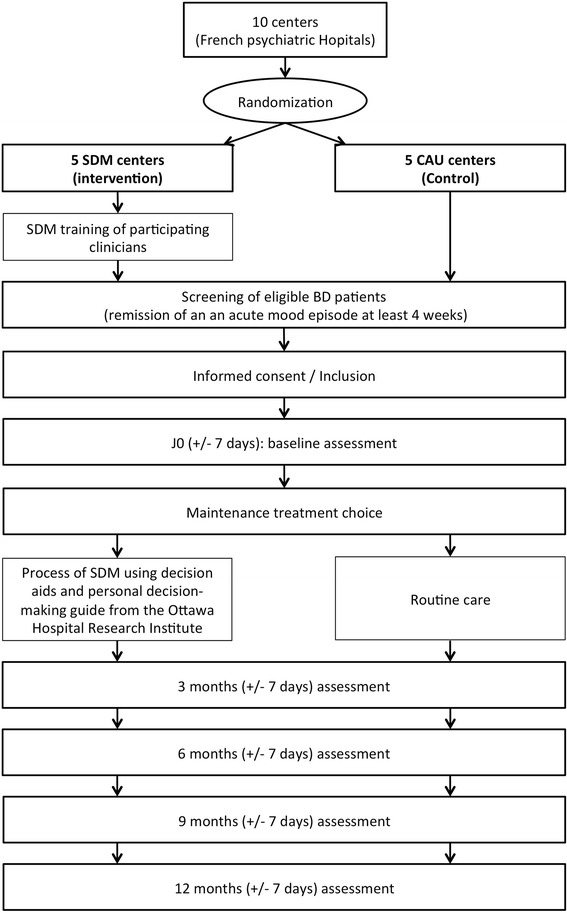
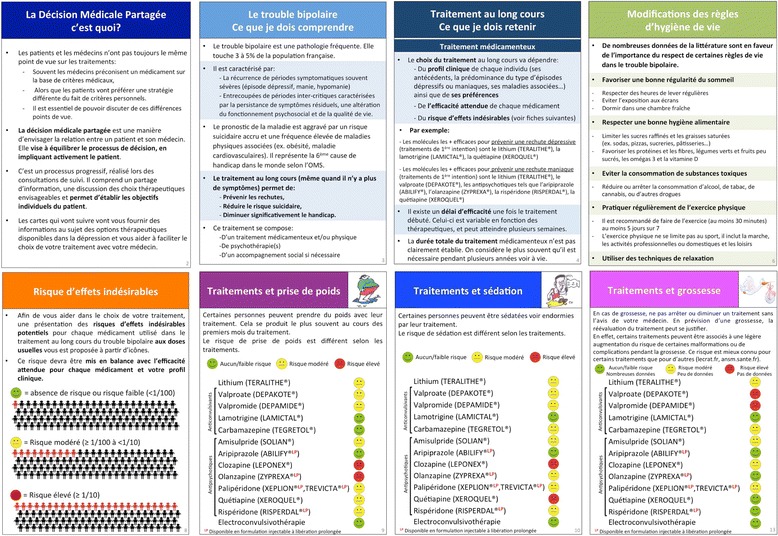
Methods/design: This is a 12-month multi-centre, cluster-randomized controlled trial comparing the efficacy of SDM to CAU. Adult BD patients (n = 300) will be eligible after stabilization for at least 4 weeks following an acute mood episode. The intervention will consist of applying the standardized SDM process as developed by the Ottawa Hospital Research Institute in order to choose the maintenance treatment of BD. A multidisciplinary team developed a decision aid "choose my long-term treatment with my doctor" for BD patients to clarify possible therapeutic options. Primary outcome will assess the patient's level of adherence (based on hetero-evaluation) of ongoing treatment at 12 months. Secondary outcomes will assess the difference between the 2 groups of patients in terms of adherence to maintenance drug therapy based on other measures (self-assessment scale and plasma levels of mood stabilizers). Additionally, other dimensions will be assessed: decisional conflict, satisfaction with care and involvement in decision making, beliefs about treatment, therapeutic relationship, knowledge about information for medical decision and clinical outcomes (depression, mania, functioning and quality of life). The primary endpoint will be analysed without adjustment by comparison of adherence scores between the two groups using Student t-tests or Mann-Whitney tests according to the variable distribution. A set of secondary analyses will be adjusted for covariates of clinical interest using generalized linear mixed regression models.
Discussion: This will be the first study evaluating the effect of an SDM intervention on patient adherence in BD. This is also an innovative protocol because it proposes the development of an evidence-based tool that should help patients and clinicians to initiate discussions regarding the use of BD treatment.
Trial registration: The study has been registered with ClinicalTrials.gov as NCT03245593 .
Keywords: Bipolar disorder; Cluster randomized trial; Decision aid; Maintenance treatment; Medication adherence; Shared decision-making; Study protocol.
Conflict of interest statement
Ethics approval and consent to participate
The study was approved by the Ile de France 1 ethical committee (2017-juil.-14,602 ND). All participants have to give written informed consent.
Competing interests
L.S. Dr. Samalin has received grants, honoraria, or consulting fees from AstraZeneca, Bristol-Myers Squibb, Janssen-Cilag, Lundbeck, Otsuka, Sanofi-Aventis, and Takeda.
M.A. has received grants, honoraria, or consulting fees from AstraZeneca, Bristol-Myers Squibb, Janssen-Cilag, Lundbeck and Otsuka.
P.M.L. has received grants, honoraria, or consulting fees from AstraZeneca, Bristol-Myers Squibb, Eli Lilly, Ferrer, Janssen-Cilag, Lundbeck, Otsuka, Sanofi-Aventis, Servier, and Takeda.
M.H., L.B., I.C. and O.B. declare that they have no competing interests.
Publisher’s Note
Springer Nature remains neutral with regard to jurisdictional claims in published maps and institutional affiliations.
Figures
References
-
- Wittchen HU, Jacobi F, Rehm J, Gustavsson A, Svensson M, Jönsson B, Olesen J, Allgulander C, Alonso J, Faravelli C. The size and burden of mental disorders and other disorders of the brain in Europe 2010. Eur Neuropsychopharmacol. 2011;21:655–679. doi: 10.1016/j.euroneuro.2011.07.018. - DOI - PubMed
Publication types
MeSH terms
Associated data
LinkOut - more resources
Full Text Sources
Other Literature Sources
Medical
