


HEROs: Design of a Mixed-Methods Formative Research Phase for an Ecocultural Intervention to Promote Healthy Eating and Activity Behaviors in Rural Families With Preschoolers
- PMID: 29653807
- PMCID: PMC6453531
- DOI: 10.1016/j.jneb.2018.02.012
HEROs: Design of a Mixed-Methods Formative Research Phase for an Ecocultural Intervention to Promote Healthy Eating and Activity Behaviors in Rural Families With Preschoolers
Abstract
Objective: To describe the mixed-methods formative research phase in the development of the Healthy Environments Study (HEROs), a technology-based, interactive family intervention to promote healthy eating and activity behaviors for young children in the home environment.
Design: A mixed-method iterative approach, using ecocultural theory as a framework, will guide the development of both quantitative and qualitative formative research assessments.
Setting: Rural eastern Colorado.
Participants: Low-income families (n = 200) with preschool-aged children enrolled at 6 Head Start/preschool centers.
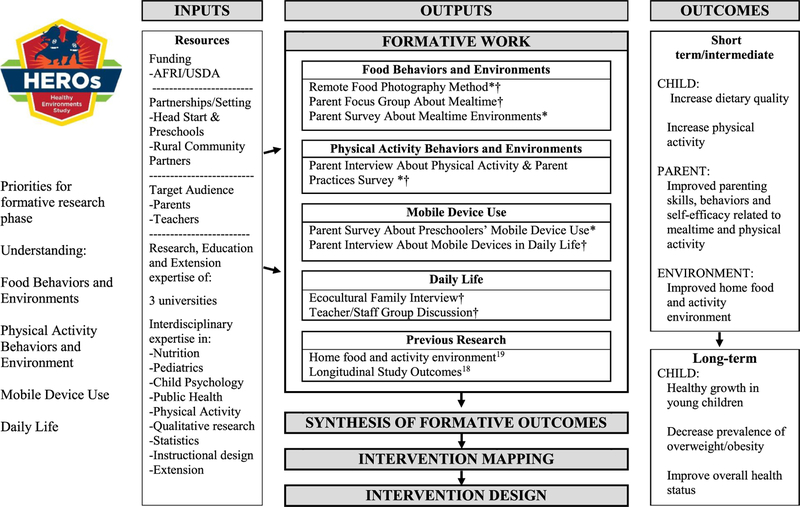
Main outcome measures: Quantitative and qualitative methodologies will garner insights into 4 key topic areas: (1) food behaviors and environments (Remote Food Photography Method, parent focus group, and survey), (2) physical activity behaviors and environments (parent interview and survey), (3) mobile device use (parent survey and interview), and (4) daily life (ecocultural family interview and teacher/staff group discussions).
Analysis: Results will be interpreted in combination to allow for a holistic understanding of participant behaviors, beliefs, attitudes and values related to each of the 4 topic areas. Collectively, outcomes will provide a comprehensive picture of preschoolers' daily life and inform intervention design and strategies to enhance preschoolers' eating and activity behaviors in the home environment.
Keywords: child; ecocultural theory; formative research; mixed methods; mobile devices; nutrition environment.
Copyright © 2018 Society for Nutrition Education and Behavior. Published by Elsevier Inc. All rights reserved.
Conflict of interest statement
Figures
References
-
- Fiese BH, Tomcho TJ, Douglas M, Josephs K, Poltrock S, Baker T. A review of 50 years of research on naturally occurring family routines and rituals: cause for celebration? J Fam Psychol 2002;16: 381–390. - PubMed
-
- Spagnola M, Fiese BH. Family routines and rituals: a context for development in the lives of young children. Infants Young Child 2007;20:284–299.
-
- Burchinal MR, Peisner-Feinberg E, Pianta R, Howes C. Development of academic skills from preschool through second grade: family and classroom predictors of developmental trajectories. J Sch Psychol 2002;40:415–436.
-
- Bekelman TA, Bellows LL, Johnson SL. Are family routines modifiable determinants of preschool children’s eating, dietary intake, and growth? A review of intervention studies. Curr Nutr Rep 2017; 1–19.
Publication types
MeSH terms
Grants and funding
LinkOut - more resources
Full Text Sources
Other Literature Sources
Medical
