


Effectiveness and Safety of Apixaban, Dabigatran, and Rivaroxaban Versus Warfarin in Frail Patients With Nonvalvular Atrial Fibrillation
- PMID: 29654196
- PMCID: PMC6015429
- DOI: 10.1161/JAHA.118.008643
Effectiveness and Safety of Apixaban, Dabigatran, and Rivaroxaban Versus Warfarin in Frail Patients With Nonvalvular Atrial Fibrillation
Abstract
Background: Frailty predicts poorer outcomes and decreased anticoagulation use in patients with nonvalvular atrial fibrillation. We sought to assess the effectiveness and safety of apixaban, dabigatran and rivaroxaban versus warfarin in frail nonvalvular atrial fibrillation patients.
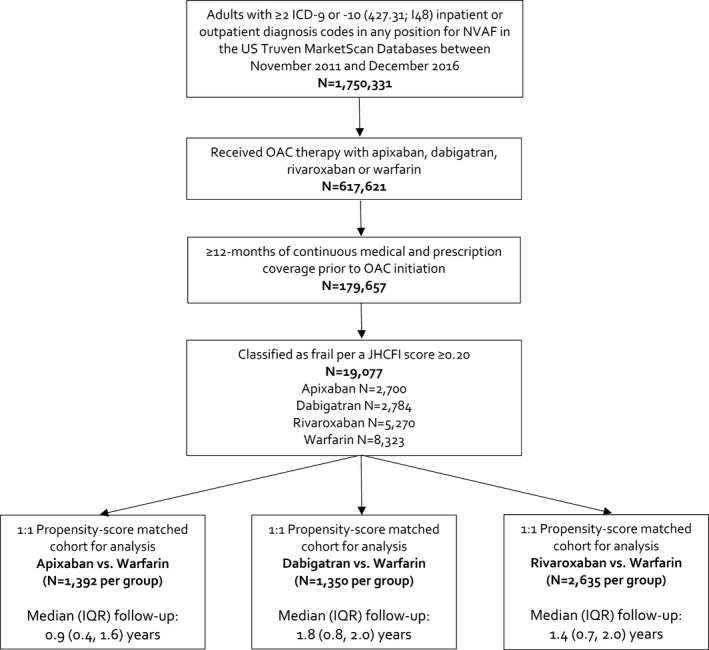
Methods and results: Using US MarketScan claims data from November 2011 to December 2016, we identified frail oral anticoagulant-naïve nonvalvular atrial fibrillation patients with ≥12 months of continuous insurance coverage before oral anticoagulant initiation. Frailty status was determined using the Johns Hopkins Claims-based Frailty Indicator score (≥0.20 indicating frailty). Users of apixaban, dabigatran, or rivaroxaban were separately 1:1 matched to warfarin users via propensity-scores, with residual absolute standardized differences <0.1 being achieved for all covariates after matching. Patients were followed for up to 2 years or until an event, insurance disenrollment or end of follow-up. Rates of stroke or systemic embolism and major bleeding were compared using Cox regression and reported as hazard ratios (HRs) and 95% confidence intervals (CIs). In total, 2700, 2784, and 5270 patients were included in the apixaban, dabigatran, and rivaroxaban 1:1 matched analyses to warfarin. At 2 years, neither apixaban nor dabigatran were associated with differences in the hazard of stroke or systemic embolism (HR=0.78; 95% CI=0.46-1.35 and HR=0.94; 0.60-1.45) or major bleeding (HR=0.72; 95% CI=0.49-1.06 and HR=0.87; 95% CI=0.63-1.19) versus warfarin. Rivaroxaban was associated with reduced stroke or systemic embolism at 2 years (HR=0.68; 95% CI=0.49-0.95) without significantly altering major bleeding risk (HR=1.07; 95% CI=0.81-1.32).
Conclusions: Our study found rivaroxaban but not apixaban or dabigatran to be associated with reduced SSE versus warfarin in frail nonvalvular atrial fibrillation patients. No direct-acting oral anticoagulants demonstrated a significant difference in major bleeding versus warfarin.
Keywords: anticoagulants; atrial fibrillation; direct‐acting oral anticoagulants; frailty; warfarin.
© 2018 The Authors. Published on behalf of the American Heart Association, Inc., by Wiley.
Figures
References
-
- Polidoro A, Stefanelli F, Ciacciarelli M, Pacelli A, Di Sanzo D, Alessandri C. Frailty in patients affected by atrial fibrillation. Arch Gerontol Geriatr. 2013;57:325–327. - PubMed
-
- Villacampa‐Fernández P, Navarro‐Pardo E, Tarín JJ, Cano A. Frailty and multimorbidity: two related yet different concepts. Maturitas. 2017;95:31–35. - PubMed
-
- Go AS, Hylek EM, Phillips KA, Chang Y, Henault LE, Selby JV, Singer DE. Prevalence of diagnosed atrial fibrillation in adults: national implications for rhythm management and stroke prevention: the AnTicoagulation and Risk Factors in Atrial Fibrillation (ATRIA) study. JAMA. 2001;285:2370–2375. - PubMed
-
- Perera V, Bajorek BV, Matthews S, Hilmer SN. The impact of frailty on the utilisation of antithrombotic therapy in older patients with atrial fibrillation. Age Ageing. 2009;38:156–162. - PubMed
-
- Induruwa I, Evans NR, Aziz A, Reddy S, Khadjooi K, Romero‐Ortuno R. Clinical frailty is independently associated with non‐prescription of anticoagulants in older patients with atrial fibrillation. Geriatr Gerontol Int. 2017;17:2178–2183. - PubMed
Publication types
MeSH terms
Substances
LinkOut - more resources
Full Text Sources
Other Literature Sources
Medical
