. 2018 Apr 13;8(1):5980.
doi: 10.1038/s41598-018-24407-x.

Detection and characterisation of coronaviruses in migratory and non-migratory Australian wild birds

Affiliations

Detection and characterisation of coronaviruses in migratory and non-migratory Australian wild birds

Anthony Chamings et al. Sci Rep. .

Abstract

We evaluated the presence of coronaviruses by PCR in 918 Australian wild bird samples collected during 2016-17. Coronaviruses were detected in 141 samples (15.3%) from species of ducks, shorebirds and herons and from multiple sampling locations. Sequencing of selected positive samples found mainly gammacoronaviruses, but also some deltacoronaviruses. The detection rate of coronaviruses was improved by using multiple PCR assays, as no single assay could detect all coronavirus positive samples. Sequencing of the relatively conserved Orf1 PCR amplicons found that Australian duck gammacoronaviruses were similar to duck gammacoronaviruses around the world. Some sequenced shorebird gammacoronaviruses belonged to Charadriiformes lineages, but others were more closely related to duck gammacoronaviruses. Australian duck and heron deltacoronaviruses belonged to lineages with other duck and heron deltacoronaviruses, but were almost 20% different in nucleotide sequence to other deltacoronavirus sequences available. Deltacoronavirus sequences from shorebirds formed a lineage with a deltacoronavirus from a ruddy turnstone detected in the United States. Given that Australian duck gammacoronaviruses are highly similar to those found in other regions, and Australian ducks rarely come into contact with migratory Palearctic duck species, we hypothesise that migratory shorebirds are the important vector for moving wild bird coronaviruses into and out of Australia.


Conflict of interest statement

The authors declare no competing interests.

Figures
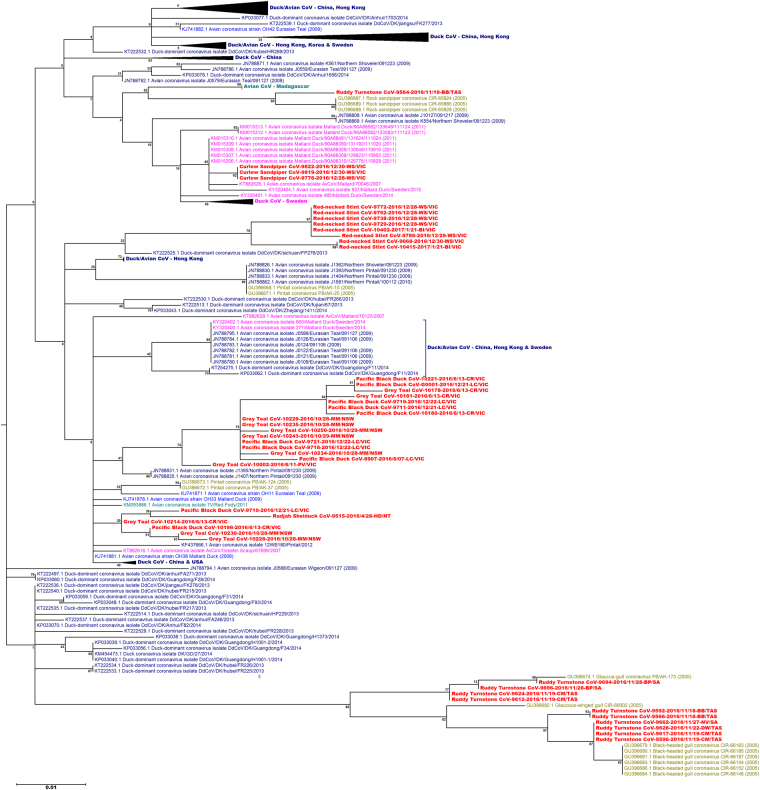
Figure 1
Figure 1
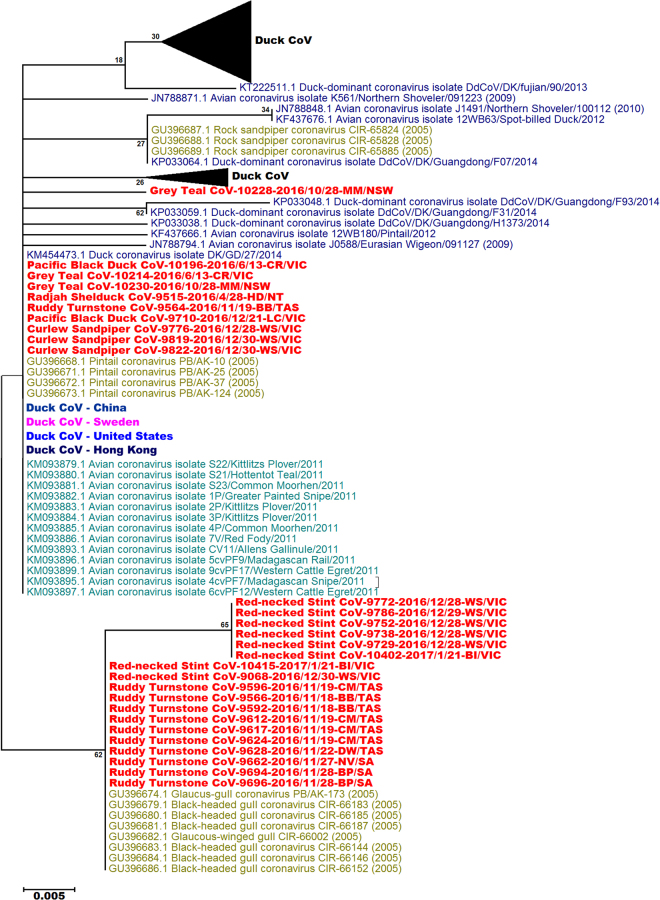
Maximum likelihood phylogenetic tree of the 277 nt fragment of the polymerase gene of gammacoronaviruses from wild birds including the sequences obtained in this study. Bootstrap confidence of each branch was calculated from 1000 replicates. The region where each sequence was obtained is indicated with colour. Australia (red), Madagascar (teal), China, Hong Kong and Korea (dark blue), Bering Strait (green), United States of America (light blue) and Sweden (pink). The sampling location and state of each Australian sample is identified with a two letter code and the state: New South Wales (NSW): MM-Moulamein; Northern Territory (NT): HD-Humpty Doo; South Australia (SA): BP-Boatswain Point, NV-Nene Valley; Tasmania (TAS): BB-Borges Bay, King Island, CM-Central Manuka, King Island, DW-Dripping Wells, King Island, Tasmania; Victoria (VIC): BI-Barrallier Island, CR-Carlisle River, LC-Lake Connewarre, PV-Paynesville, WS-Werribee South. Some branches have been collapsed if all sequences came from the same region. The complete tree is shown in Supplementary Figure S1.
Figure 2
Figure 2
Maximum likelihood phylogenetic tree of the 92 amino acid sequence of the gammacoronaviruses from wild birds. Bootstrap confidence of each branch was calculated from 500 replicates. Some branches have been collapsed for clarity. The region where each sequence was obtained is indicated with colour. Australia (red), Madagascar (teal), China, Hong Kong and Korea (dark blue), Bering Strait (green), United States of America (light blue) and Sweden (pink). The sampling location and state of each Australian sample is identified with a two letter code and the state: New South Wales (NSW): MM-Moulamein; Northern Territory (NT): HD-Humpty Doo; South Australia (SA): BP-Boatswain Point, NV-Nene Valley; Tasmania (TAS): BB-Borges Bay, King Island, CM-Central Manuka, King Island, DW-Dripping Wells, King Island, Tasmania; Victoria (VIC): BI-Barrallier Island, CR-Carlisle River, LC-Lake Connewarre, PV-Paynesville, WS-Werribee South. Some branches have been collapsed if all sequences came from the same region. The complete tree is shown in Supplementary Figure S2.
Figure 3
Figure 3
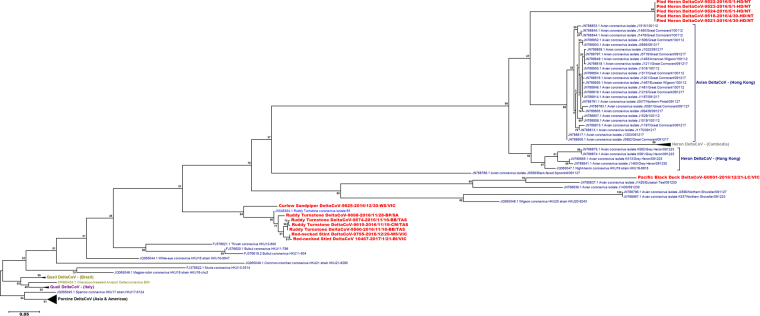
Maximum likelihood phylogenetic tree of the 311 nt fragment of the polymerase gene of deltacoronaviruses from wild birds, including the sequences obtained in this study. Bootstrap confidence of each branch was calculated from 1000 replicates. The region where each sequence was obtained is indicated with colour. Australia (red), Madagascar (teal), China, Hong Kong and Korea (dark blue), Bering Strait region (green), United States of America (light blue) and Sweden (pink). The sampling location and state of each Australian sample is identified with a two letter code and the state: New South Wales (NSW): MM-Moulamein; Northern Territory (NT): HD-Humpty Doo; South Australia (SA): BP-Boatswain Point, NV-Nene Valley; Tasmania (TAS): BB-Borges Bay, King Island, CM-Central Manuka, King Island, DW-Dripping Wells, King Island, Tasmania; Victoria (VIC): BI-Barrallier Island, CR-Carlisle River, LC-Lake Connewarre, PV-Paynesville, WS-Werribee South. Some branches have been collapsed if all sequences came from the same region. The complete tree is shown in Supplementary Figure S3.

References

    1. World Bank. People, pathogens and our planet: the economics of one health. (World Bank., Washington, DC 2012).
    1. Lee S. Costly Lessons From the Middle East Respiratory Syndrome Coronavirus Outbreak in Korea. Journal of Preventive Medicine and Public Health. 2015;48:274–276. doi: 10.3961/jpmph.15.064. - DOI - PMC - PubMed
    1. Lee, J.-W. & McKibbin, W. J. In Learning from SARS: Preparing for the Next Disease Outbreak: Workshop Summary The National Academies Collection: Reports funded by National Institutes of Health (eds Knobler, S. et al.) (2004). - PubMed
    1. Cavanagh D. Coronaviruses in poultry and other birds. Avian Pathol. 2005;34:439–448. doi: 10.1080/03079450500367682. - DOI - PubMed
    1. Ignjatovic J, Ashton DF, Reece R, Scott P, Hooper P. Pathogenicity of Australian Strains of Avian Infectious Bronchitis Virus. J. Comp. Pathol. 2002;126:115–123. doi: 10.1053/jcpa.2001.0528. - DOI - PubMed

Publication types

LinkOut - more resources