


A model for rigorously applying the Exploration, Preparation, Implementation, Sustainment (EPIS) framework in the design and measurement of a large scale collaborative multi-site study
- PMID: 29654518
- PMCID: PMC5899075
- DOI: 10.1186/s40352-018-0068-3
A model for rigorously applying the Exploration, Preparation, Implementation, Sustainment (EPIS) framework in the design and measurement of a large scale collaborative multi-site study
Abstract
Background: This paper describes the means by which a United States National Institute on Drug Abuse (NIDA)-funded cooperative, Juvenile Justice-Translational Research on Interventions for Adolescents in the Legal System (JJ-TRIALS), utilized an established implementation science framework in conducting a multi-site, multi-research center implementation intervention initiative. The initiative aimed to bolster the ability of juvenile justice agencies to address unmet client needs related to substance use while enhancing inter-organizational relationships between juvenile justice and local behavioral health partners.
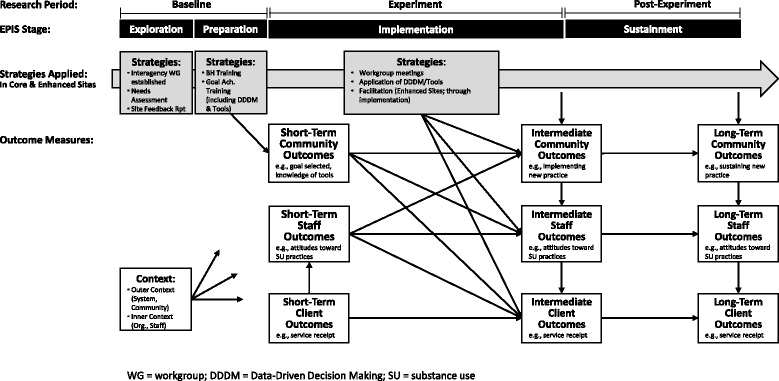
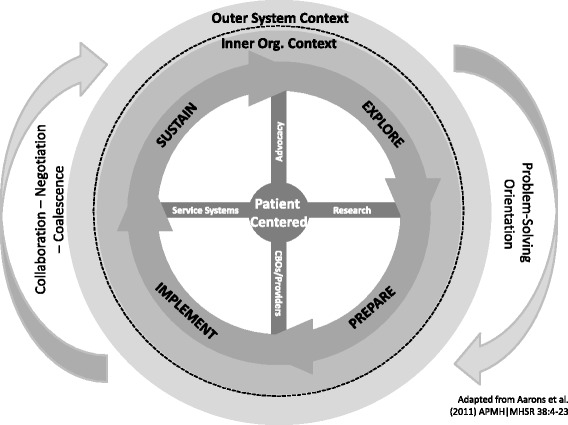
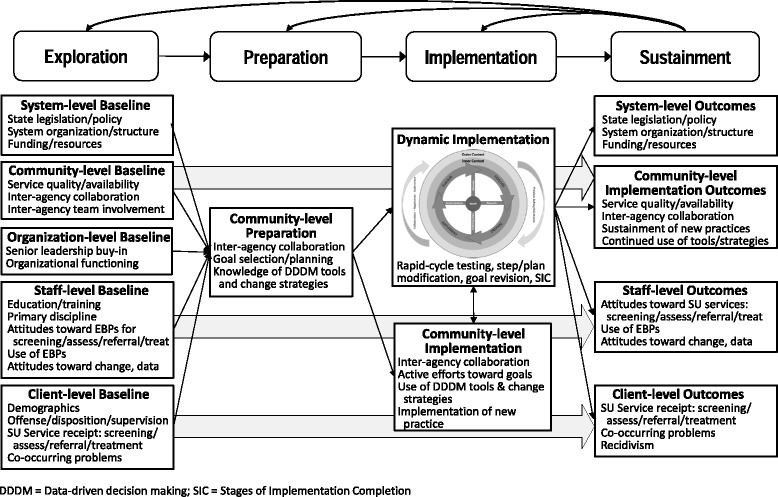
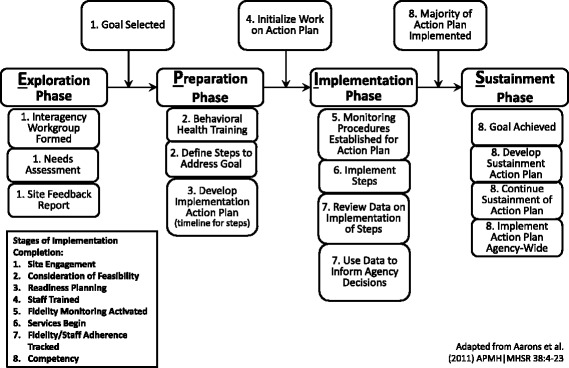
Methods: The EPIS (Exploration, Preparation, Implementation, Sustainment) framework was selected and utilized as the guiding model from inception through project completion; including the mapping of implementation strategies to EPIS stages, articulation of research questions, and selection, content, and timing of measurement protocols. Among other key developments, the project led to a reconceptualization of its governing implementation science framework into cyclical form as the EPIS Wheel. The EPIS Wheel is more consistent with rapid-cycle testing principles and permits researchers to track both progressive and recursive movement through EPIS. Moreover, because this randomized controlled trial was predicated on a bundled strategy method, JJ-TRIALS was designed to rigorously test progress through the EPIS stages as promoted by facilitation of data-driven decision making principles. The project extended EPIS by (1) elucidating the role and nature of recursive activity in promoting change (yielding the circular EPIS Wheel), (2) by expanding the applicability of the EPIS framework beyond a single evidence-based practice (EBP) to address varying process improvement efforts (representing varying EBPs), and (3) by disentangling outcome measures of progression through EPIS stages from the a priori established study timeline.
Discussion: The utilization of EPIS in JJ-TRIALS provides a model for practical and applied use of implementation frameworks in real-world settings that span outer service system and inner organizational contexts in improving care for vulnerable populations.
Trial registration: NCT02672150 . Retrospectively registered on 22 January 2016.
Keywords: Conceptual frameworks; Data-driven decision making; Exploration, Preparation, Implementation, Sustainment; Facilitation; Juvenile justice; Substance use.
Conflict of interest statement
Ethics approval and consent to participate
Institutional Review Board approval was granted by all seven research institutions and the coordinating center.
Competing interests
The authors declare that they have no competing interests.
Publisher’s Note
Springer Nature remains neutral with regard to jurisdictional claims in published maps and institutional affiliations.
Figures
References
-
- Aarons, GA, Fettes, DL, Hurlburt, MS, Palinkas, LA, Gunderson, L, Willging, CE, Chaffin, MJ. (2014). Collaboration, negotiation, and coalescence for interagency-collaborative teams to scale-up evidence-based practice. Journal of Clinical Child and Adolescent Psychology, 43(6), 915–928. - PMC - PubMed
-
- Aarons GA, Green AE, Trott E, Willging CE, Torres EM, Ehrhart MG, Roesch SC. The roles of system and organizational leadership in system-wide evidence-based intervention sustainment: A mixed-method study. Administration and Policy in Mental Health and Mental Health Services Research. 2016;43(6):991–1108. doi: 10.1007/s10488-016-0751-4. - DOI - PMC - PubMed
Associated data
Grants and funding
- U01 DA036221/DA/NIDA NIH HHS/United States
- U01 DA036226/DA/NIDA NIH HHS/United States
- U01 DA016205/DA/NIDA NIH HHS/United States
- U01DA036233/DA/NIDA NIH HHS/United States
- U01 DA036225/DA/NIDA NIH HHS/United States
- R21 DA044378/DA/NIDA NIH HHS/United States
- U01 DA036158/DA/NIDA NIH HHS/United States
- U01 DA025284/DA/NIDA NIH HHS/United States
- U01DA036224/DA/NIDA NIH HHS/United States
- U01DA036221/DA/NIDA NIH HHS/United States
- U01DA036158/DA/NIDA NIH HHS/United States
- U01DA036226/DA/NIDA NIH HHS/United States
- U01 DA036224/DA/NIDA NIH HHS/United States
- U01 DA036176/DA/NIDA NIH HHS/United States
- U01DA036176/DA/NIDA NIH HHS/United States
- U01 DA036233/DA/NIDA NIH HHS/United States
- R21DA044378/DA/NIDA NIH HHS/United States
- U01DA036225/DA/NIDA NIH HHS/United States
LinkOut - more resources
Full Text Sources
Other Literature Sources
Medical
