. 2019 Jan;8(1):e00621.
doi: 10.1002/mbo3.621. Epub 2018 Apr 14.

Noncontiguous finished genome sequence and description of Intestinimonas massiliensis sp. nov strain GD2T , the second Intestinimonas species cultured from the human gut

Affiliations

Noncontiguous finished genome sequence and description of Intestinimonas massiliensis sp. nov strain GD2T , the second Intestinimonas species cultured from the human gut

Pamela Afouda et al. Microbiologyopen. 2019 Jan.

Abstract

Intestinimonas massiliensis sp. nov strain GD2T is a new species of the genus Intestinimonas (the second, following Intestinimonas butyriciproducens gen. nov., sp. nov). First isolated from the gut microbiota of a healthy subject of French origin using a culturomics approach combined with taxono-genomics, it is strictly anaerobic, nonspore-forming, rod-shaped, with catalase- and oxidase-negative reactions. Its growth was observed after preincubation in an anaerobic blood culture enriched with sheep blood (5%) and rumen fluid (5%), incubated at 37°C. Its phenotypic and genotypic descriptions are presented in this paper with a full annotation of its genome sequence. This genome consists of 3,104,261 bp in length and contains 3,074 predicted genes, including 3,012 protein-coding genes and 62 RNA-coding genes. Strain GD2T significantly produces butyrate and is frequently found among available 16S rRNA gene amplicon datasets, which leads consideration of Intestinimonas massiliensis as an important human gut commensal.

Keywords: anaerobe; butyrate; culturomics; new species; taxono-genomics.


Figures

Figure 1
Figure 1
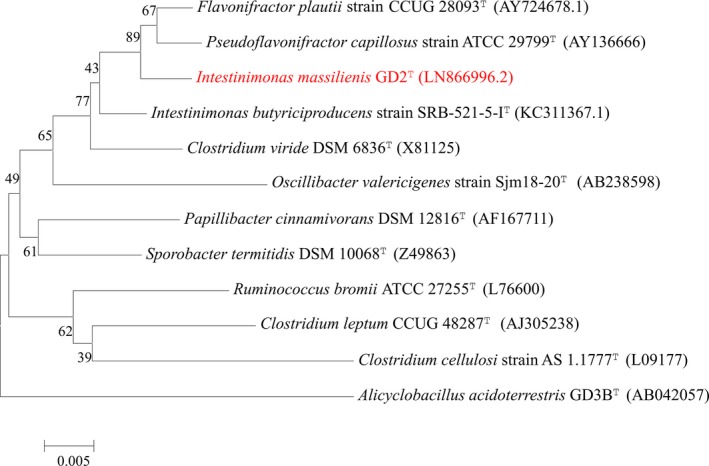
Phylogenetic tree highlighting the position of Intestinimonas massiliensis strain GD2 T relative to other Firmicutes. Numbers at the nodes are percentages of bootstrap values obtained by repeating the analysis 1,000 times to generate a majority consensus tree. The scale bar represents a 5% nucleotide sequence divergence
Figure 2
Figure 2
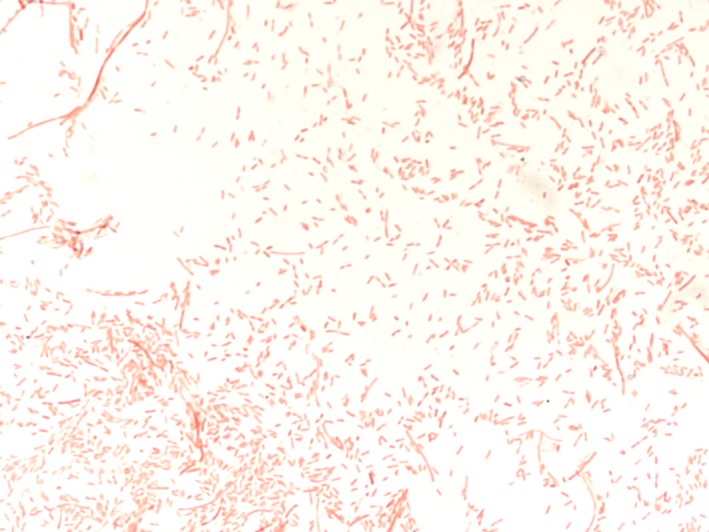
Gram staining of the Intestinimonas massiliensis strain GD2T
Figure 3
Figure 3
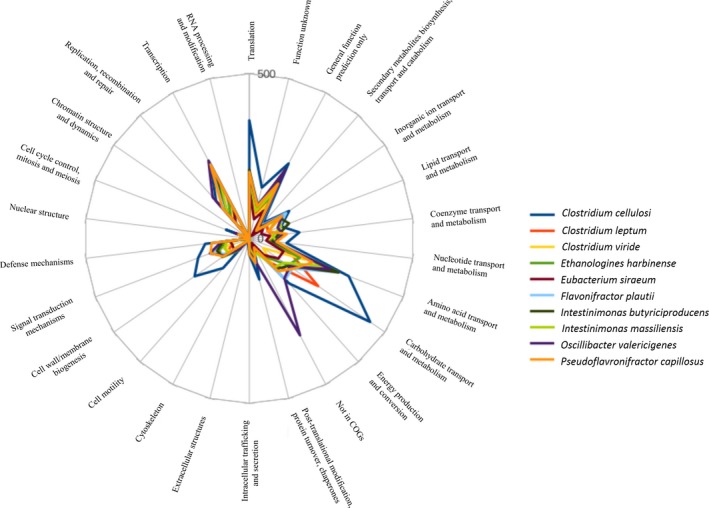
Distribution of functional classes of predicted genes on the chromosomes of strain CD2T and related taxa Clostridium cellulosi, Clostridium leptum, Clostridium viride, Ethanoligenens harbinense, Eubacterium siraeum, Flavonifractor plautii, Intestinimonas butyriciproducens, Intestinimonas massiliensis, Oscillibacter valericigenes, Pseudoflavonifractor capillosus, according to the clusters of orthologous groups of protein

References

    1. Auch, A. F. , von Jan, M. , Klenk, H.‐P. , & Göker, M. (2010). Digital DNA‐DNA hybridization for microbial species delineation by means of genome‐to‐genome sequence comparison. Standards in Genomic Sciences, 2(1), 117–134. 10.4056/sigs.531120 - DOI - PMC - PubMed
    1. Aziz, R. K. , Bartels, D. , Best, A. A. , DeJongh, M. , Disz, T. , Edwards, R. A. , … Meyer, F . (2008). The RAST server: Rapid annotations using subsystems technology. BMC Genomics., 8(9), 75 10.1186/1471-2164-9-75 - DOI - PMC - PubMed
    1. Bendtsen, J. D. , Nielsen, H. , vonHeijne, G. , & Brunak, S . (2004). Improved prediction of signal peptides: SignalP 3.0. Journal of Molecular Biology, 340(4), 783–795. 10.1016/j.jmb.2004.05.028 - DOI - PubMed
    1. Benson, D. A. , Karsch‐Mizrachi, I. , Clark, K. , Lipman, D. J. , Ostell, J. , & Sayers, E. W . (2012). GenBank. Nucleic Acids Research, 40(Database issue), D48–D53. 10.1093/nar/gkr1202 - DOI - PMC - PubMed
    1. Bui, T. P. N. , Ritari, J. , Boeren, S. , de Waard, P. , Plugge, C. M. , & de Vos, W. M. (2015). Production of butyrate from lysine and the Amadori product fructoselysine by a human gut commensal. Nature Communications, 1(6), 651. - PMC - PubMed

Publication types

LinkOut - more resources