


Serum magnesium, phosphorus, and calcium levels and subclinical calcific aortic valve disease: A population-based study
- PMID: 29655832
- PMCID: PMC5991478
- DOI: 10.1016/j.atherosclerosis.2018.03.035
Serum magnesium, phosphorus, and calcium levels and subclinical calcific aortic valve disease: A population-based study
Abstract
Background and aims: Calcific aortic valve disease (CAVD) is the most common valve disease. Although micronutrients are known to contribute to cardiovascular disease, the relationship with CAVD remains poorly evaluated. We examined the association of serum levels of magnesium, phosphorus, and calcium with prevalence, incidence, and progression of aortic valve calcification (AVC).
Methods: We conducted a prospective study in a population-based sample of Japanese men aged 40-79 years without known cardiovascular disease and chronic kidney disease at baseline, and quantified AVC from serial computed tomographic images with the Agatston method.
Results: Of 938 participants at baseline (mean age, 63.7 ± 9.9 years), AVC prevalence was observed in 173 (18.4%). Of 596 participants without baseline AVC at follow-up (median duration, 5.1 years), AVC incidence was observed in 138 (23.2%). After adjustment for demographics, behaviors and cardiovascular risk factors, relative risks (95% confidence intervals) in the highest versus lowest categories of serum magnesium, phosphorus, and calcium were 0.62 (0.44-0.86), 1.45 (1.02-2.04), and 1.43 (0.95-2.15), respectively, for AVC prevalence and 0.62 (0.42-0.92), 1.93 (1.28-2.91), and 1.09 (0.77-1.55), respectively, for AVC incidence. Their linear trends of serum magnesium and phosphorus were also all statistically significant. Of 131 participants with baseline AVC, there was no association of any serum micronutrients with AVC progression.
Conclusions: Serum magnesium was inversely associated, while serum phosphorus was positively associated with AVC prevalence and incidence, suggesting that these serum micronutrients may be potential candidates for risk prediction or prevention of CAVD, and warranting further studies.
Keywords: Aortic valve disease; Calcification; Epidemiology; Magnesium; Phosphorus; Prospective study.
Copyright © 2018 Elsevier B.V. All rights reserved.
Conflict of interest statement
The authors declared they do not have anything to disclose regarding conflict of interest with respect to this manuscript.
Figures
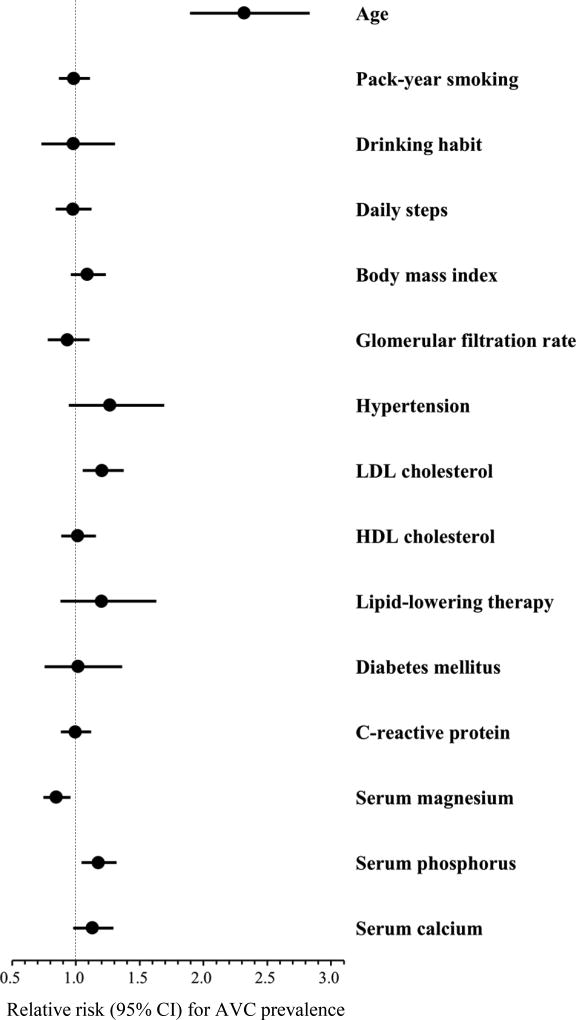
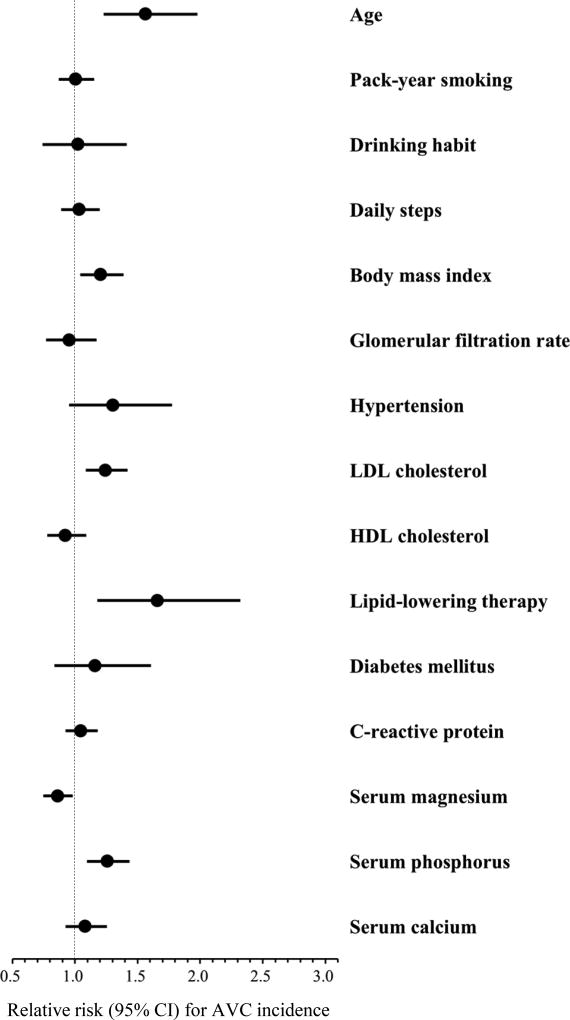
Comment in
-
Cardiovascular calcification: The emerging role of micronutrients.Atherosclerosis. 2018 Jun;273:119-121. doi: 10.1016/j.atherosclerosis.2018.04.019. Epub 2018 Apr 20. Atherosclerosis. 2018. PMID: 29705018 No abstract available.
References
-
- Rajamannan NM, Moura L. The lipid hypothesis in calcific aortic valve disease: The role of the Multi-Ethnic Study of Atherosclerosis. Arterioscler Thromb Vasc Biol. 2016;36:774–776. - PubMed
-
- Rajamannan NM, Evans FJ, Aikawa E, Grande-Allen KJ, Demer LL, Heistad DD, Simmons CA, Masters KS, Mathieu P, O'Brien KD, Schoen FJ, Towler DA, Yoganathan AP, Otto CM. Calcific aortic valve disease: Not simply a degenerative process: A review and agenda for research from the national heart and lung and blood institute aortic stenosis working group. Executive summary: Calcific aortic valve disease-2011 update. Circulation. 2011;124:1783–1791. - PMC - PubMed
-
- Otto CM, Lind BK, Kitzman DW, Gersh BJ, Siscovick DS. Association of aortic-valve sclerosis with cardiovascular mortality and morbidity in the elderly. N Engl J Med. 1999;341:142–147. - PubMed
-
- Saikrishnan N, Kumar G, Sawaya FJ, Lerakis S, Yoganathan AP. Accurate assessment of aortic stenosis: A review of diagnostic modalities and hemodynamics. Circulation. 2014;129:244–253. - PubMed
Publication types
MeSH terms
Substances
Supplementary concepts
Grants and funding
LinkOut - more resources
Full Text Sources
Other Literature Sources
