


The prevalence of meibomian gland dysfunction, tear film and ocular surface parameters in an Austrian dry eye clinic population
- PMID: 29656524
- PMCID: PMC6619403
- DOI: 10.1111/aos.13732
The prevalence of meibomian gland dysfunction, tear film and ocular surface parameters in an Austrian dry eye clinic population
Abstract
Purpose: The purpose of this study was to assess the prevalence of meibomian gland dysfunction (MGD) and its association with tear film and ocular surface parameters in an Austrian clinical population of dry eye patients.
Methods: The records of 1372 consecutive patients from a dry eye unit were analysed retrospectively. Symptoms and objective tear film and ocular surface parameters were evaluated. Patients were classified into pure MGD, pure aqueous tear deficiency (ATD), MGD combined with ATD, pure anterior blepharitis (AB), Sjogren's syndrome (SS) without MGD and SS together with MGD.
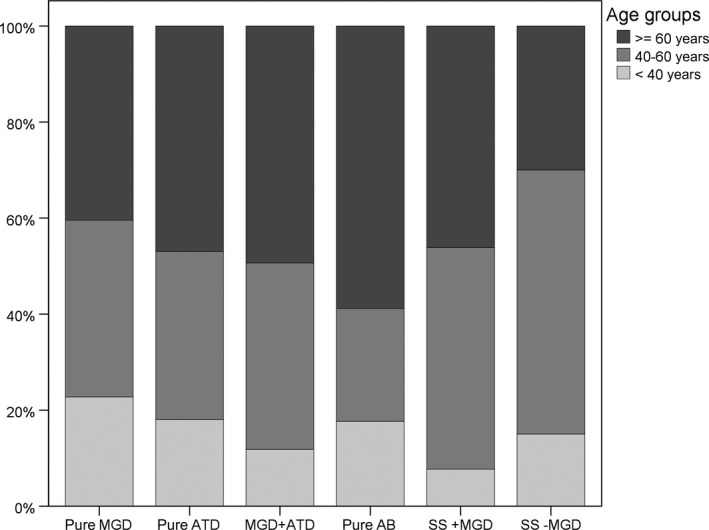
Results: Nine-hundred and sixty-five patients, that is 70.3% of the investigated population, mean age 55.4 ± 16.6 years, had signs of MGD. Of these, 684 (70.9%) were female. The intensity of symptoms did not differ between subgroups. Four hundred and ninety (50.8%) MGD patients had Schirmer test values ≤10 mm/5 min. The fluorescein break-up time and Schirmer test values were significantly higher in the pure AB and MGD group. The pure MGD group showed a significantly lower fluorescein staining of the cornea compared to the other groups, except for pure AB. Lissamine green staining of the ocular surface was present in all groups, but was at least pronounced in the pure MGD and AB group.
Conclusion: Meibomian gland dysfunction is a major cause of ocular discomfort and could often be found in combination with a reduced aqueous tear secretion. Although the intensity of subjective complaints was similar to all other subgroups, pure MGD exhibited the lowest severity of signs of ocular surface damage and also affected younger people.
Keywords: Austria; clinical population; dry eye; meibomian gland dysfunction; prevalence; tear film parameters.
© 2018 Acta Ophthalmologica Scandinavica Foundation. Published by John Wiley & Sons Ltd.
Figures
References
-
- No authors listed (2007a): The definition and classification of dry eye disease: report of the Definition and Classification Subcommittee of the International Dry Eye WorkShop (2007). Ocul Surf 5: 75–92. - PubMed
-
- No authors listed (2007b): The epidemiology of dry eye disease: report of the Epidemiology Subcommittee of the International Dry Eye WorkShop (2007). Ocul Surf 5: 93–107. - PubMed
-
- Arita R, Itoh K, Maeda S, Maeda K, Furuta A, Fukuoka S, Tomidokoro A & Amano S (2009): Proposed diagnostic criteria for obstructive meibomian gland dysfunction. Ophthalmology 116: 2058–2063. e1. - PubMed
MeSH terms
LinkOut - more resources
Full Text Sources
Other Literature Sources
Medical
Research Materials
