


Analysis of glenoid inter-anchor distance with an all-suture anchor system
- PMID: 29657449
- PMCID: PMC5895907
- DOI: 10.1016/j.jor.2018.01.049
Analysis of glenoid inter-anchor distance with an all-suture anchor system
Abstract
Background: All-suture anchors used in arthroscopic shoulder stabilization employ small diameter anchors, which allow greater placement density on narrow surfaces such as the glenoid. There is no consensus in the literature about how close to one another two anchors may be implanted.
Purpose: The purpose of the present study is to compare the strength characteristics of two all-suture anchors placed in cadaveric human glenoid at variable distances to one another, in order to determine the minimum distance required for optimal strength.
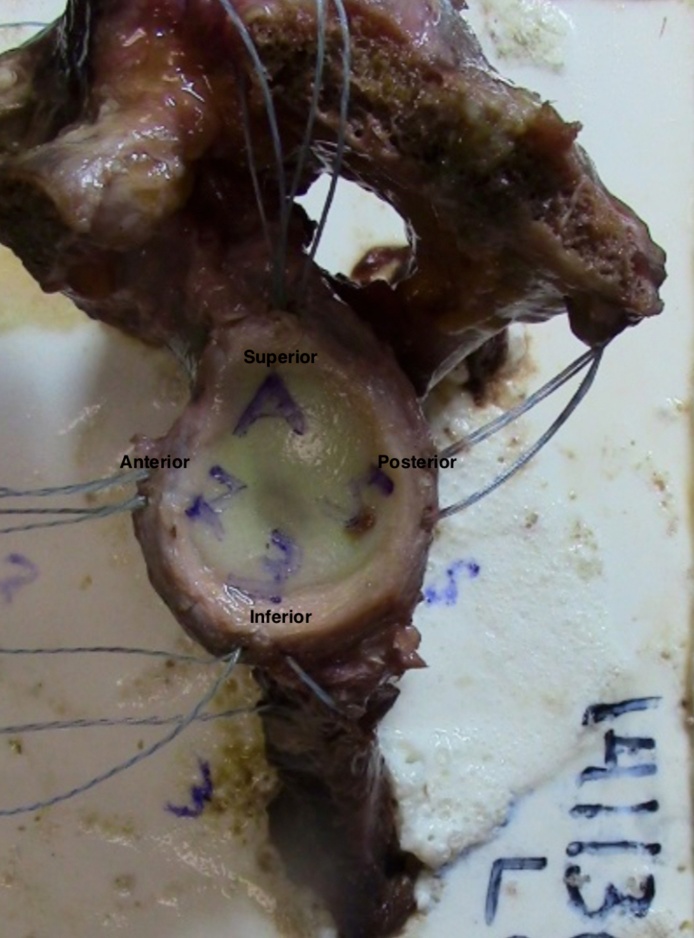
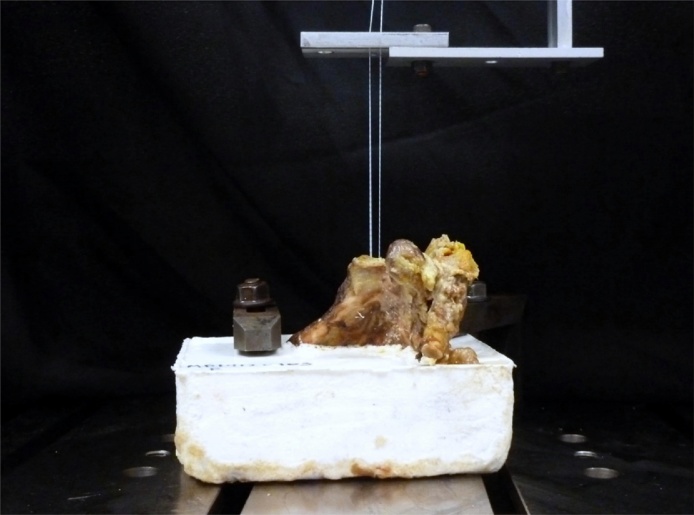
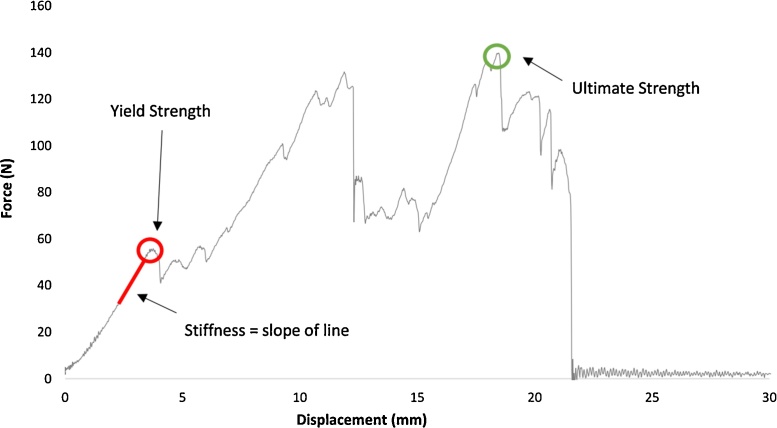
Methods: Twelve fresh-frozen human cadaveric glenoids were implanted with 1.4 mm all-suture anchors at varying inter-anchor distances. Each glenoid was used for four tests, for a total of 48 tests. Anchors were implanted adjacent to one another or with 2, 3, or 5 mm bone bridges between pilot holes. The glenoids then underwent pullout testing using a test frame with a 5N preload followed by displacement of 12.5 mm/s. The primary outcomes were stiffness, failure strength, and ultimate strength.
Results: Stiffness was 13.52 ± 3.8, 17.97 ± 5.02, 17.59 ± 4.65 and 18.95 ± 4.67 N/mm for the adjacent, 2, 3, and 5 mm treatment groups, respectively. The adjacent group had a significantly lower stiffness compared to the other treatment groups. Failure strength was 48.68 ± 20.64, 76.16 ± 23.78, 73.19 ± 35.83 and 87.04 ± 34.67 N for the adjacent, 2, 3, and 5 mm treatment groups, respectively. The adjacent group had a significantly lower failure strength compared to the other treatment groups. Ultimate strength was also measured to be 190.59 ± 140.93, 268.7 ± 115.1, 283.23 ± 118.43, and 291.28 ± 118.24 for the adjacent, 2, 3, and 5 mm treatment groups, respectively.
Conclusions: This biomechanical study provides evidence that 1.4 mm all-suture anchors demonstrate similar strength characteristics when placed at least 2 mm or greater from one another. When 1.4 mm all-suture anchors were placed adjacent to one another, there was an observed decrease in failure strength and stiffness.
Clinical relevance: This study suggests that 1.4 mm all-suture anchors may be placed as close as 2 mm to one another while preserving strength characteristics.
Keywords: All-suture anchor; Biomechanics; Pull out strength; Shoulder instability.
Figures
References
-
- Diduch D.R., Scanelli J., Tompkins M., Milewski M.D., Carson E., Ma S.-Y. Tissue anchor use in arthroscopic glenohumeral surgery. J Am Acad Orthop Surg. 2012;20:459–471. Richard. - PubMed
-
- Owens B.D., Harrast J.J., Hurwitz S.R., Thompson T.L., Wolf J.M. Surgical trends in Bankart repair: an analysis of data from the American Board of Orthopaedic Surgery certification examination. Am J Sports Med. 2011;39:1865–1869. - PubMed
-
- Wolf E.M., Wilk R.M., Richmond J.C. Arthroscopic Bankart repair using suture anchors. Oper Tech Orthop. 1991;1:184–191.
-
- Dhawan A., Ghodadra N., Karas V., Salata M.J., Cole B.J. Complications of bioabsorbable suture anchors in the shoulder. Am J Sports Med. 2012;40:1424–1430. - PubMed
-
- Silver M.D., Daigneault J.P. Symptomatic interarticular migration of glenoid suture anchors. Arthrosc J Arthrosc Relat Surg. 2000;16:102–105. - PubMed
LinkOut - more resources
Full Text Sources
Other Literature Sources
