


Obstructive Sleep Apnea as a Risk Factor for Atrial Fibrillation: A Meta-Analysis
- PMID: 29657903
- PMCID: PMC5898401
- DOI: 10.4172/2167-0277.1000282
Obstructive Sleep Apnea as a Risk Factor for Atrial Fibrillation: A Meta-Analysis
Abstract
Objectives: To conducted a meta-analysis assessing the relationship between Obstructive Sleep Apnea (OSA) and the risk of Atrial Fibrillation (AF).
Methods: We searched PUBMED, Medline, and Cochrane Library using the keywords "atrial fibrillation", "obstructive sleep apnea" and "sleep disordered breathing (SDB)". All subjects included had established diagnosis of OSA/SDB. We then compared the occurrence of AF versus no AF. Analysis done with Comprehensive Meta-Analysis package V3 (Biostat, USA).
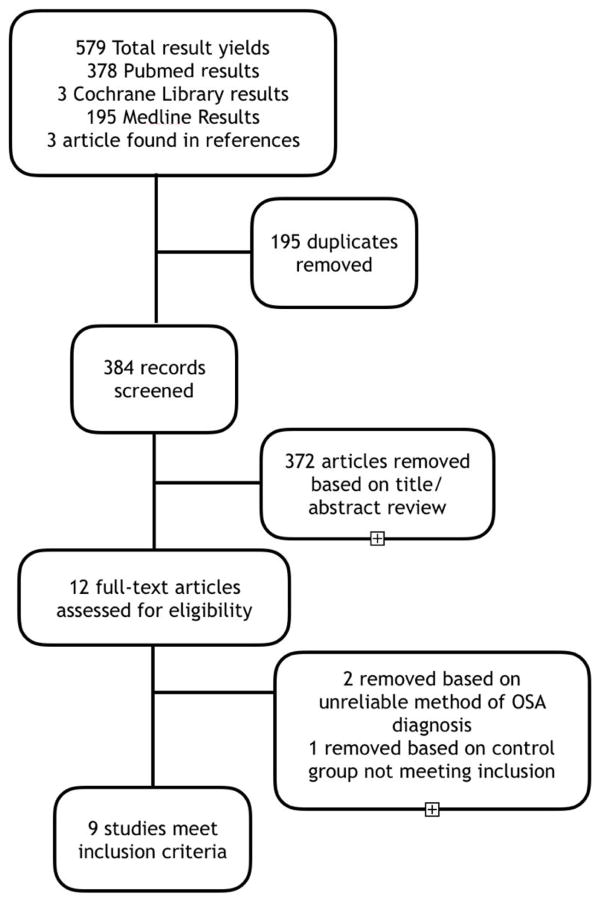
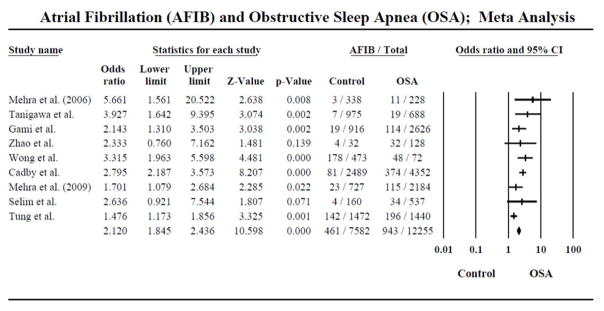
Results: A total of 579 results were generated. Duplicates were removed and 372 records were excluded based on irrelevant abstracts, titles, study design not consistent with the stated outcome, or full-text unavailable. Twelve studies meeting the inclusion criteria were reviewed in full-text; 2 of these articles were eventually removed due to unconfirmed OSA diagnostic modality, and one was also removed based on a control group inconsistent with the other studies. Therefore, a total of 9 studies were included (n=19,837). Sample sizes ranged from n=160 patients to n=6841 patients. The risk of AF was found to be higher among OSA/SDB versus control group (OR; 2.120, C.I: 1.845-2.436, Z; 10.598 p: <0.001). The heterogeneity observed for the pooled analysis was Q-value; 22.487 df (Q); 8 P-value; 0.004, I-squared; 64.424 Tau2; 0.098, suggesting appropriate study selection and moderate heterogeneity.
Conclusion: OSA/SDB is strongly associated with AFib confirming the notion that OSA/SDB populations are high risk for development of AF. Prospective studies are needed to ascertain the effect of the treatment of OSA/SDB for the prevention of AF, a growing health burden with serious consequences.
Keywords: Atrial Fibrillation; Cardiac arrhythmias; Health; Meta-analysis; Sleep Apnea.
Figures
References
-
- Miyasaka Y, Barnes ME, Gersh BJ, Cha SS, Bailey KR, et al. Secular trends in incidence of atrial fibrillation in Olmsted County, Minnesota, 1980 to 2000, and implications on the projections for future prevalence. Circulation. 2006;114:119–125. - PubMed
-
- Benjamin EJ, Wolf PA, D’Agostino RB, Silbershatz H, Kannel WB, et al. Impact of atrial fibrillation on the risk of death: the Framingham Heart Study. Circulation. 1998;98:946–952. - PubMed
-
- Du X, Dong J, Ma C. Is Atrial Fibrillation a Preventable Disease? J Am Coll Cardiol. 2017;69:1968–1982. - PubMed
-
- Young T, Peppard PE, Gottlieb DJ. Epidemiology of obstructive sleep apnea: A population health perspective. Am J Respir Crit Care Med. 2002;165:1217–1239. - PubMed
Grants and funding
LinkOut - more resources
Full Text Sources
Other Literature Sources
Miscellaneous