


THE ROLE OF PROTEIN CHAPERONES IN THE SURVIVAL FROM ANTHRACYCLINE-INDUCED OXIDATIVE STRESS IN SACCHAROMYCES CEREVISIAE
- PMID: 29657945
- PMCID: PMC5894877
THE ROLE OF PROTEIN CHAPERONES IN THE SURVIVAL FROM ANTHRACYCLINE-INDUCED OXIDATIVE STRESS IN SACCHAROMYCES CEREVISIAE
Abstract
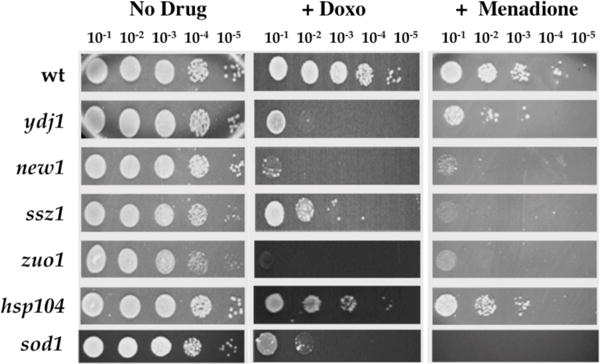
Several S. cerevisiae deletion strains involving heat-shock response factors were among the most sensitive mutants identified in a previous genetic screen for doxorubicin hypersensitivity. These strains included ydj1Δ, ssz1Δ and zuo1Δ mutants. In addition, new1Δ, whose function was unknown, also displayed significant sensitivity to anthracyclines. We further investigated the basis for the sensitivity of these mutants. We determined that heat-shock could partially rescue the sensitivity of the strains to doxorubicin, including the homologous recombination mutant rad52Δ, which is sensitive to doxorubicin-mediated DNA double strand breaks (DSBs). However, none of the heat-shock response mutants were sensitive to DSBs, but were highly sensitive to reactive oxygen species (ROS) generated by quinone-ring-containing agents, such as anthracyclines and menadione. A fluorescent-based assay indicates that doxorubicin causes protein aggregation. Interestingly, the disaggregase mutant hsp104Δ is not sensitive to anthracyclines or menadione suggesting that Hsp104p does not play a role in disaggregating doxorubicin-induced protein aggregates. However New1p, which has been recently shown to be a novel disaggregase, is essential for cell viability after exposure to anthracyclines and menadione and it is not involved in thermotolerance. Our data suggest that in S. cerevisiae, doxorubicin produces protein aggregation through ROS and requires Ydj1p and New1p for resolution.
Keywords: Anthracyclines; Cancer; Heat-Shock Response; Molecular Chaperones; Oxidative Stress.
Conflict of interest statement
Conflict of Interests The authors declare that there is no conflict of interests regarding the publication of this paper.
Figures


References
-
- Piekarski M, Jelinska A. Anthracyclines still prove effective in anticancer therapy. Mini Rev Med Chem. 2013;13(5):627–34. - PubMed
-
- Minotti G, et al. Anthracyclines: molecular advances and pharmacologic developments in antitumor activity and cardiotoxicity. Pharmacol Rev. 2004;56(2):185–229. - PubMed
-
- von Minckwitz G, Martin M. Neoadjuvant treatments for triple-negative breast cancer (TNBC) Ann Oncol. 2012;23(Suppl 6):vi35–9. - PubMed
-
- Dal Ben D, et al. DNA topoisomerase II structures and anthracycline activity: insights into ternary complex formation. Curr Pharm Des. 2007;13(27):2766–80. - PubMed
-
- Cummings J, et al. The enzymology of doxorubicin quinone reduction in tumour tissue. Biochem Pharmacol. 1992;44(11):2175–83. - PubMed
Grants and funding
LinkOut - more resources
Full Text Sources
Molecular Biology Databases