Surgical Treatment of Annuloaortic Ectasia - Replace or Repair?
- PMID: 29657952
- PMCID: PMC5890764
- DOI: 10.12945/j.aorta.2017.17.044
Surgical Treatment of Annuloaortic Ectasia - Replace or Repair?
Abstract
Background: Patients with annuloaortic ectasia may be surgically treated with modified Bentall or David I valve-sparing procedures. Here, we compared the long-term results of these procedures.
Methods: A total of 181 patients with annuloaortic ectasia underwent modified Bentall (102 patients, Group 1) or David I (79 patients, Group 2) procedures from 1994 to 2015. Mean age was 62 ± 11 years in Group 1 and 64 ± 16 years in Group 2. Group 1 patients were in poorer health, with a lower ejection fraction and higher functional class.
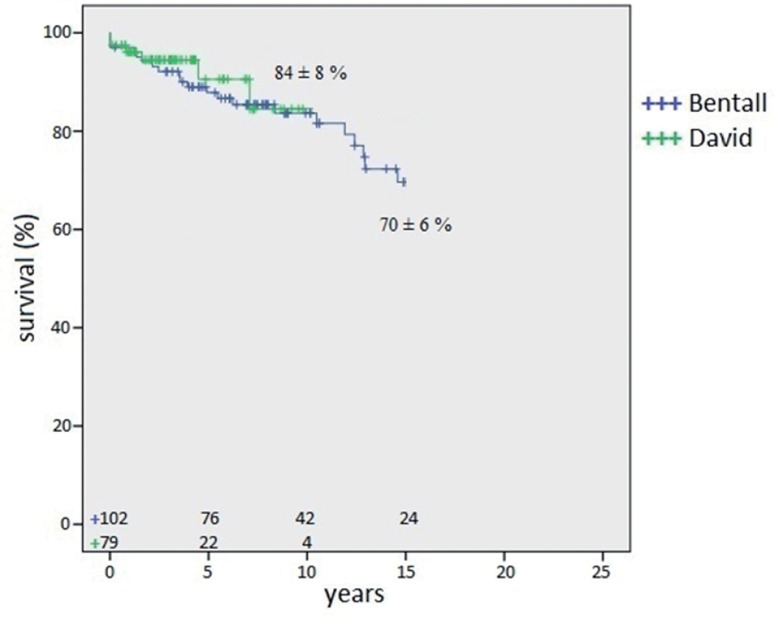
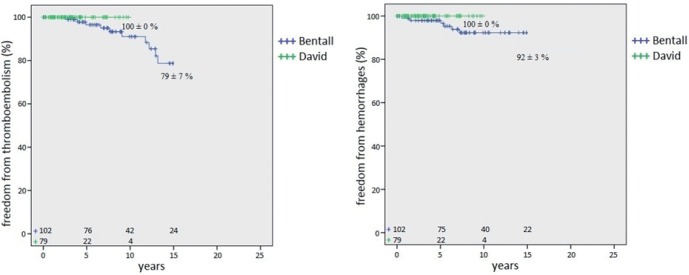
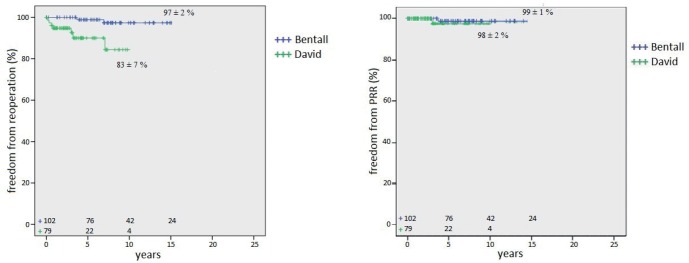
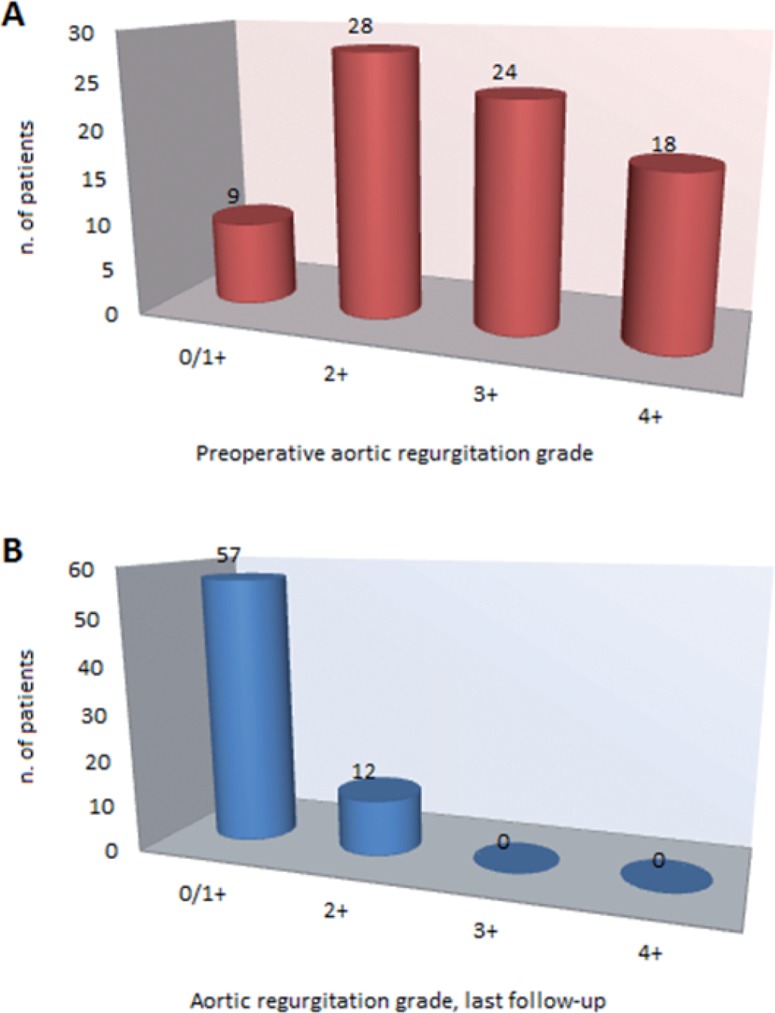
Results: Early mortality was 3% in Group 1 and 2.5% in Group 2. Patients undergoing a modified Bentall procedure had a higher incidence of thromboembolism and hemorrhage, whereas those undergoing a David I procedure had a higher incidence of endocarditis. Actuarial survival was 70 ± 6% at 15 years in Group 1 and 84 ± 7% at 10 years in Group 2. Actuarial freedom from reoperation was 97 ± 2% at 15 years in Group 1 and 84 ± 7% at 10 years in Group 2. In Group 2, freedom from procedure-related reoperations was 98 ± 2% at 10 years. At last follow-up, no cases of moderate or severe aortic regurgitation were observed.
Conclusions: The modified Bentall and David I procedures showed excellent early and late results. The modified Bentall procedure with a mechanical conduit was associated with thromboembolic and hemorrhagic complications, whereas the David I procedure was associated with unexplained occurrences of endocarditis. Thus, the David I procedure appears to be safe, reproducible, and capable of achieving stable aortic valve repair and is therefore our currently preferred solution for patients with annuloaortic ectasia. However, the much shorter follow-up for David I patients limits the strength of our comparison between the two techniques.
Keywords: Aorta; Aortic aneurysm; Aortic valve.
Figures
References
-
- Kouchoukos NT, Marshall WG Jr, Wedige-Stecher TA. Eleven-year experience with composite graft replacement of the ascending aorta and aortic valve. J Thorac Cardiovasc Surg. 1986;92:691-705. PMID: - PubMed
-
- David TE, Feindel M. An aortic valve-sparing operation for patients with aortic incompetence and aneurysm of the ascending aorta. J Thorac Cardiovasc Surg. 1992;103: 617-622. PMID: - PubMed
-
- Sarsam MA, Yacoub M. Remodeling of the aortic valve annulus. J Thorac Cardiovasc Surg. 1993;105:435-438. PMID: - PubMed
LinkOut - more resources
Full Text Sources
Other Literature Sources