Relationship between electronically measured medication adherence and vision-related quality of life in a cohort of patients with open-angle glaucoma
- PMID: 29657978
- PMCID: PMC5895971
- DOI: 10.1136/bmjophth-2017-000114
Relationship between electronically measured medication adherence and vision-related quality of life in a cohort of patients with open-angle glaucoma
Abstract
Objective: To investigate whether electronically measured medication adherence is associated with vision-related quality of life (VRQoL) in patients with open-angle glaucoma.
Methods and analysis: This is a 3-year prospective cohort study of 79 subjects with open-angle glaucoma at a Veterans Affairs medical centre. Participants returned a medication event monitoring system (MEMS) for their glaucoma eye-drops and had at least two visits with glaucoma during the study period. Those taking less than 80% of prescribed glaucoma medication doses were considered to be non-adherent. Subjects were interviewed using the National Eye Institute's Visual Function Questionnaire-25 (VFQ-25) at baseline and after 3 years.
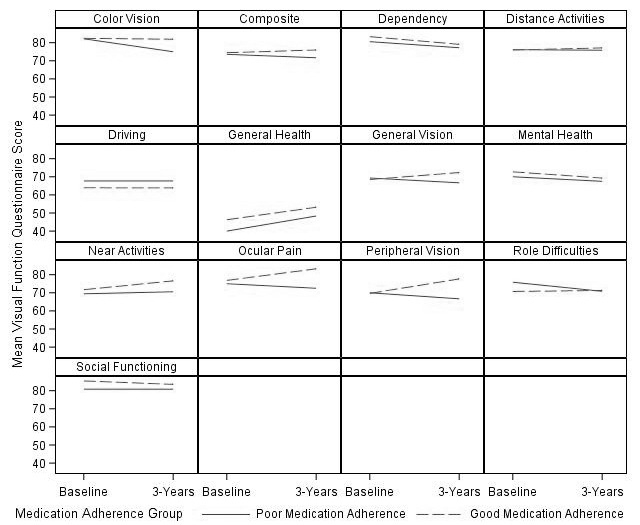
Results: Thirty per cent (n=24/79) of participants took less than 80% of prescribed doses of their glaucoma medications at baseline. Patients who did not adhere to their medications at baseline had lower mean composite VFQ-25 scores at baseline (70.66±20.50 vs 75.91±19.12, standardised mean difference=0.27) and after 3 years (71.68±21.93 vs 76.25±21.67, standardised mean difference=0.21). Visual acuity (P=0.03), but not visual field severity (P=0.13) or medication adherence (P=0.30), was significantly associated with composite VFQ-25 score in an adjusted model.
Conclusions: Subjects who were non-adherent to their glaucoma medications at baseline as assessed by a MEMS device reported lower VRQoL than adherent subjects at baseline and after 3 years. However, visual acuity was significantly associated with VRQoL. Future studies should assess whether improved adherence to eye-drops impacts VRQoL in patients with glaucoma.
Keywords: electronically measured medication adherence; open angle glaucoma; vision-related quality of life.
Conflict of interest statement
Competing interests: None declared.
Figures
References
-
- Resnikoff S, Pascolini D, Etya’ale D, et al. Global data on visual impairment in the year 2002. Bull World Health Organ 2004;82:844–51. doi:/S0042-96862004001100009 - PMC - PubMed
-
- Heijl A, Leske MC, Bengtsson B, et al. Reduction of intraocular pressure and glaucoma progression: results from the Early Manifest Glaucoma Trial. Archives of ophthalmology 2002;120:1268–79. - PubMed
-
- Friedman DS, Wolfs RC, O’Colmain BJ, et al. Prevalence of open-angle glaucoma among adults in the United States. Arch Ophthalmol 2004;122:532–8. doi:10.1001/archopht.122.4.532 - DOI - PMC - PubMed
-
- Patel SC, Spaeth GL. Compliance in patients prescribed eye drops for glaucoma. Ophthalmic Surg. May 1995;26:233–6. - PubMed
-
- Muir KW, Christensen L, Bosworth HB. Health literacy and glaucoma. Curr Opin Ophthalmol 2013;24:119–24. doi:10.1097/ICU.0b013e32835c8b0e - DOI - PubMed
LinkOut - more resources
Full Text Sources
Other Literature Sources