. 2018 May;19(7):687-711.
doi: 10.1080/14656566.2018.1462795. Epub 2018 Apr 16.

An update and systematic review on drug therapies for the treatment of refractory chronic cough

Affiliations

An update and systematic review on drug therapies for the treatment of refractory chronic cough

Nicole M Ryan et al. Expert Opin Pharmacother. 2018 May.

Abstract

Introduction: Chronic Cough (CC) is common and often associated with significant comorbidity and decreased quality of life. In up to 50% of cases, the cough is refractory despite extensive investigation and treatment trials. It is likely that the key abnormality in refractory CC is dysfunctional, hypersensitive sensory nerves, similar to conditions such as laryngeal hypersensitivity and neuropathic pain.

Areas covered: The aim of this systematic review is to assess drug therapies for refractory CC. The authors review the current management of CC and provide discussion of the similarities between neuropathic pain and refractory CC. They review repurposed and new pharmacological treatments. Several meta-analyses were performed to compare the efficacy of treatments where possible.

Expert opinion: Repurposed pain medications such as gabapentin and pregabalin reduce the frequency of cough and improve quality of life. Along with speech pathology, they are important and alternate treatments for refractory CC. However, more treatments are needed and the P2X3 ion channel receptor antagonists show the most promise. With a better understanding of neuronal activation and sensitisation and their signal processing in the brain, improved animal models of cough, and the use of validated cough measurement tools, more effective treatments will develop.

Keywords: Antitussives; cough hypersensitivity syndrome; ion channel receptor antagonists; neuromodulating drugs; refractory chronic cough.


Figures
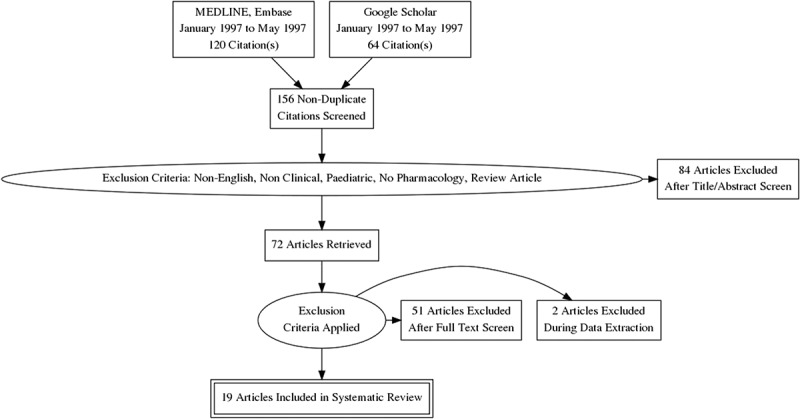
Figure 1.
Figure 1.
PRISMA flow diagram explaining the screening process of citations and number of articles included in the systematic review.
Figure 2.
Figure 2.
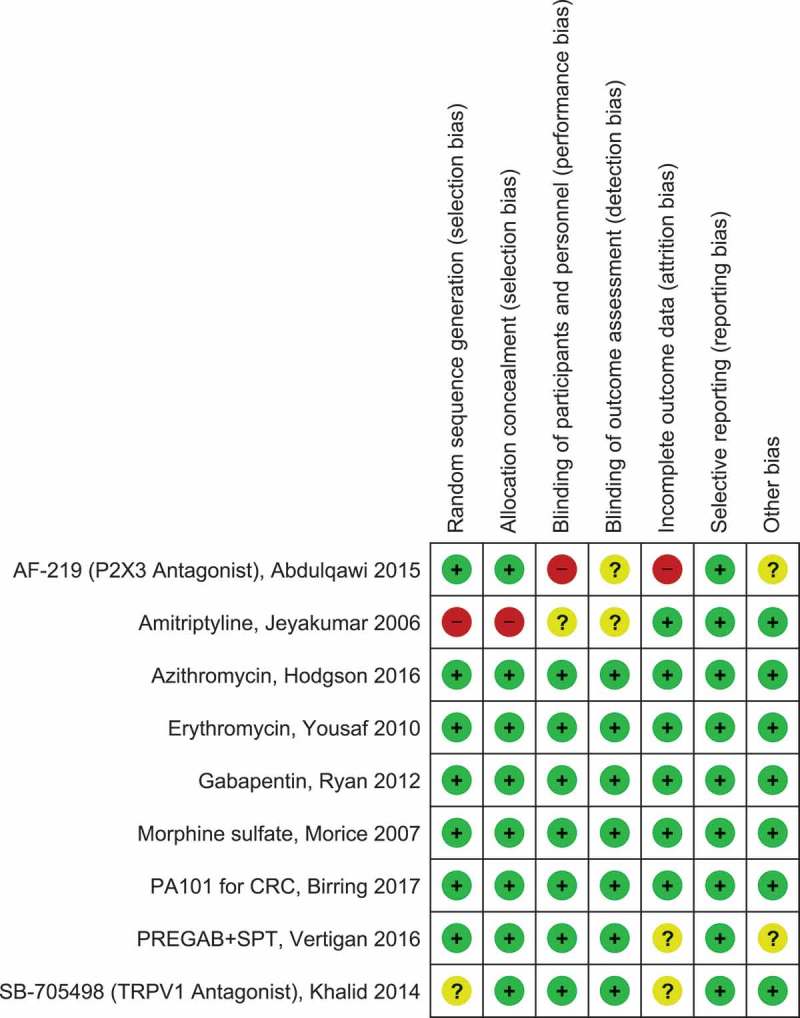
Quality assessment (Cochrane risk of bias tool) for included RCTs. Green circle with plus sign indicates low risk of bias, yellow circle with question mark indicates unclear risk of bias, red circle with minus sign indicates high risk of bias. RevMan Version 5.3. Copenhagen: The Nordic Cochrane Centre, the Cochrane Collaboration, 2014. Full color available online.
Figure 3.
Figure 3.
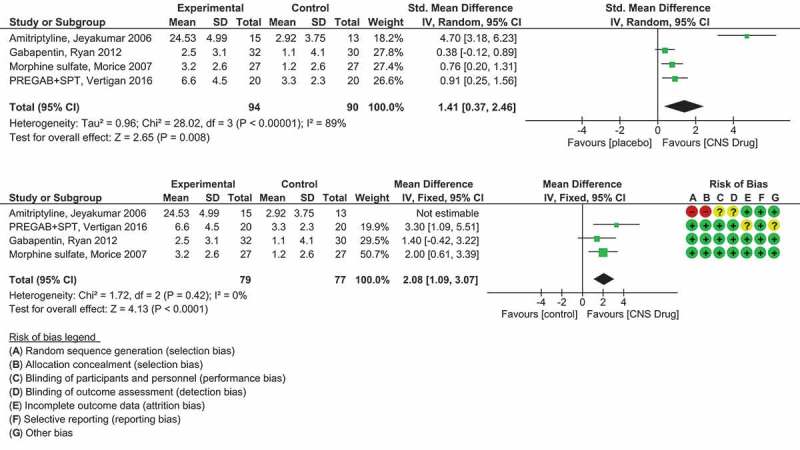
(a) Forest plot of a meta-analysis on CNS/neuromodulating medication vs. placebo medication on cough QOL. As the Jeyakumar et al study used a different cough QOL measurement (the CQLQ) compared to the LCQ the standardised mean difference (SMDs) were calculated. (b) Forest plot of a meta-analysis on CNS/neuromodulating medication vs. placebo medication on cough QOL. The study under high risk of selection bias (Jeyakumar et al.) was removed in a sensitivity analysis. The remaining three studies all used the same cough QOL measurement (LCQ) so the mean differences (MDs) were calculated. The green squares and black horizontal lines represent the SMD or MD and 95% CI for each study. The larger the green square the more weight that study contributes to the overall pooled estimate (black diamond). Risk of bias summary has also been included for each study (top right). RevMan Version 5.3. Copenhagen: The Nordic Cochrane Centre, the Cochrane Collaboration, 2014. Full color available online.
Figure 4.
Figure 4.
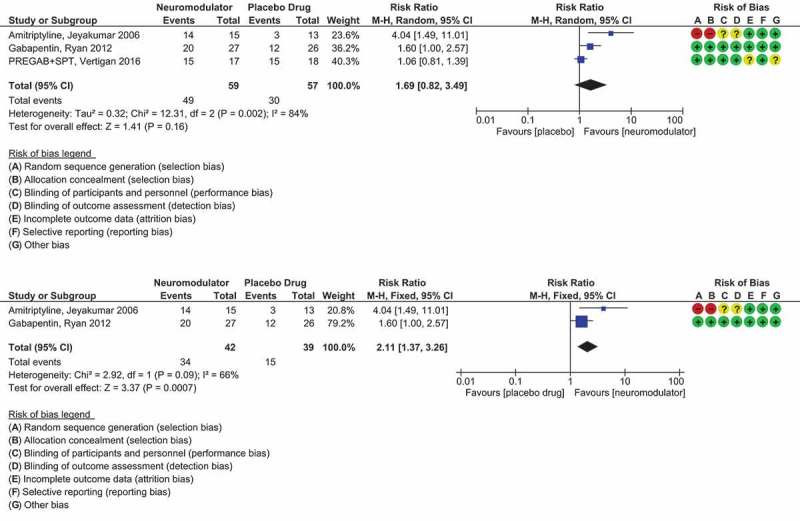
(a) Forest plot comparing responders to non-responders for the CNS/neuromodulating medications of amitriptyline, gabapentin and pregabalin placebo-controlled randomised trials. (b) Forest plot comparing responders to non-responders for gabapentin and amitriptyline placebo-controlled randomised trials only. The blue squares and black horizontal lines represent the Risk Ratio and 95% CI for each study. The larger the blue square the more weight that study contributes to the overall pooled estimate (black diamond). Summary risk of bias has also been included for each study. RevMan Version 5.3. Copenhagen: The Nordic Cochrane Centre, the Cochrane Collaboration, 2014. Full color available online.
Figure 5.
Figure 5.
Forest plot of the P2X3 receptor antagonist AF-219/MK-7264 compared to placebo medication. The green squares and black horizontal lines represent the SMDs and 95% CI for each study. The larger the green square the more weight that study contributes to the overall pooled estimate (black diamond). Risk of bias assessment not included as the Smith et al [92] study is a published Abstract only. Full color available online.
Figure 6.
Figure 6.
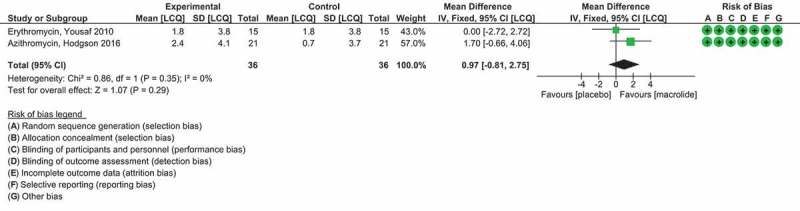
Forest plot of macrolide antibiotics erythromycin and azithromycin compared to placebo medication. The green squares and black horizontal lines represent the Risk Ratio and 95% CI for each study. The larger the green square the more weight that study contributes to the overall pooled estimate (black diamond). Summary risk of bias has also been included for each study. Full color available online.

References

    1. Birring SS, Prudon B, Carr AJ, et al. Development of a symptom specific health status measure for patients with chronic cough: Leicester Cough Questionnaire (LCQ). Thorax. 2003;58:339–343. - PMC - PubMed
    1. Haque RA, Usmani OS, Barnes PJ.. Chronic idiopathic cough: a discrete clinical entity? CHEST J. 2005;127:1710–1713. - PubMed
    1. Gibson P, Wang G, McGarvey L, et al. Treatment of unexplained chronic cough: CHEST guideline and expert panel report. CHEST J. 2016;149:27–44. - PMC - PubMed
    2. • These recent cough guidelines recommend that speech pathology treatment or a trial of gabapentin be trialed for those patients with unexplained cough or to those that remain refractory to usual cough treatments.

    1. Chung KF, Pavord ID.. Prevalence, pathogenesis, and cause of chronic cough. Lancet. 2008;371:1364–1374. - PubMed
    1. Irwin RS, Boulet LP, Cloutier MM, et al. Managing cough as a defence mechanism and as a symptom. A consensus panel report of the American College of Chest Physicians. Chest. 1998;114:1269–1275. - PubMed

Publication types