


Opioid Discussion in the Twittersphere
- PMID: 29659320
- PMCID: PMC6314840
- DOI: 10.1080/10826084.2018.1458319
Opioid Discussion in the Twittersphere
Abstract
Background: The rise in opioid use and overdose has increased the importance of improving data collection methods for the purpose of targeting resources to high-need populations and responding rapidly to emerging trends.
Objective: To determine whether Twitter data could be used to identify geographic differences in opioid-related discussion and whether opioid topics were significantly correlated with opioid overdose death rate.
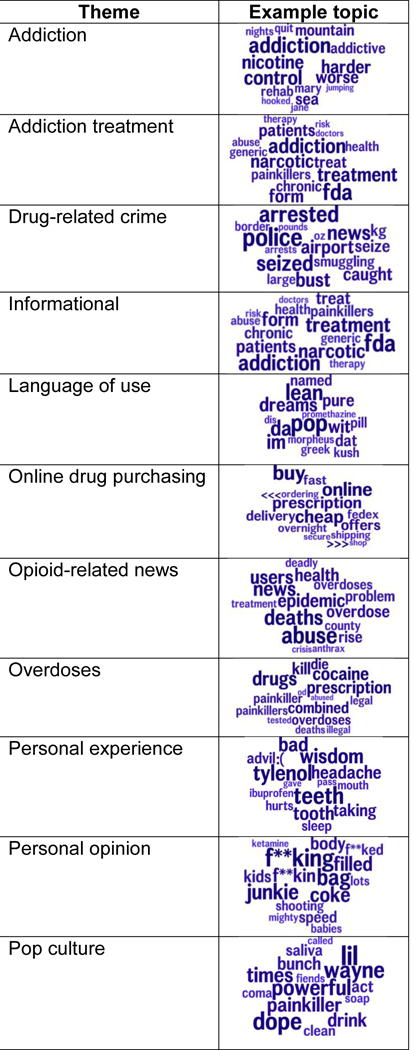
Methods: We filtered approximately 10 billion tweets for keywords related to opioids between July 2009 and October 2015. The content of the messages was summarized into 50 topics generated using Latent Dirchlet Allocation, a machine learning analytic tool. The correlation between topic distribution and census region, census division, and opioid overdose death rate were quantified.
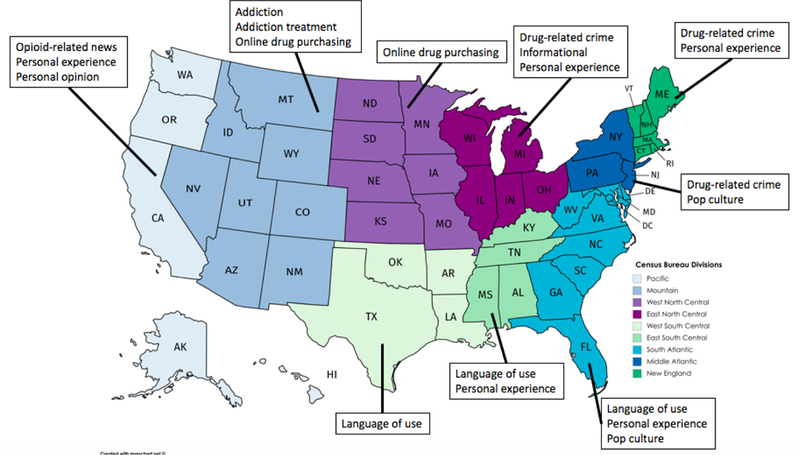
Results: We evaluated a tweet cohort of 84,023 tweets from 72,211 unique users across the US. Unique opioid-related topics were significantly correlated with different Census Bureau divisions and with opioid overdose death rates at the state and county level. Drug-related crime, language of use, and online drug purchasing emerged as themes in various Census Bureau divisions. Drug-related crime, opioid-related news, and pop culture themes were significantly correlated with county-level opioid overdose death rates, and online drug purchasing was significantly correlated with state-level opioid overdoses.
Conclusions: Regional differences in opioid-related topics reflect geographic variation in the content of Twitter discussion about opioids. Analysis of Twitter data also produced topics significantly correlated with opioid overdose death rates. Ongoing analysis of Twitter data could provide a means of identifying emerging trends related to opioids.
Keywords: Crime; opioids; overdose; social media; twitter.
Figures
References
-
- Association for Computational Linguistics. (2012, July 10). Proceeding of the system demonstrations. Retrieved from http://www.anthology.aclweb.org/P/P12/P12-3.pdf#page=37
-
- Beletsky L, Davis CS (2017). Today’s fentanyl crisis: Prohibition’s Iron Law, revisited. Int J Drug Policy, 46:156–159. - PubMed
-
- Blanco C, Alderson D, Ogburn E, et al. (2007). Changes in the prevalence of non-medical prescription drug use and drug use disorders in the United States: 1991–1992 and 2001–2002. Drug Alcohol Depend, 90(2–3):252–260. - PubMed
-
- Centers for Disease Control and Prevention. (2014). Opioid painkiller prescribing infographic . Retrieved from https://www.cdc.gov/vitalsigns/opioid-prescribing/infographic.html
Publication types
MeSH terms
Substances
Grants and funding
LinkOut - more resources
Full Text Sources
Other Literature Sources
Medical
