. 2018 Apr 16;14(4):e1007342.
doi: 10.1371/journal.pgen.1007342. eCollection 2018 Apr.

Cyclic di-AMP regulation of osmotic homeostasis is essential in Group B Streptococcus

Affiliations

Cyclic di-AMP regulation of osmotic homeostasis is essential in Group B Streptococcus

Laura Devaux et al. PLoS Genet. .

Abstract

Cyclic nucleotides are universally used as secondary messengers to control cellular physiology. Among these signalling molecules, cyclic di-adenosine monophosphate (c-di-AMP) is a specific bacterial second messenger recognized by host cells during infections and its synthesis is assumed to be necessary for bacterial growth by controlling a conserved and essential cellular function. In this study, we sought to identify the main c-di-AMP dependent pathway in Streptococcus agalactiae, the etiological agent of neonatal septicaemia and meningitis. By conditionally inactivating dacA, the only diadenyate cyclase gene, we confirm that c-di-AMP synthesis is essential in standard growth conditions. However, c-di-AMP synthesis becomes rapidly dispensable due to the accumulation of compensatory mutations. We identified several mutations restoring the viability of a ΔdacA mutant, in particular a loss-of-function mutation in the osmoprotectant transporter BusAB. Identification of c-di-AMP binding proteins revealed a conserved set of potassium and osmolyte transporters, as well as the BusR transcriptional factor. We showed that BusR negatively regulates busAB transcription by direct binding to the busAB promoter. Loss of BusR repression leads to a toxic busAB expression in absence of c-di-AMP if osmoprotectants, such as glycine betaine, are present in the medium. In contrast, deletion of the gdpP c-di-AMP phosphodiesterase leads to hyperosmotic susceptibility, a phenotype dependent on a functional BusR. Taken together, we demonstrate that c-di-AMP is essential for osmotic homeostasis and that the predominant mechanism is dependent on the c-di-AMP binding transcriptional factor BusR. The regulation of osmotic homeostasis is likely the conserved and essential function of c-di-AMP, but each species has evolved specific c-di-AMP mechanisms of osmoregulation to adapt to its environment.


Conflict of interest statement

The authors have declared that no competing interests exist.

Figures
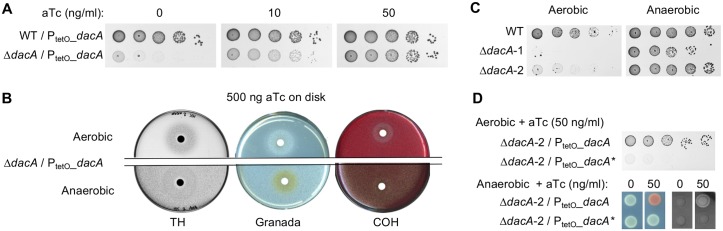
Fig 1
Fig 1. c-di-AMP synthesis is conditionally essential in GBS.
(A) Serial dilutions of the WT and ΔdacA mutant containing the inducible PtetO_dacA vector were spotted on TH agar supplemented or not with anydrotetracycline (aTc), and incubated 24 hours in standard growth condition (i.e. aerobic condition). (B) Growth of the ΔdacA / PtetO_dacA mutant on TH, Granada, and Columbia + 5% horse blood (COH) incubated in aerobiosis or anaerobiosis for 24 hours. About 104 bacteria were spread on each media and a disk containing 500 ng aTc was added on each plate before incubation. (C) Growth of the ΔdacA-1 and ΔdacA-2 mutants on TH incubated in aerobiosis or anaerobiosis. (D) Growth of the ΔdacA-2 mutant complemented with the WT dacA or the inactivated dacA* alleles under the control of the inducible promoter PtetO on TH incubated in aerobiosis with aTc, and on Granada and COH in anaerobiosis with or without aTc.
Fig 2
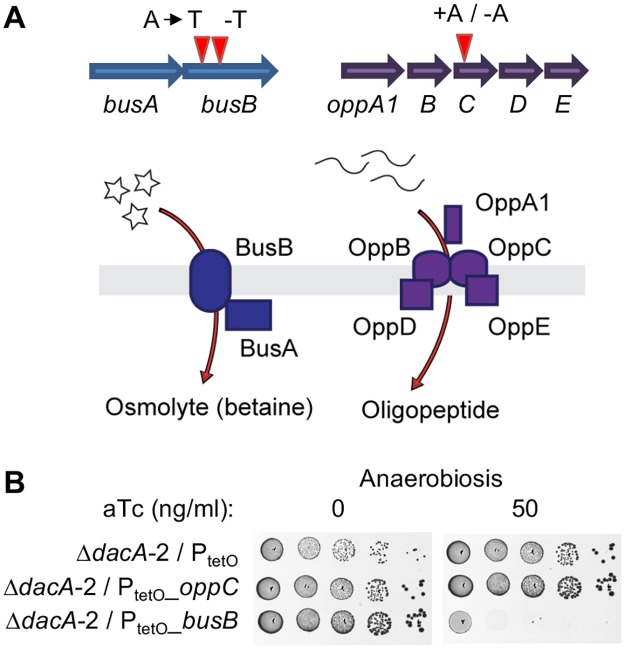
Fig 2. Mutation of the BusAB transporter is necessary in the absence of c-di-AMP.
(A) Schematic representations of the independent busB and oppC mutations in ΔdacA mutants and of the BusAB and Opp transporters. (B) Conditional expression of a WT copy of oppC and busB in the ΔdacA-2 mutant in anaerobiosis on TH with and without aTc. The ΔdacA-2 mutant with the empty vector PtetO is used as a control.
Fig 3
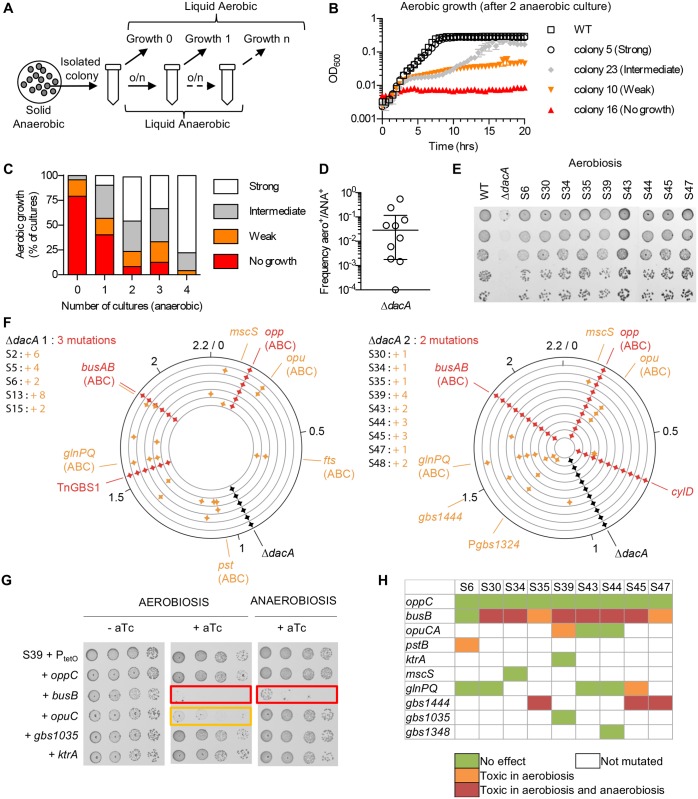
Fig 3. Adaptation to the absence of c-di-AMP synthesis involves intertwined mutations.
(A) Schematic representation of the experiment. Strains were propagated on solid media in anaerobiosis. Isolated colonies were picked in TH and incubated overnight (o/n) at 37°C in anaerobiosis. At each serial dilution step (0, 1, … n), aliquots were taken and the growth in aerobiosis was monitored in triplicate. (B) Representative growth curves of the ΔdacA-2 mutant in aerobiosis after two serial culture in anaerobiosis. The growth curves obtained from 4 independent ΔdacA colonies (number 5, 8, 9 and 16) illustrate the variability. Growth curves were classified as corresponding to no growth (OD < 0.01), weak (OD < 0.1), intermediate (OD > 0.1 at 20 hrs), or strong adaptation (OD > 0.1 at 10 hrs). Growth curves are the mean of triplicate +/- SEM for each independent colony. (C) Percentage of ΔdacA-2 cultures (n = 24) showing aerobic adaptation following serial cultures in anaerobic condition. Similar results were obtained with 24 cultures done with the ΔdacA-1 mutant. (D) Frequency of ΔdacA mutant able to grow in aerobiosis on TH agar plates after dilution of one overnight anaerobic cultures. Median with interquartile range were calculated from ten independent cultures. (E) Suppressors corresponding to ΔdacA mutant able to grow aerobically were isolated and their phenotype confirmed by spotting on TH agar. (F) Distribution of the mutation on the 2.2 Mb genome of ΔdacA-1 (left) and ΔdacA-2 (right) mutants (outer ring) and of ΔdacA suppressors (inner rings). The dacA deletion is highlighted in black. Mutations in the ΔdacA-1 and ΔdacA-2 mutants absent in the parental WT strain are color-coded in red, and mutations specific of suppressors are in orange. Identity of gene or operon independently mutated in more than two strains are shown. ABC transporters are indicated in bracket. (G) Conditional expression of a WT copy of mutated genes in the ΔdacA suppressors S39. Phenotypic effect of the expression of each gene was tested by adding aTc (50 ng/ml) in TH. Coloured boxes highlight growth inhibition upon expression of a WT allele in aerobiosis and anaerobiosis (red boxes), or aerobiosis only (orange). (H) Same experiment as in (G) in 9 ΔdacA suppressors. See S3 Fig for the corresponding images.
Fig 4
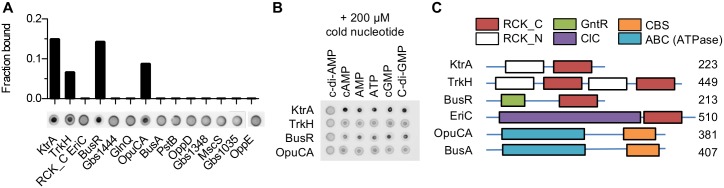
Fig 4. c-di-AMP binds three transporters subunits and a transcriptional factor.
(A) Interaction of radiolabelled c-di-AMP with targeted protein by DRaCALA. Full-length proteins were expressed in E. coli, except for EriC where only the RCK_C can be expressed. Whole E. coli extracts were mixed with radiolabelled c-di-AMP and spotted on a nitrocellulose membrane. C-di-AMP bounds to protein does not diffuse as far as free c-di-AMP. Quantification of the inner and outer circles intensities allows to calculate the fraction of bound c-di-AMP. (B) Specificity of the c-di-AMP interaction. Same as (A) with the addition of cold competitor to the reaction before spotting on membrane. (C) Color-coded representation of the domain organisation of selected proteins. Number of amino acids are indicated at the end of proteins. The RCK_C (red) and CBS (orange) domains are predicted c-di-AMP and nucleotides binding domains, respectively. The RCK_N domain (regulator of potassium conductance, white) is prevalent among potassium channels. The GntR domain (green) is a winged helix-turn-helix DNA binding domain. The ABC domain (blue) represent the ATPase domain of ABC transporter. The ClC domain (purple) is found in chloride ion channels, a family of voltage-dependent gating transporter with 11 transmembrane domains.
Fig 5
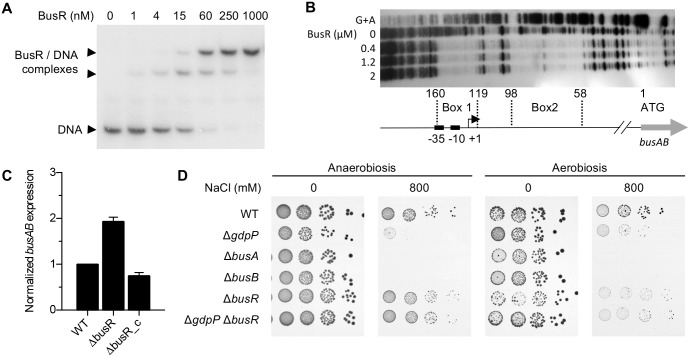
Fig 5. BusR is a transcriptional repressor of the osmolyte transporter BusAB.
(A) Gel shift assay with increasing concentration of recombinant BusR and the radiolabelled PbusAB promoter. (B) Footprint experiment on the PbusAB promoter with BusR. The two DNase I protected boxes are numbered from the start codon of the busAB operon. The position of the transcriptional start site and of the -10 and -35 elements are highlighted. (C) Quantification of busAB transcript by RT-qPCR in the WT, the ΔbusR mutant, and the ΔbusR_c complemented strain. Means and SD are calculated from three independent RNA purification done from exponentially growing cultures in TH. (D) Spotting dilutions of WT, ΔgdpP, ΔbusA, ΔbusB, ΔbusR, and ΔgdpP ΔbusR cultures on TH with and without 800 mM NaCl incubated in aerobiosis and anaerobiosis.
Fig 6
Fig 6. c-di-AMP is dispensable in osmolyte depleted medium.
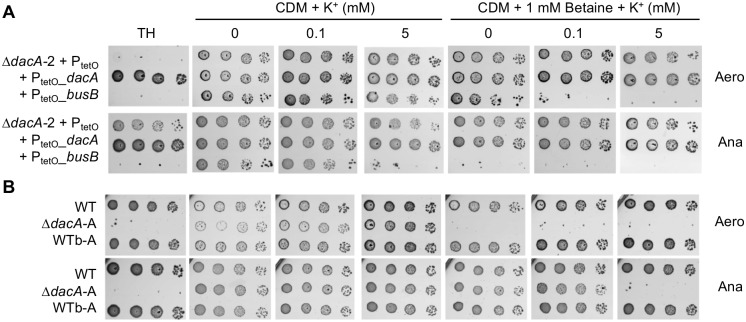
(A) Growth of the ΔdacA-2 mutant with the empty vector control (PtetO), and the dacA or busB conditional expression vectors (PtetO_dacA or PtetO_busB) on media with 50 ng/ml aTc. The rich TH medium was used as control and potassium and glycine betaine was added to synthetic medium (CDM) incubated in aerobiosis and anaerobiosis. (B) Same experiment as in (A) with the ΔdacA-A mutant and its isogenic WTb-A control.
Fig 7
Fig 7. c-di-AMP is a central regulator of osmotic homeostasis in GBS.
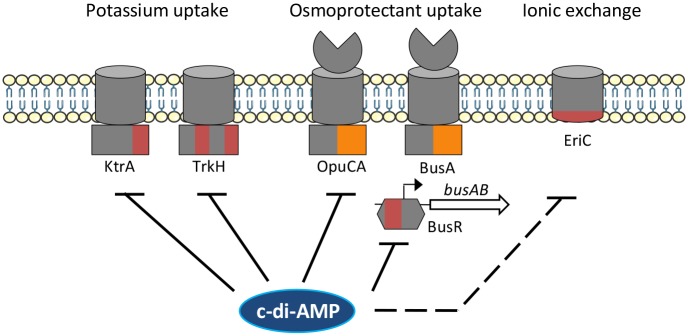
Coordination of osmotic transporters by c-di-AMP occurs at the post-translational and transcriptional levels. The KtrA and TrkH potassium transporter subunits and the OpuCA osmolyte transporter subunit are conserved c-di-AMP binding proteins. The c-di-AMP binding BusR transcriptional factor is a repressor of the second osmolyte transporter BusAB. Inactivation of BusR leads to busAB expression, a main cause of growth inhibition in the absence of c-di-AMP in rich media or in presence of osmolytes. C-di-AMP might also regulate EriC, a RCK_C domain containing chloride channel protein with 11 transmembrane domains. The RCK_C and CBS domains are color-coded red and orange, respectively.

References

    1. McDonough KA, Rodriguez A. The myriad roles of cyclic AMP in microbial pathogens: from signal to sword. Nat Rev Microbiol. 2012;10(1):27–38. - PMC - PubMed
    1. Jenal U, Reinders A, Lori C. Cyclic di-GMP: second messenger extraordinaire. Nat Rev Microbiol. 2017;15(5):271–84. doi: 10.1038/nrmicro.2016.190 - DOI - PubMed
    1. Krasteva PV, Sondermann H. Versatile modes of cellular regulation via cyclic dinucleotides. Nat Chem Biol. 2017;13(4):350–9. doi: 10.1038/nchembio.2337 - DOI - PMC - PubMed
    1. Danilchanka O, Mekalanos JJ. Cyclic dinucleotides and the innate immune response. Cell. 2013;154(5):962–70. doi: 10.1016/j.cell.2013.08.014 - DOI - PMC - PubMed
    1. Gao J, Tao J, Liang W, Jiang Z. Cyclic (di)nucleotides: the common language shared by microbe and host. Curr Opin Microbiol. 2016;30:79–87. doi: 10.1016/j.mib.2015.12.005 - DOI - PubMed

Publication types

MeSH terms

LinkOut - more resources