The non-linear and lagged short-term relationship between rainfall and leptospirosis and the intermediate role of floods in the Philippines
- PMID: 29659576
- PMCID: PMC5919665
- DOI: 10.1371/journal.pntd.0006331
The non-linear and lagged short-term relationship between rainfall and leptospirosis and the intermediate role of floods in the Philippines
Abstract
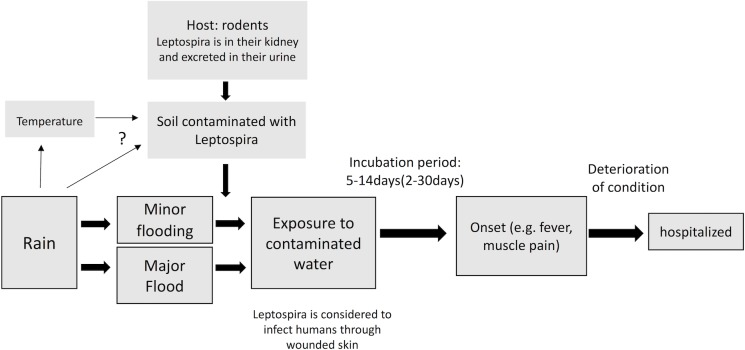
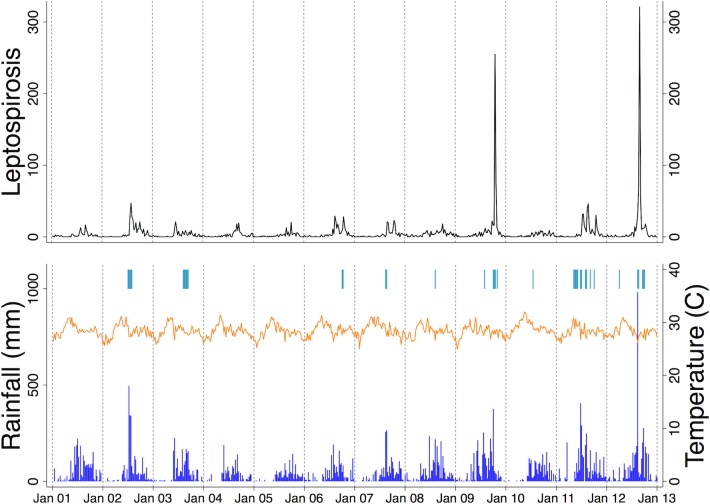
Background: Leptospirosis is a worldwide bacterial zoonosis. Outbreaks of leptospirosis after heavy rainfall and flooding have been reported. However, few studies have formally quantified the effect of weather factors on leptospirosis incidence. We estimated the association between rainfall and leptospirosis cases in an urban setting in Manila, the Philippines, and examined the potential intermediate role of floods in this association.
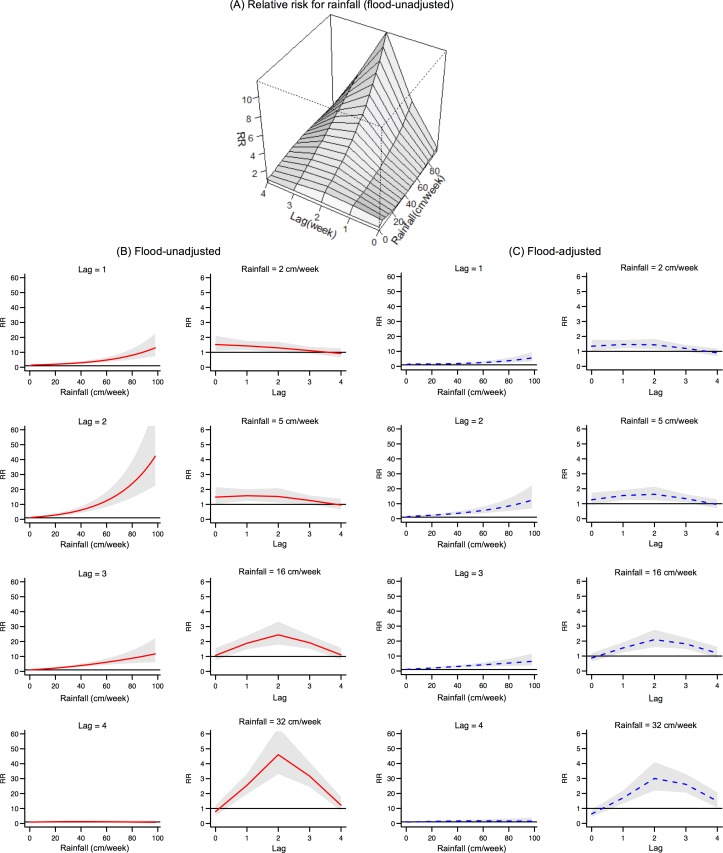
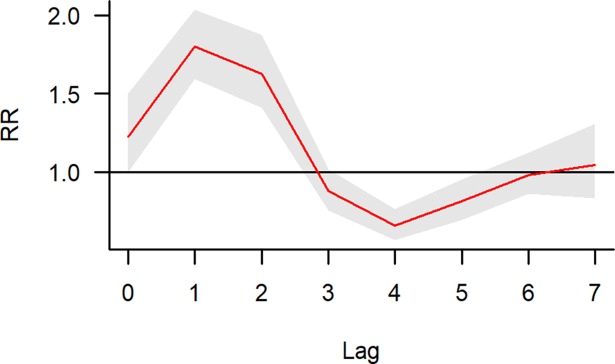
Methods/principal findings: Relationships between rainfall and the weekly number of hospital admissions due to leptospirosis from 2001 to 2012 were analyzed using a distributed lag non-linear model in a quasi-Poisson regression framework, controlling for seasonally varying factors other than rainfall. The role of floods on the rainfall-leptospirosis relationship was examined using an indicator. We reported relative risks (RRs) by rainfall category based on the flood warning system in the country. The risk of post-rainfall leptospirosis peaked at a lag of 2 weeks (using 0 cm/week rainfall as the reference) with RRs of 1.30 (95% confidence interval: 0.99-1.70), 1.53 (1.12-2.09), 2.45 (1.80-3.33), 4.61 (3.30-6.43), and 13.77 (9.10-20.82) for light, moderate, heavy, intense and torrential rainfall (at 2, 5, 16, 32 and 63 cm/week), respectively. After adjusting for floods, RRs (at a lag of 2 weeks) decreased at higher rainfall levels suggesting that flood is on the causal pathway between rainfall and leptospirosis.
Conclusions: Rainfall was strongly associated with increased hospital admission for leptospirosis at a lag of 2 weeks, and this association was explained in part by floods.
Conflict of interest statement
The authors declared no competing interests.
Figures
References
-
- Bharti AR, Nally JE, Ricaldi JN, Matthias MA, Diaz MM, Lovett MA, et al. Leptospirosis: a zoonotic disease of global importance. The Lancet infectious diseases. 2003;3(12):757–71. Epub 2003/12/04. . - PubMed
-
- Levett PN. Leptospirosis. Clinical microbiology reviews. 2001;14(2):296–326. Epub 2001/04/09. doi: 10.1128/CMR.14.2.296-326.2001 ; PubMed Central PMCID: PMC88975. - DOI - PMC - PubMed
-
- Ko AI, Goarant C, Picardeau M. Leptospira: the dawn of the molecular genetics era for an emerging zoonotic pathogen. Nature reviews Microbiology. 2009;7(10):736–47. Epub 2009/09/17. doi: 10.1038/nrmicro2208 ; PubMed Central PMCID: PMCPMC3384523. - DOI - PMC - PubMed
-
- Costa F, Hagan JE, Calcagno J, Kane M, Torgerson P, Martinez-Silveira MS, et al. Global Morbidity and Mortality of Leptospirosis: A Systematic Review. PLoS neglected tropical diseases. 2015;9(9):e0003898 Epub 2015/09/18. doi: 10.1371/journal.pntd.0003898 ; PubMed Central PMCID: PMCPMC4574773. - DOI - PMC - PubMed
-
- Budihal SV, Perwez K. Leptospirosis diagnosis: competancy of various laboratory tests. J Clin Diagn Res. 2014;8(1):199–202. doi: 10.7860/JCDR/2014/6593.3950 - DOI - PMC - PubMed
Publication types
MeSH terms
LinkOut - more resources
Full Text Sources
Other Literature Sources
Medical