


Anti-Müllerian hormone levels and incidence of early natural menopause in a prospective study
- PMID: 29659835
- PMCID: PMC6366539
- DOI: 10.1093/humrep/dey077
Anti-Müllerian hormone levels and incidence of early natural menopause in a prospective study
Abstract
Study question: Are anti-Müllerian hormone (AMH) levels assessed in women aged 32-44 associated with risk of incident early natural menopause?
Summary answer: We observed strong, significant associations between lower AMH levels and higher risk of early menopause.
What is known already: The ability to predict risk early menopause, defined as menopause before age 45, prior to fertility decline would improve options for family planning and cardiovascular disease prevention. Though AMH is an established marker of menopause timing in older reproductive-aged women, whether AMH is associated with risk of early menopause has not been evaluated.
Study design, size, duration: We assessed these relations in a nested case-control study within the prospective Nurses' Health Study II cohort. Premenopausal blood samples were collected in 1996-1999. Participants were followed until 2011 for early natural menopause, with follow-up rates >94%.
Participants/materials, setting, methods: Early menopause cases (n = 327) were women reporting natural menopause between blood collection and age 45. Controls (n = 491) experienced menopause after age 45 and included 327 cases matched to controls on the basis of age at blood draw (±4 months) and other factors. AMH levels up to 12 years before early menopause were assayed in 2016.
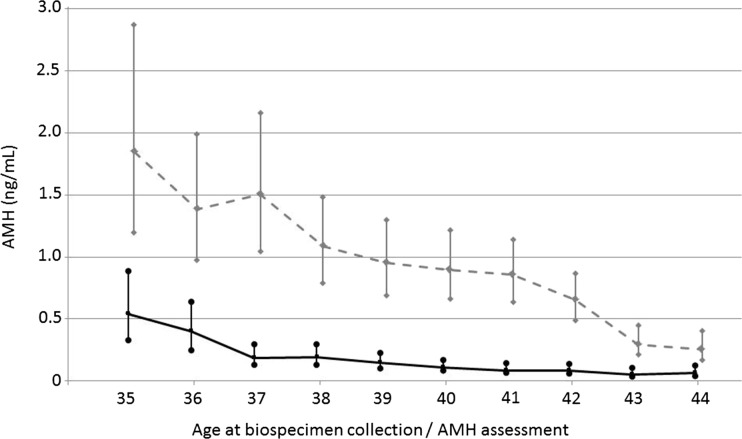
Main results and the role of chance: In multivariable conditional logistic regression models adjusting for matching factors, body mass index, smoking, parity, oral contraceptive use, and other factors, each 0.10 ng/ml decrease in AMH was associated with a 14% higher risk of early menopause (95% confidence interval (CI) 1.10 to 1.18; P < 0.001). In polynomial regression models including linear and quadratic terms for AMH, odds ratios for early menopause for women with AMH levels of 1.5, 1.0 and 0.5 ng/ml compared to 2.0 ng/ml were 2.6, 7.5 and 23 (all P < 0.001). Significant associations were observed irrespective of smoking status, adiposity, infertility history and menstrual cycle characteristics. Furthermore, models assessing the predictive ability of AMH showed high concordance, and C-statistics were high, ranging from 0.68 (age ≤35) to 0.93 (age 42).
Limitations, reasons for caution: Our population was relatively homogenous with respect to race/ethnicity. Further work in more ethnically diverse populations is needed.
Wide implication of the findings: To our knowledge, this is the first prospective study to evaluate whether AMH levels are associated with early menopause. These findings support the utility of AMH as a clinical marker of early menopause in otherwise healthy women.
Study funding/competing interest(s): This project was supported by UM1CA176726, R01CA67262, and R01HD078517 from the U.S. Department of Health and Human Services, National Institutes of Health. No competing interests declared.
Figures
References
-
- Broekmans FJ, Soules MR, Fauser BC. Ovarian aging: mechanisms and clinical consequences. Endocr Rev 2009;30:465–493. - PubMed
-
- Broer SL, Eijkemans MJ, Scheffer GJ, van Rooij IA, de Vet A, Themmen AP, Laven JS, de Jong FH, Te Velde ER, Fauser BC et al. Anti-Müllerian hormone predicts menopause: a long-term follow-up study in normoovulatory women. J Clin Endocrinol Metab 2011;96:2532–2539. - PubMed
-
- Colditz GA, Stampfer MJ, Willett WC, Stason WB, Rosner B, Hennekens CH, Speizer FE. Reproducibility and validity of self-reported menopausal status in a prospective cohort study. Am J Epidemiol 1987;126:319–325. - PubMed
-
- Depmann M, Eijkemans MJC, Broer SL, Scheffer GJ, van Rooij IA, Lavens JS, Broekmans FJ. Does anti-Mullerian hormone predict menopause in the general population? Results of a prospective ongoing cohort study. Human Reprod 2016;31:1579–1587. - PubMed
Publication types
MeSH terms
Substances
Grants and funding
LinkOut - more resources
Full Text Sources
Other Literature Sources
Medical
Research Materials
