Case Reports
. 2018 Jul 2;218(3):485-489.
doi: 10.1093/infdis/jiy198.

Prototheca zopfii Colitis in Inherited CARD9 Deficiency

Affiliations
Case Reports

Prototheca zopfii Colitis in Inherited CARD9 Deficiency

Sinan Sari et al. J Infect Dis. .

Abstract

Human protothecosis is a rare microalgae infection, and its dissemination typically occurs in immunocompromised individuals, but no specific immune defect has been reported. Here, we describe an 8-year-old daughter of a consanguineous union with abdominal pain and bloody diarrhea for 3 months who was found to have pancolitis with numerous microalgae identified as Prototheca zopfii. In the absence of a known immunodeficiency, exome sequencing was performed, which uncovered a novel recessive frameshift mutation in CARD9 (p.V261fs). This report highlights that CARD9 deficiency should be investigated in patients with unexplained systemic/visceral protothecosis and suggests a new mechanistic insight into anti-Prototheca immunity.


Figures
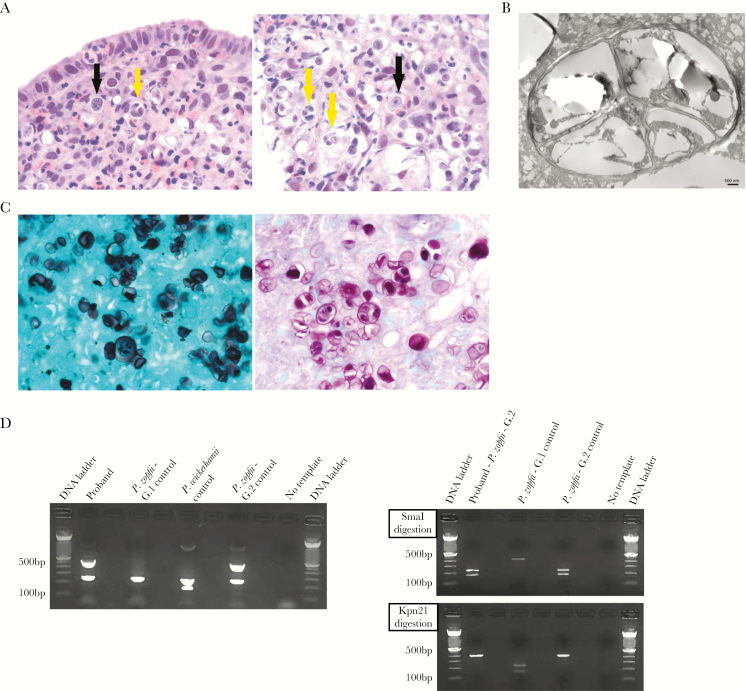
Figure 1.
Figure 1.
Pathological and molecular characterization of Prototheca zopfii genotype 2 in proband’s colonic tissue. A, Hematoxylin-and-eosin stain shows numerous eosinophils and macrophages surrounding numerous round to oval algae (black arrows), with many of them undergoing endosporulation with multiple wedge-shaped endospores (yellow arrows) (left panel, 400×; right panel, 630×). B, Prototheca algae show characteristic endosporulation by transmission electron microscopy. Scale bar, 500 nm. C, Prototheca algae stain strongly with Grocott’s methenamine silver (left panel, 630×) and with periodic acid–Schiff stain (right panel, 630×). D, Prototheca multiplex polymerase chain reaction (PCR) assay (left panel) shows Prototheca zopfii genotype 2 at 508 base pairs (bp), Prototheca zopfii genotype 1 at 216 bp, and Prototheca wickerhamii at 115 bp. Prototheca PCR–restriction fragment length polymorphism (RFLP) assay distinguishes between P. zopfii genotype 1 and 2. The 450-bp PCR product was cut by the P. zopfii genotype 2–specific restriction enzyme SmaI, depicted in the right top panel, and not with the P .zopfii genotype 1–specific restriction enzyme Kpn21, shown in the right bottom panel. Abbreviations: bp, base pair; G.1, genotype 1; G.2, genotype 2; P. zopfii, Protheca zopfii; P. wickerhamii, Prototheca wickerhamii.
Figure 2.
Figure 2.
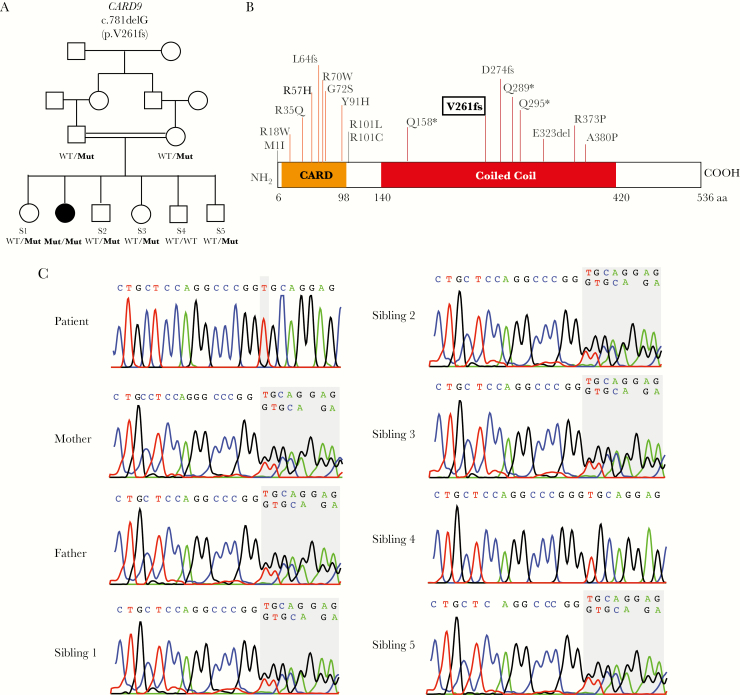
Recessive CARD9 mutation in a child with Prototheca zopfii colitis. A, The affected proband and unaffected subjects are shown with black and white symbols, respectively. Consanguineous union is shown with a double line. CARD9 alleles are denoted wild-type or mutant (p.V261fs). B, Schematic representation of human CARD9 protein (isoform 1) with CARD domain depicted in orange and coiled coil domain shown in red. Proband’s mutation (p.V261fs) is highlighted in bold among other previously reported pathogenic mutations [2–11]. C, Sanger sequencing chromatograms of the proband, her unaffected parents, and 5 siblings. The CARD9 p.V261fs mutation is homozygous in the proband, heterozygous in the unaffected parents and 4 siblings, and wild-type in sibling 4. Abbreviations: MUT, mutant (p.V261fs); S, sibling; WT, wild-type.

References

    1. Carey WP, Kaykova Y, Bandres JC, Sidhu GS, Bräu N. Cutaneous protothecosis in a patient with AIDS and a severe functional neutrophil defect: successful therapy with amphotericin B. Clin Infect Dis 1997; 25:1265–6. - PubMed
    1. Glocker EO, Hennigs A, Nabavi M et al. A homozygous CARD9 mutation in a family with susceptibility to fungal infections. N Engl J Med 2009; 361:1727–35. - PMC - PubMed
    1. Rieber N, Gazendam RP, Freeman AF et al. Extrapulmonary Aspergillus infection in patients with CARD9 deficiency. JCI Insight 2016; 1:e89890. - PMC - PubMed
    1. Lanternier F, Barbati E, Meinzer U et al. Inherited CARD9 deficiency in 2 unrelated patients with invasive Exophiala infection. J Infect Dis 2015; 211:1241–50. - PMC - PubMed
    1. Lanternier F, Mahdaviani SA, Barbati E et al. Inherited CARD9 deficiency in otherwise healthy children and adults with Candida species–induced meningoencephalitis, colitis, or both. J Allergy Clin Immunol 2015; 135:1558–68 e2. - PMC - PubMed

Publication types

Substances

Supplementary concepts