. 2018 Jul 1;35(7):1728-1743.
doi: 10.1093/molbev/msy068.

Convergent Acquisition of Nonembryonic Development in Styelid Ascidians

Affiliations

Convergent Acquisition of Nonembryonic Development in Styelid Ascidians

Alexandre Alié et al. Mol Biol Evol. .

Abstract

Asexual propagation and whole body regeneration are forms of nonembryonic development (NED) widespread across animal phyla and central in life history and evolutionary diversification of metazoans. Whereas it is challenging to reconstruct the gains or losses of NED at large phylogenetic scale, comparative studies could benefit from being conducted at more restricted taxonomic scale, in groups for which phylogenetic relationships are well established. The ascidian family of Styelidae encompasses strictly sexually reproducing solitary forms as well as colonial species that combine sexual reproduction with different forms of NED. To date, the phylogenetic relationships between colonial and solitary styelids remain controversial and so is the pattern of NED evolution. In this study, we built an original pipeline to combine eight genomes with 18 de novo assembled transcriptomes and constructed data sets of unambiguously orthologous genes. Using a phylogenomic super-matrix of 4,908 genes from these 26 tunicates we provided a robust phylogeny of this family of chordates, which supports two convergent acquisitions of NED. This result prompted us to further describe the budding process in the species Polyandrocarpa zorritensis, leading to the discovery of a novel mechanism of asexual development. Whereas the pipeline and the data sets produced can be used for further phylogenetic reconstructions in tunicates, the phylogeny provided here sets an evolutionary framework for future experimental studies on the emergence and disappearance of complex characters such as asexual propagation and whole body regeneration.


Figures
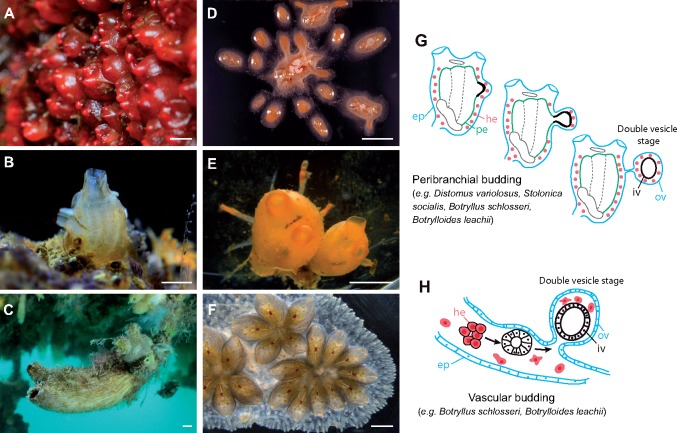
<sc>Fig</sc>. 1.
Fig. 1.
(AC) Solitary Styelidae. (A) Dendrodoa grossularia. (B) juvenile of Styela plicata. (C) Styela clava © Thomas Wilfried Station Biologique de Roscoff. (DF) Colonial Styelidae. (D) Polyandrocarpa misakiensis. (E) Stolonica socialis. (F) Botryllus schlosseri (courtesy of L. Ricci). (G) Schematic representation of peribranchial budding at three successive stages, from peribranchial invagination to double vesicle. (H) Schematic representation of vascular budding at three successive stages, from hemocyte clustering to double vesicle. ep: epidermis, he: hemocytes, iv: inner vesicle, ov: outer vesicle, pe: peribranchial epithelium. Scale bars: (AC) 1 cm, (DE) 5 mm, (F) 1 mm.
<sc>Fig</sc>. 2.
Fig. 2.
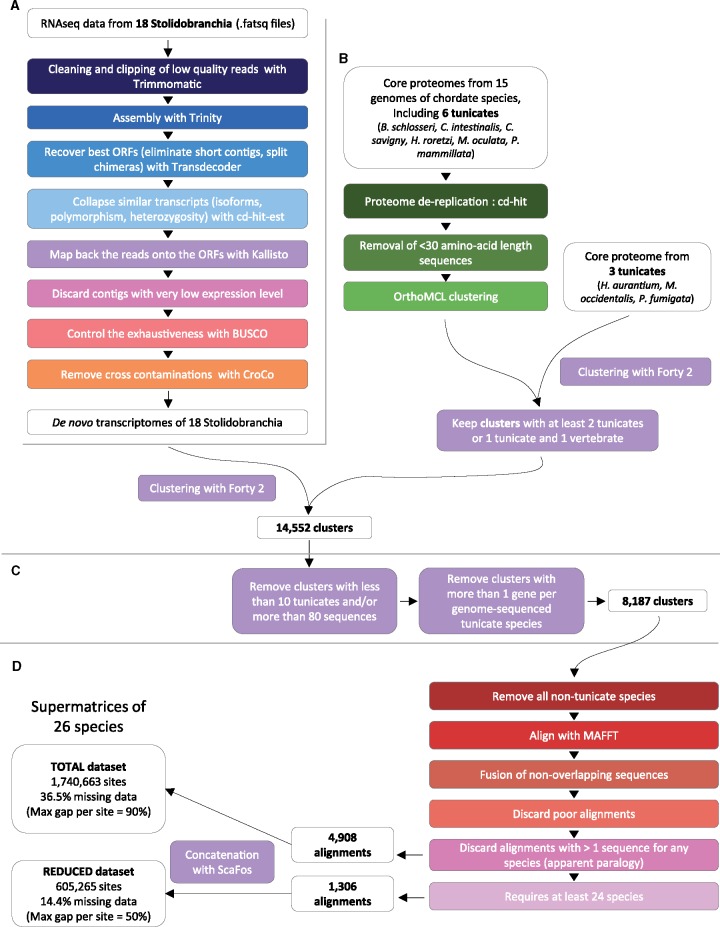
Graphical summary of the data set construction protocol used in this study (see Materials and Methods for the details of each step). (A) Part of the pipeline corresponding to the de novo transcriptome assembly. (B) Part of the clustering pipeline resulting in 14,552 clusters deduced from 9 tunicate genomes and 18 de novo transcriptomes. (C) Part of the clustering pipeline leading to 8,187 clusters with no apparent paralogy in genome-sequenced species. (D) Part of the pipeline corresponding to alignment and building of the FULL and REDUCED data sets devoid of paralogy for any species.
<sc>Fig</sc>. 3.
Fig. 3.
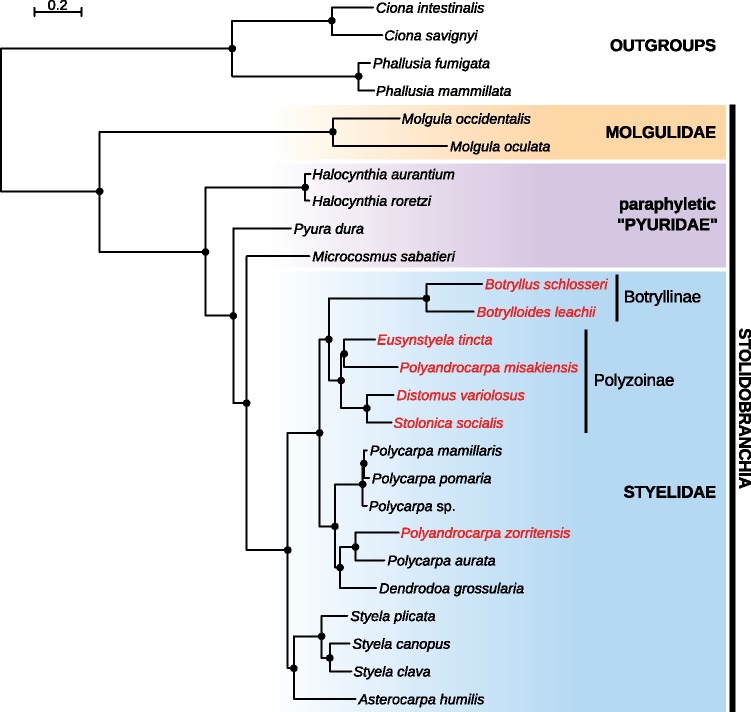
Phylogenetic relationships between Stolidobranchia, with a focus on Styelidae, inferred from the REDUCED supermatrix (1,306 genes, 605,265 aa, 14.4% missing data) using the site-heterogeneous CAT + F81 + Γ4 model. All phylogenetic analyses in this study on both FULL and REDUCED data sets inferred the same topology with maximum bootstrap support and maximum posterior probabilities for all branches. Colonial species (capable of asexual reproduction via NED) are depicted in red, solitary species in black. The three other species trees obtained in this study are provided as supplementary figures 3–5, Supplementary Material online.
<sc>Fig</sc>. 4.
Fig. 4.
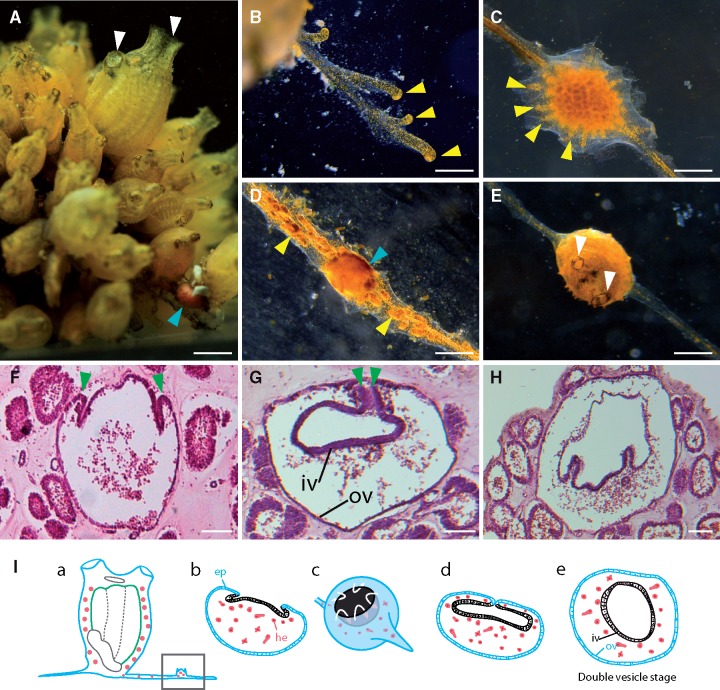
Budding process in Polyandrocarpa zorritensis. (A) A colony of young adults of P. zorritensis, with a visible bud at the base of the colony (light blue arrowhead), white arrowheads: siphons. (B) A ramifying stolon, running onto the substrate (glass dish). (C) Budding site along a stolon, characterized by numerous ampullae oriented in every direction. (D) A new zooid in the process of forming (blue arrowhead), which externally appears as a round vesicle with no apparent organs. In (B)–(D) yellow arrowheads show ampullae. (E) A very young oozoid in which siphons recently opened (white arrowheads). (FH) Histological sections of three successive budding stages. (F) Beginning of invagination. (G) Fusion of invaginating borders. Green arrowheads: invagination borders. (H) Beginning of organogenesis. (I) Diagram summarizing the process of budding: (a) A bud (squared) arises along a vascular stolon. (b) Initiation of invagination, the prospective inner vesicle is in black, whereas the stolon wall is in blue. (c) The same stage in a “3D” view, white arrows show the invagination movement. (d) Fusion of the inner invaginating borders. (e) Double-vesicle stage. ep: epidermis, he: hemocytes, iv: inner vesicle, ov: outer vesicle. Scale bars: (A) 2 mm, (BE) 1 mm, (FH) 25 µm.
<sc>Fig</sc>. 5.
Fig. 5.
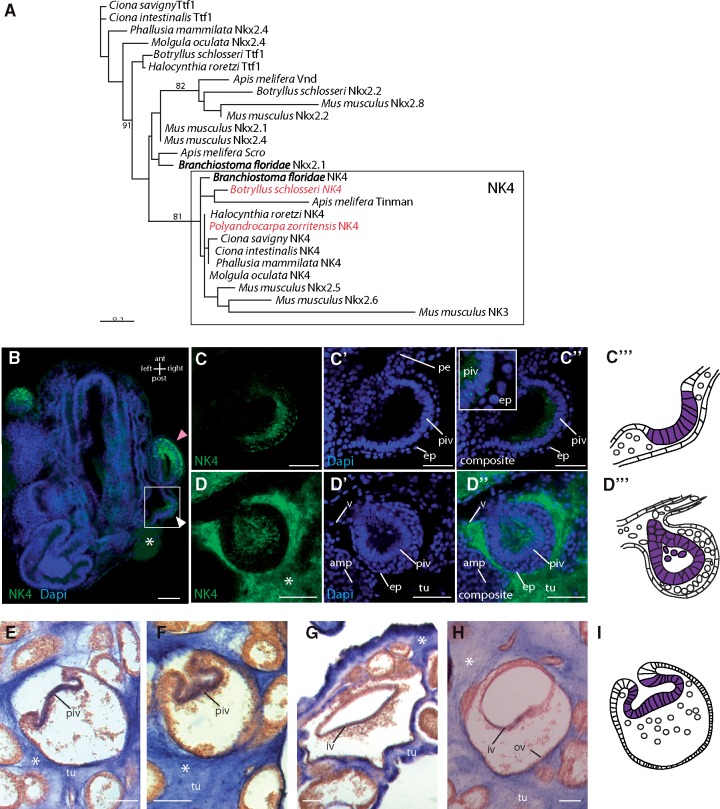
Expression of the NK4 gene in Botryllus schlosseri and Polyandrocarpa zorritensis. (A) Phylogenetic analysis of Nkx2.5/2.6 family members showing the orthology between B. schlosseri and P. zorritensis NK4 genes (NK4 orthology group was defined as the smallest group including Botryllus NK4, Ciona NK4, and mouse NKx2.5 and 2.6). (BC‴) NK4 expression in peribranchial bud of B. schlosseri. In (B) the zooid bears three buds at three different stages (white arrowhead shows the youngest one and pink arrowhead shows the oldest one). (CC″) Close-up view of NK4 expression in the early peribranchial bud, insert in (C″) is highly magnified to show the unlabeled epidermis. (C‴) Diagram of NK4 expression in the peribranchial bud. (DD″) Close-up view of NK4 expression in a vascular bud at the double vesicle stage. (D‴) Diagram of NK4 expression in the inner vesicle of a vascular bud. (EI) Expression of NK4 in bud of P. zorritensis. (E) Early invagination. (F) Closure of invagination borders. (G) Right after closure. (H) Late double vesicle stage. (I) Diagram showing NK4 expression in the forming inner vesicle of P. zorritensis. Asterisks show nonspecific staining in the tunic, amp: ampullae. ep: epidermis, iv: inner vesicle, ov: outer vesicle, pe: peribranchial epithelium, piv: prospective inner vesicle, tu: tunic, v: vessel. Scale bars: (B) and (DD″) 50 µm, (CC″) 25 µm, (EH) 25 µm.

References

    1. Abbott D. 1953. Asexual reproduction in the colonial ascidian Metandrocarpa taylori. Univ. Calif. publ. zool. 61(1):1–78.
    1. Agata K, Saito Y, Nakajima E.. 2007. Unifying principles of regeneration I: epimorphosis versus morphallaxis. Dev Growth Differ. 492:73–78. - PubMed
    1. Alié A, Hayashi T, Sugimura I, Manuel M, Sugano W, Mano A, Satoh N, Agata K, Funayama N.. 2015. The ancestral gene repertoire of animal stem cells. Proc Natl Acad Sci U S A. 11251:E7093–E7100. - PMC - PubMed
    1. Ballenghien M, Faivre N, Galtier N.. 2017. Patterns of cross-contamination in a multispecies population genomic project: detection, quantification, impact, and solutions. BMC Biol. 151:25.. - PMC - PubMed
    1. Barbeitos MS, Romano SL, Lasker HR.. 2010. Repeated loss of coloniality and symbiosis in scleractinian corals. Proc Natl Acad Sci U S A. 10726:11877–11882. - PMC - PubMed

Publication types

Substances

LinkOut - more resources