


Functional assessment of spermatogonial stem cell purity in experimental cell populations
- PMID: 29660605
- PMCID: PMC6392036
- DOI: 10.1016/j.scr.2018.03.016
Functional assessment of spermatogonial stem cell purity in experimental cell populations
Abstract
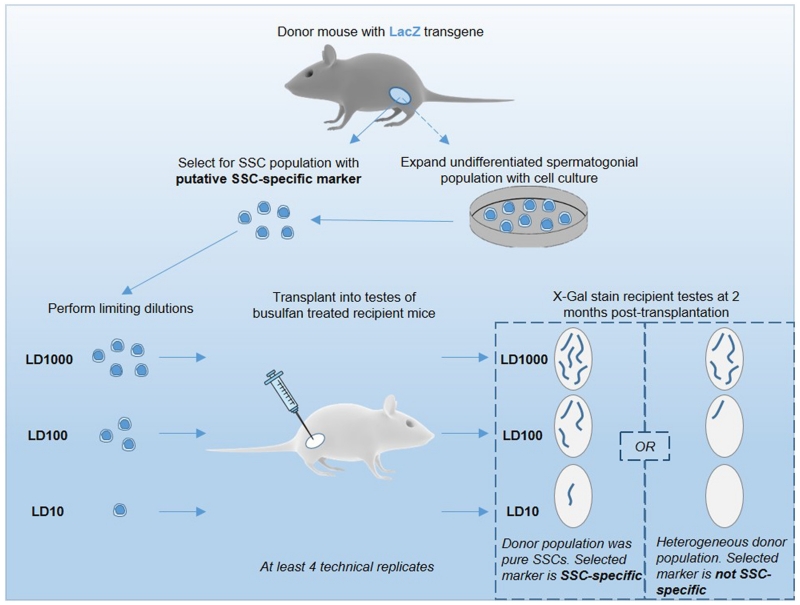
Historically, research in spermatogonial biology has been hindered by a lack of validated approaches to identify and isolate pure populations of the various spermatogonial subsets for in-depth analysis. In particular, although a number of markers of the undifferentiated spermatogonial population have now been characterized, standardized methodology for assessing their specificity to the spermatogonial stem cell (SSC) and transit amplifying progenitor pools has been lacking. To date, SSC content within an undefined population of spermatogonia has been inferred using either lineage tracing or spermatogonial transplantation analyses which generate qualitative and quantitative data, respectively. Therefore, these techniques are not directly comparable, and are subject to variable interpretations as to a readout that is representative of a 'pure' SSC population. We propose standardization across the field for determining the SSC purity of a population via use of a limiting dilution transplantation assay that would eliminate subjectivity and help to minimize the generation of inconsistent data on 'SSC' populations. In the limiting dilution transplantation assay, a population of LacZ-expressing spermatogonia are selected based on a putative SSC marker, and a small, defined number of cells (i.e. 10 cells) are microinjected into the testis of a germ cell-deficient recipient mouse. Using colony counts and an estimated colonization efficiency of 5%; a quantitative value can be calculated that represents SSC purity in the starting population. The utilization of this technique would not only be useful to link functional relevance to novel markers that will be identified in the future, but also for providing validation of purity for marker-selected populations of spermatogonia that are commonly considered to be SSCs by many researchers in the field of spermatogenesis and stem cell biology.
Keywords: Limiting dilution; Spermatogonial stem cell; Transplantation.
Copyright © 2018 The Authors. Published by Elsevier B.V. All rights reserved.
Figures
References
-
- Costoya JA, Hobbs RM, Barna M, Cattoretti G, Manova K, Sukhwani M, Orwig KE, Wolgemuth DJ, Pandolfi PP. Essential role of Plzf in maintenance of spermatogonial stem cells. Nat. Genet. 2004:36. - PubMed
Publication types
MeSH terms
Grants and funding
LinkOut - more resources
Full Text Sources
Other Literature Sources
Medical
