


The Alzheimer's Disease Assessment Scale-Cognitive Subscale (ADAS-Cog): Modifications and Responsiveness in Pre-Dementia Populations. A Narrative Review
- PMID: 29660938
- PMCID: PMC5929311
- DOI: 10.3233/JAD-170991
The Alzheimer's Disease Assessment Scale-Cognitive Subscale (ADAS-Cog): Modifications and Responsiveness in Pre-Dementia Populations. A Narrative Review
Abstract
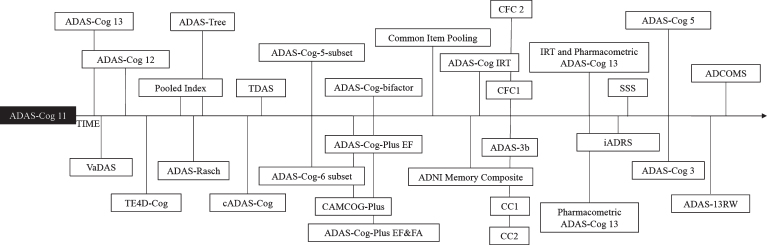
The Alzheimer's Disease Assessment Scale-Cognitive Subscale (ADAS-Cog) was developed in the 1980s to assess the level of cognitive dysfunction in Alzheimer's disease. Advancements in the research field have shifted focus toward pre-dementia populations, and use of the ADAS-Cog has extended into these pre-dementia studies despite concerns about its ability to detect important changes at these milder stages of disease progression. If the ADAS-Cog cannot detect important changes, our understanding of pre-dementia disease progression may be compromised and trials may incorrectly conclude that a novel treatment approach is not beneficial. The purpose of this review was to assess the performance of the ADAS-Cog in pre-dementia populations, and to review all modifications that have been made to the ADAS-Cog to improve its measurement performance in dementia or pre-dementia populations. The contents of this review are based on bibliographic searches of electronic databases to locate all studies using the ADAS-Cog in pre-dementia samples or subsamples, and to locate all modified versions. Citations from relevant articles were also consulted. Overall, our results suggest the original ADAS-Cog is not an optimal outcome measure for pre-dementia studies; however, given the prominence of the ADAS-Cog, care must be taken when considering the use of alternative outcome measures. Thirty-one modified versions of the ADAS-Cog were found. Modification approaches that appear most beneficial include altering scoring methodology or adding tests of memory, executive function, and/or daily functioning. Although modifications improve the performance of the ADAS-Cog, this is at the cost of introducing heterogeneity that may limit between-study comparison.
Keywords: ADAS-Cog; literature review; mild cognitive impairment; outcome measures.
Figures
References
-
- Llano DA, Laforet G, Devanarayan V (2011) Derivation of a new ADAS-cog composite using tree-based multivariate analysis: Prediction of conversion from mild cognitive impairment to Alzheimer disease. Alzheimer Dis Assoc Disord 25, 73–84. - PubMed
-
- Graham DP, Cully JA, Snow AL, Massman P, Doody R (2004) The Alzheimer’s disease assessment scale-cognitive subscale: Normative data for older adult controls. Alzheimer Dis Assoc Disord 18, 236–240. - PubMed
-
- Petersen RC, Smith GE, Waring SC, Ivnik RJ, Kokmen E, Tangelos EG (1997) Aging, memory, and mild cognitive impairment. Int psychogeriatrics 9, 65–69. - PubMed
-
- Cooper C, Sommerlad A, Lyketsos CG, Livingston G (2015) Modifiable predictors of dementia in Mild Cognitive Impairment: A systematic review and meta-analysis. Am J Psychiatry 172, 323–334. - PubMed
Publication types
MeSH terms
Grants and funding
LinkOut - more resources
Full Text Sources
Other Literature Sources
Medical
